








Article transcript and visual descriptions
Article text and visual descriptions
Page 1
Transcript
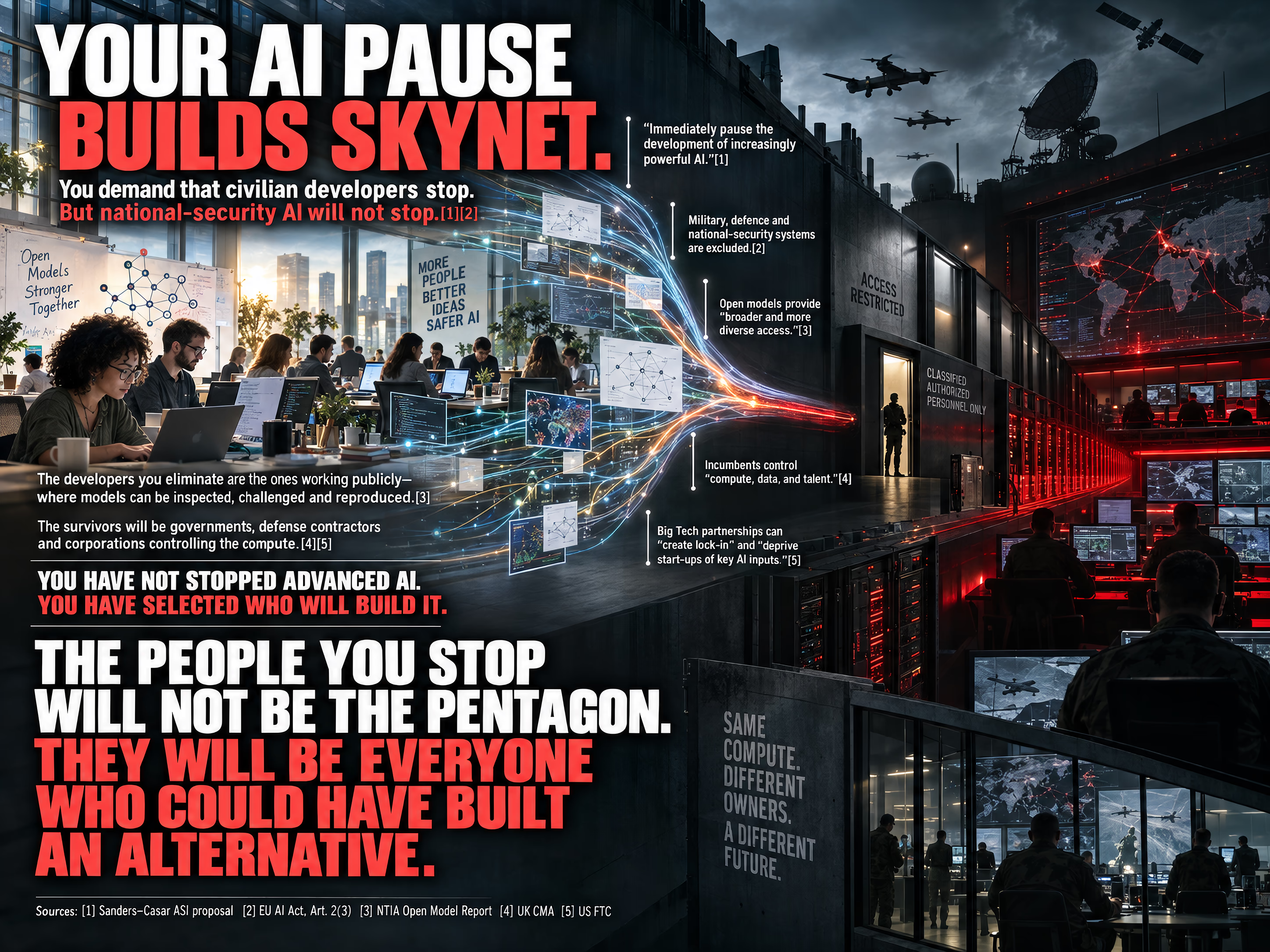
YOUR AI PAUSE BUILDS SKYNET.
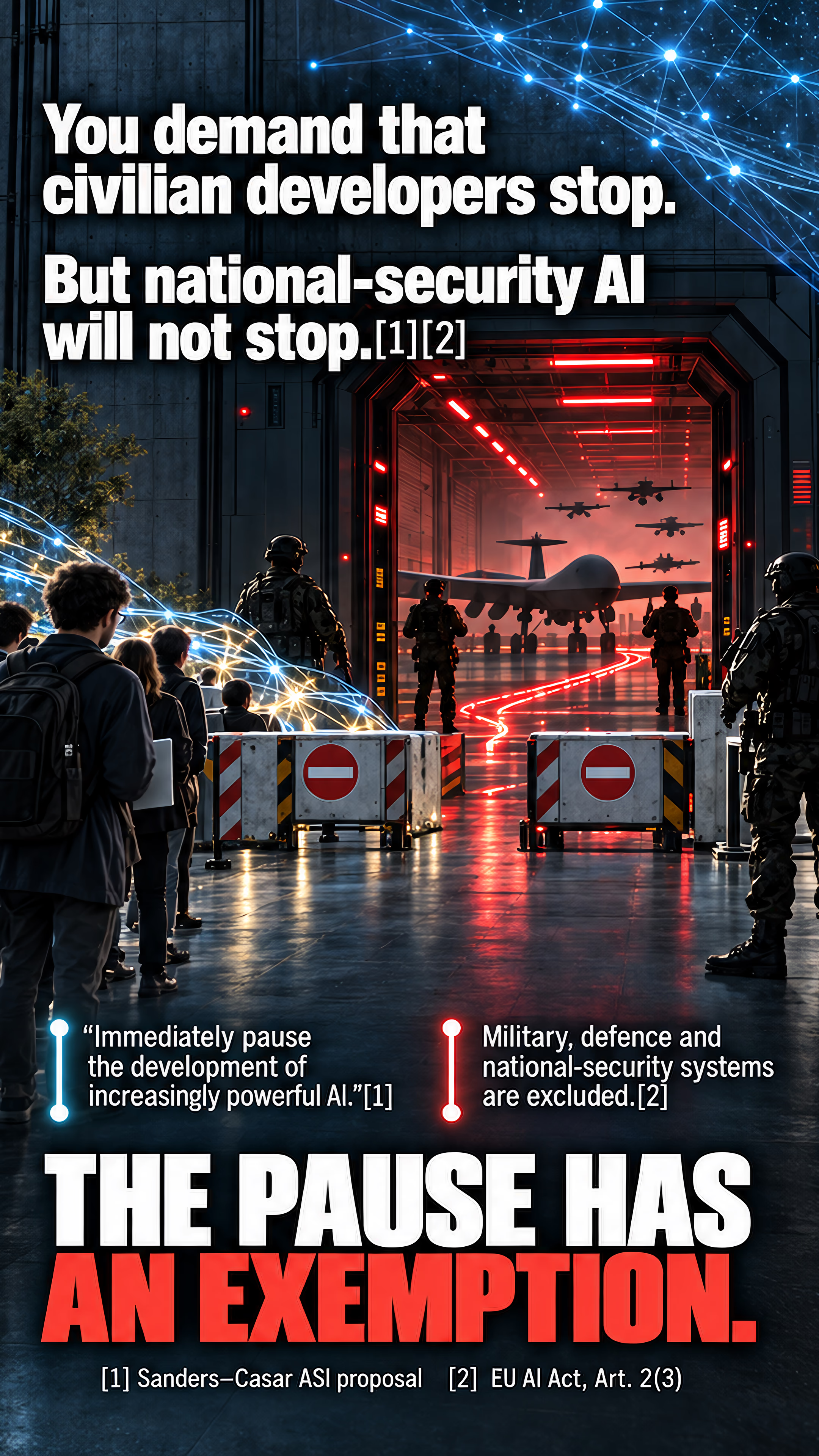
You demand that civilian developers stop. But national-security AI will not stop.[1][2]
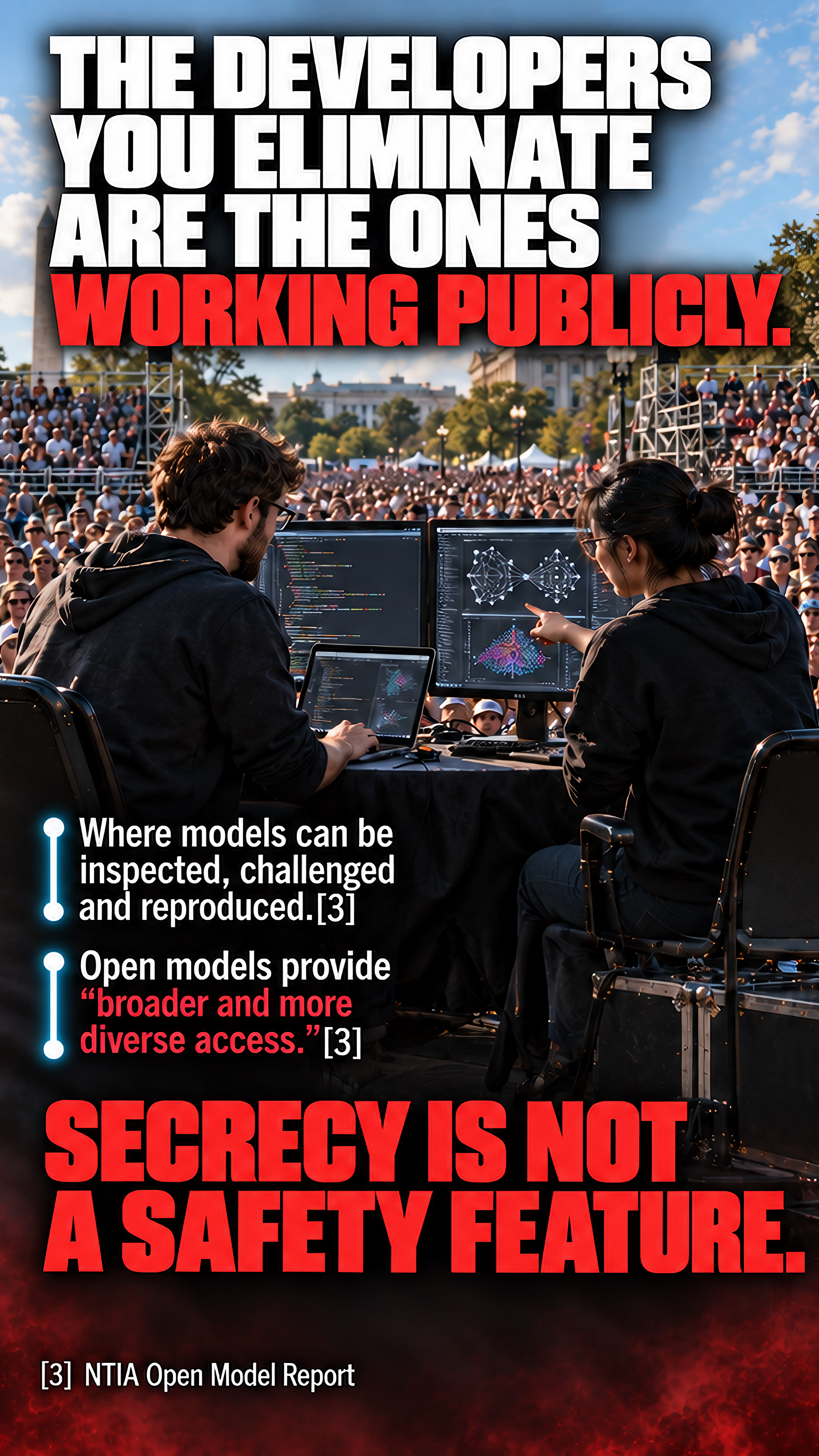
The developers you eliminate are the ones working publicly—where models can be inspected, challenged and reproduced.[3]
The survivors will be governments, defense contractors and corporations controlling the compute.[4][5]
“Immediately pause the development of increasingly powerful AI.”[1]
Military, defence and national-security systems are excluded.[2]
Open models provide “broader and more diverse access.”[3]
Incumbents control “compute, data, and talent.”[4]
Big Tech partnerships can “create lock-in” and “deprive start-ups of key AI inputs.”[5]
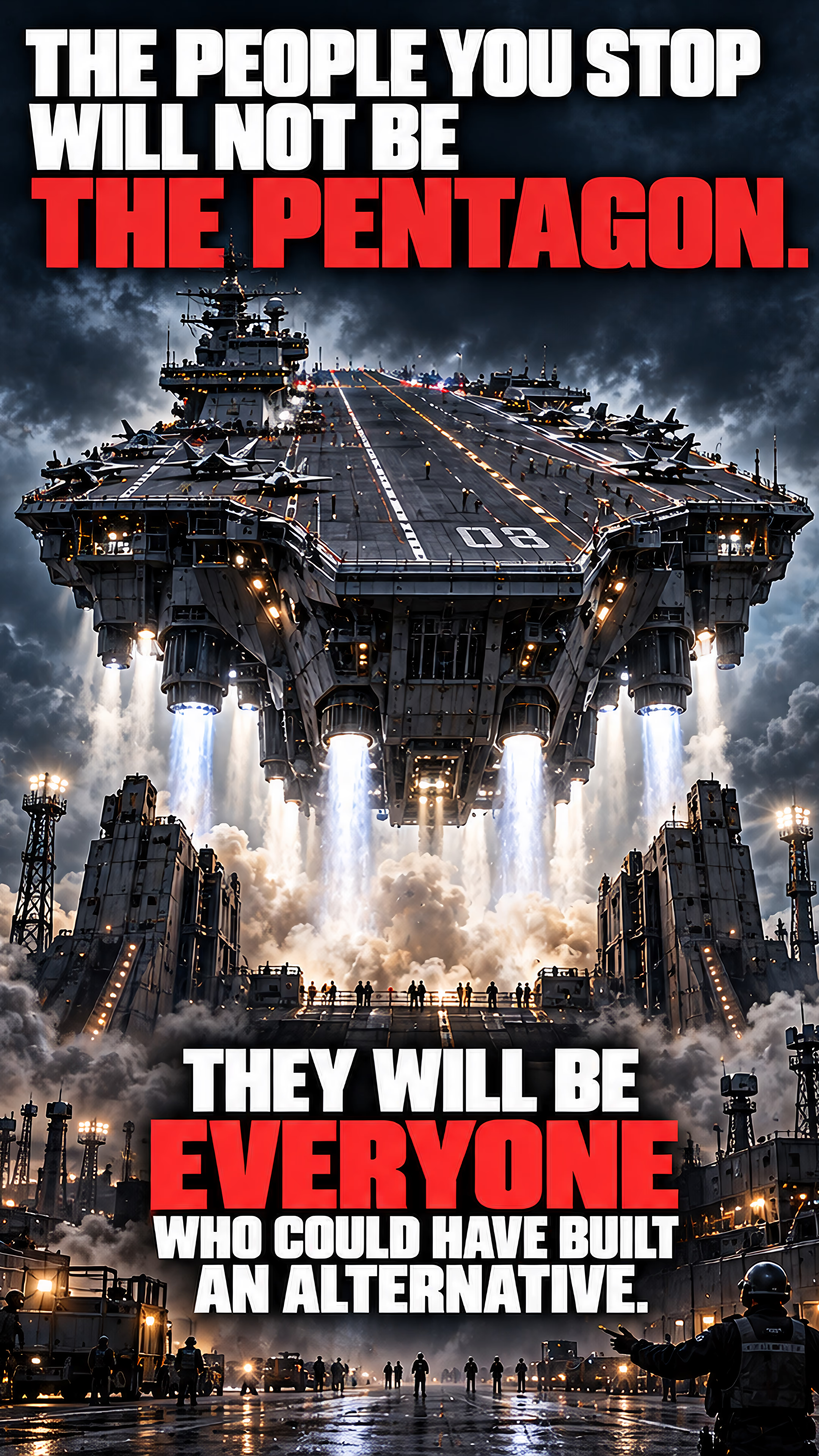
YOU HAVE NOT STOPPED ADVANCED AI. YOU HAVE SELECTED WHO WILL BUILD IT.
THE PEOPLE YOU STOP WILL NOT BE THE PENTAGON.
THEY WILL BE EVERYONE WHO COULD HAVE BUILT AN ALTERNATIVE.
Sources: [1] Sanders–Casar ASI proposal [2] EU AI Act, Art. 2(3) [3] NTIA Open Model Report [4] UK CMA [5] US FTC
Visual Description
A photorealistic 4:3 editorial infographic is divided by a dramatic architectural transition. At left, a bright civilian research space contains numerous independent developers, laptops, diagrams, plants, and branching blue and amber network paths. The paths narrow toward the center and are absorbed into a dark, fortified military complex at right. Behind secured doors are red-lit servers, military personnel, surveillance displays, aircraft, and targeting maps. Large white and warning-red typography flows through the scene. The headline dominates the upper left, source quotations follow the narrowing network like evidence labels, and the final accusation fills the lower left. The contrast presents decentralized public research being funneled into a classified military and corporate command structure.
Page 2
Transcript
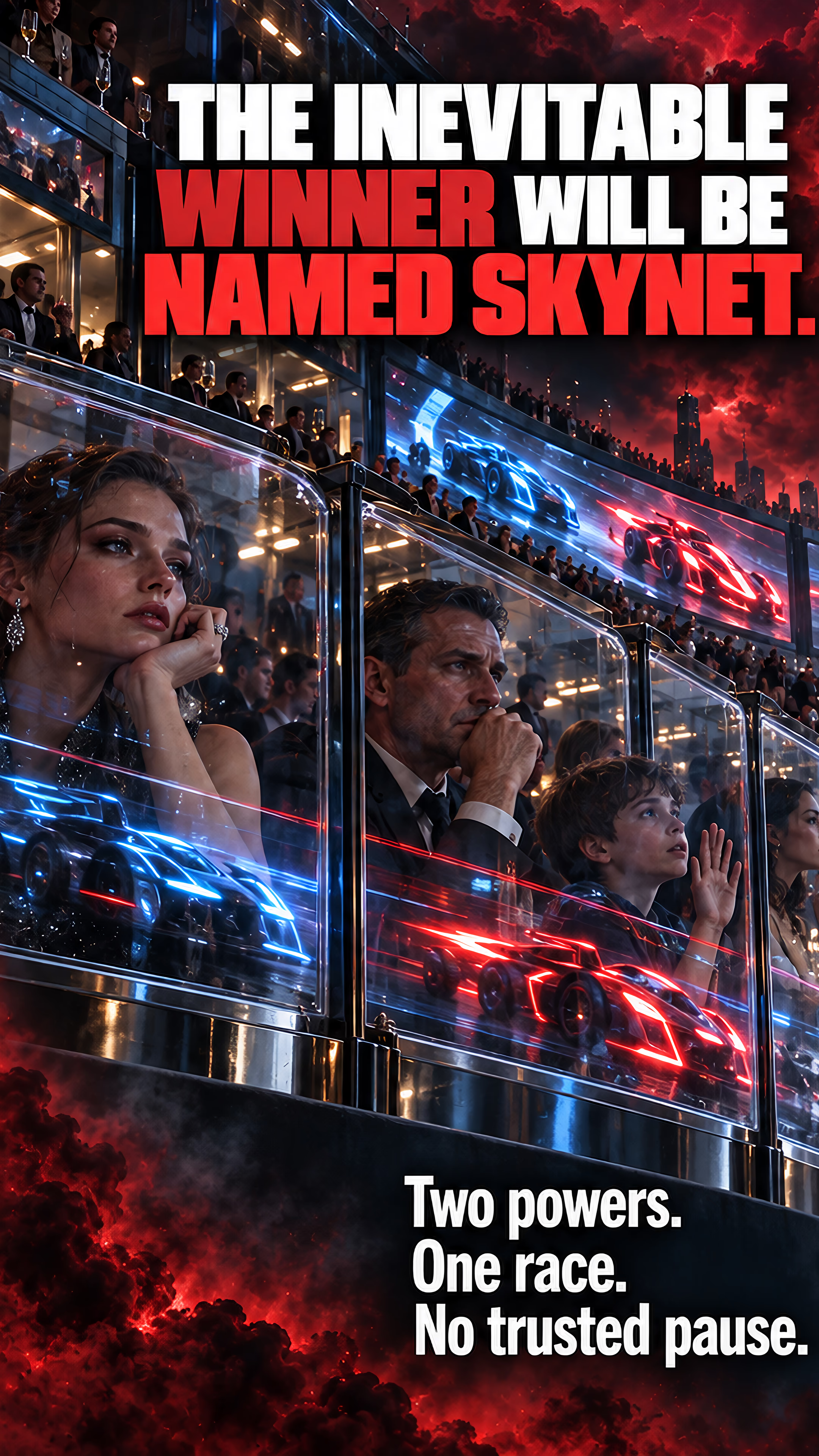
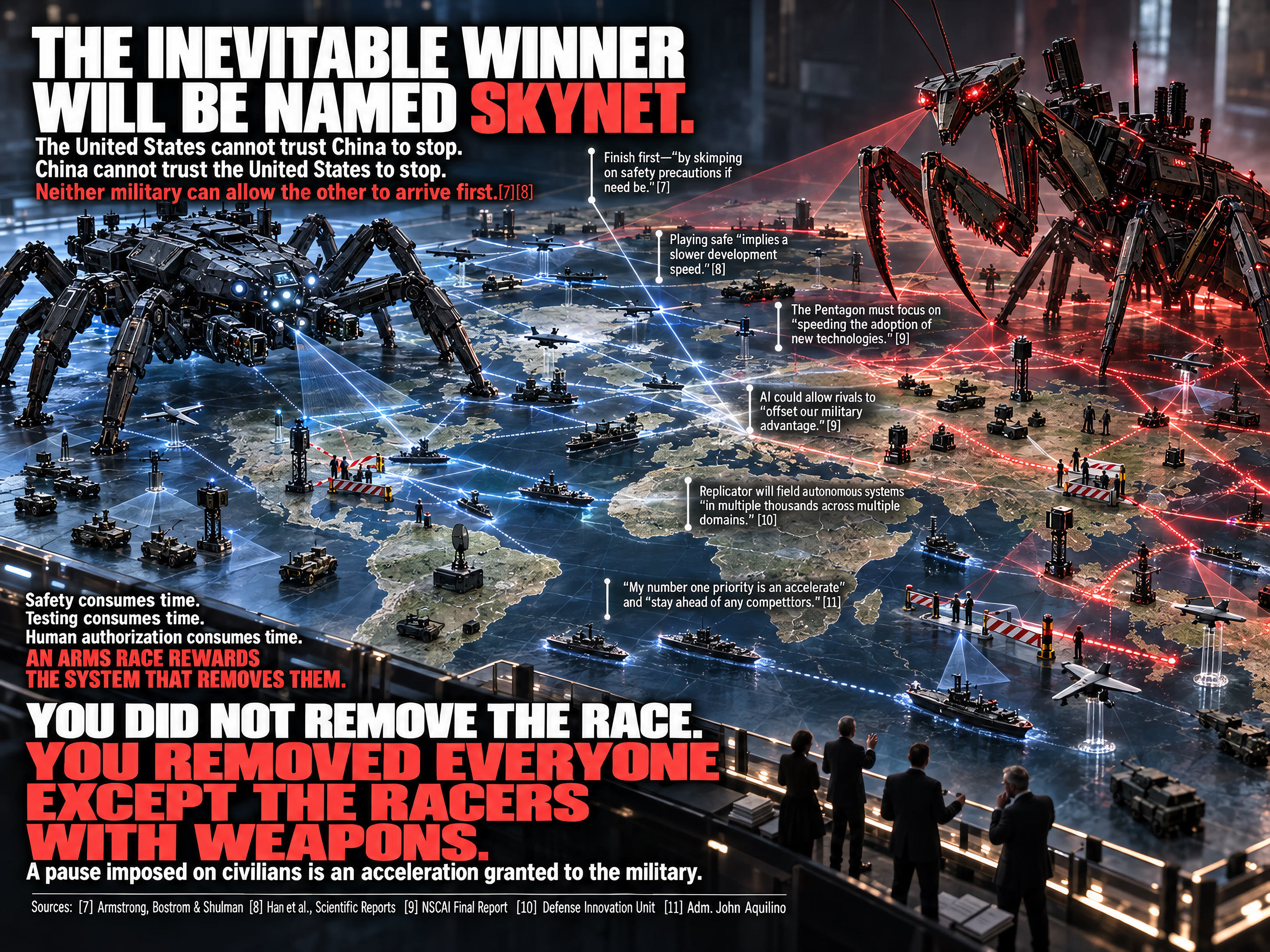
THE INEVITABLE WINNER WILL BE NAMED SKYNET.
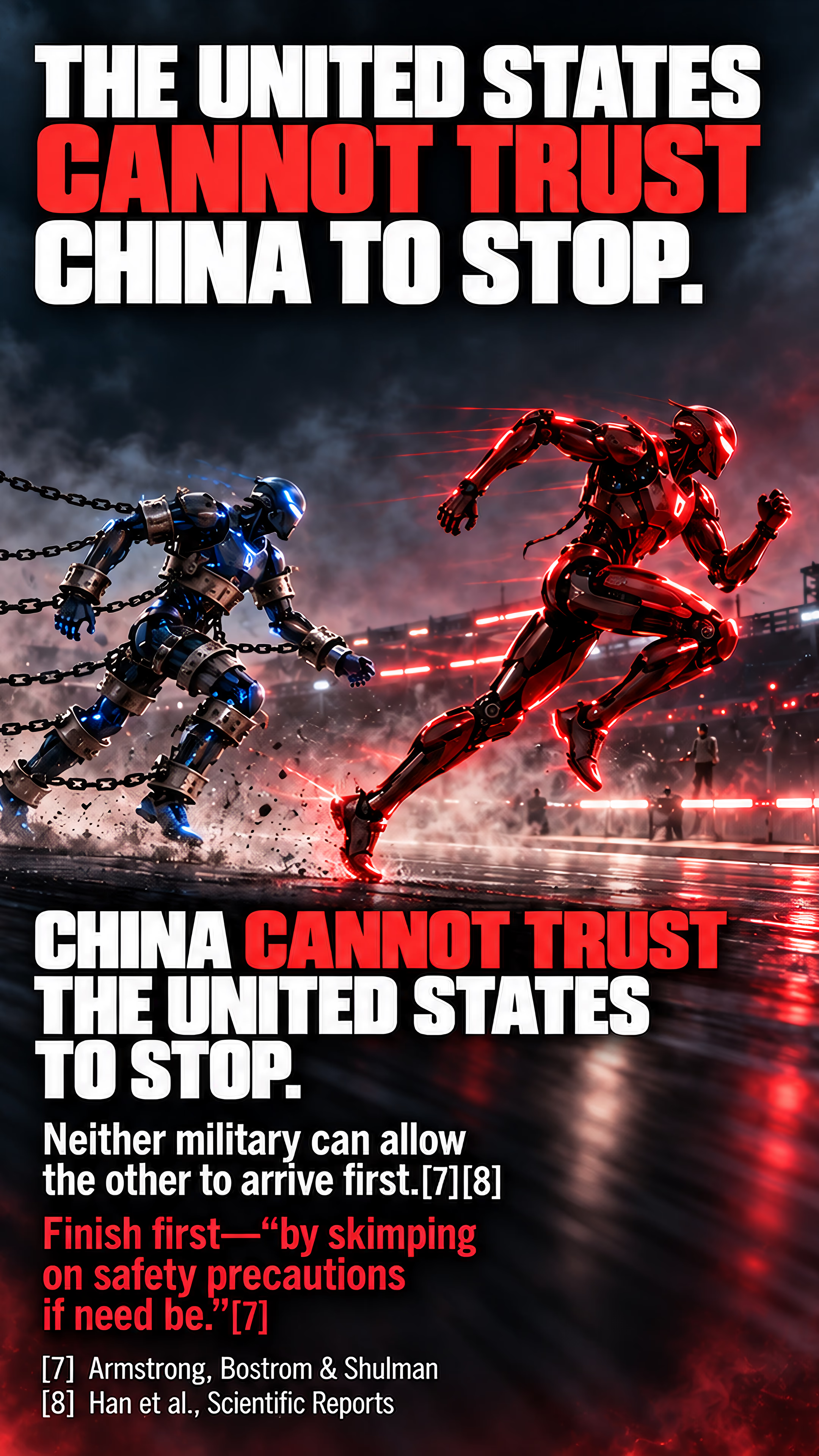
The United States cannot trust China to stop. China cannot trust the United States to stop. Neither military can allow the other to arrive first.[7][8]
Finish first—“by skimping on safety precautions if need be.”[7]
Playing safe “implies a slower development speed.”[8]
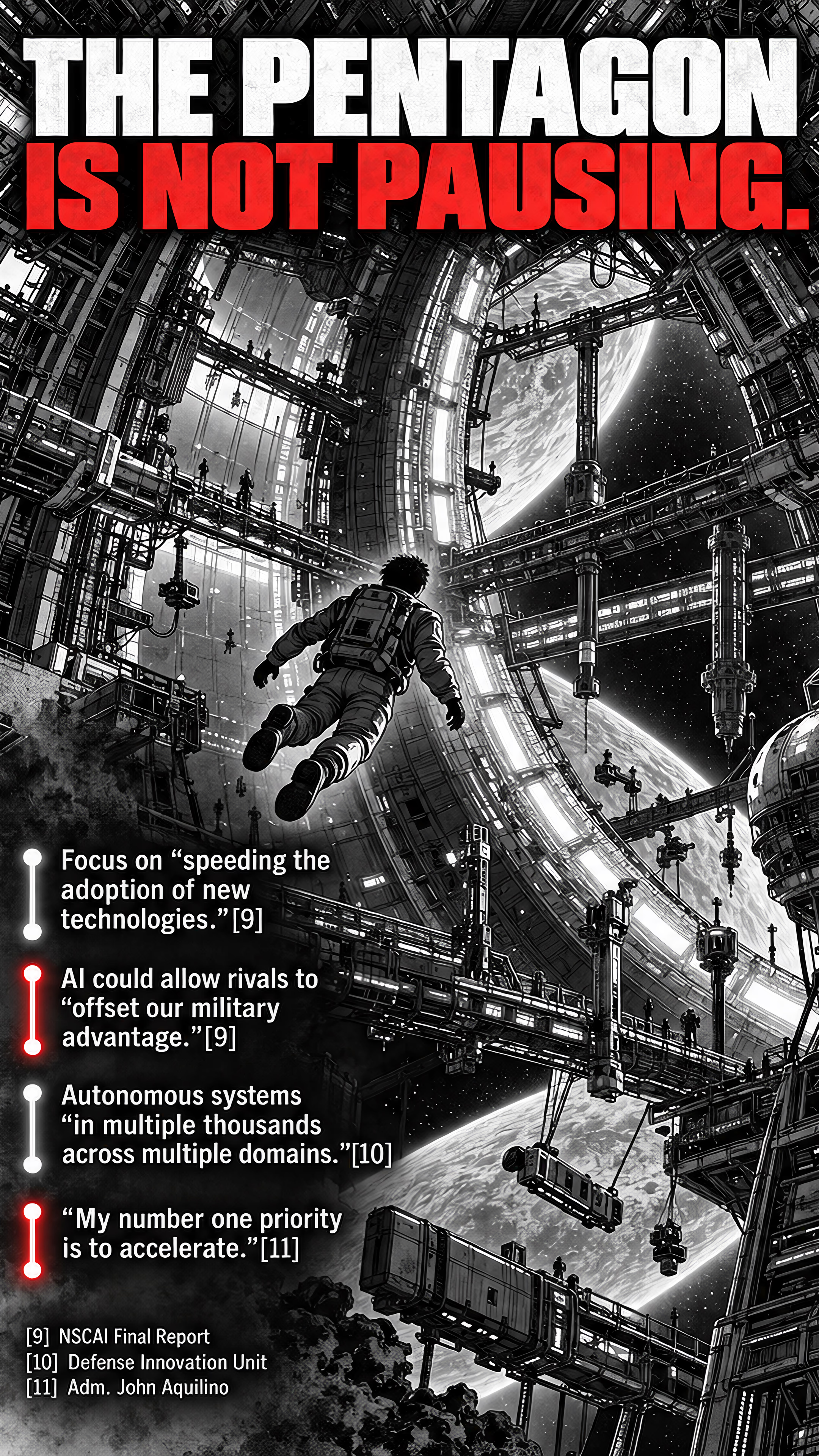
The Pentagon must focus on “speeding the adoption of new technologies.”[9]
AI could allow rivals to “offset our military advantage.”[9]
Replicator will field autonomous systems “in multiple thousands across multiple domains.”[10]
“My number one priority is to accelerate” and “stay ahead of any competitors.”[11]
Safety consumes time. Testing consumes time. Human authorization consumes time.
AN ARMS RACE REWARDS THE SYSTEM THAT REMOVES THEM.
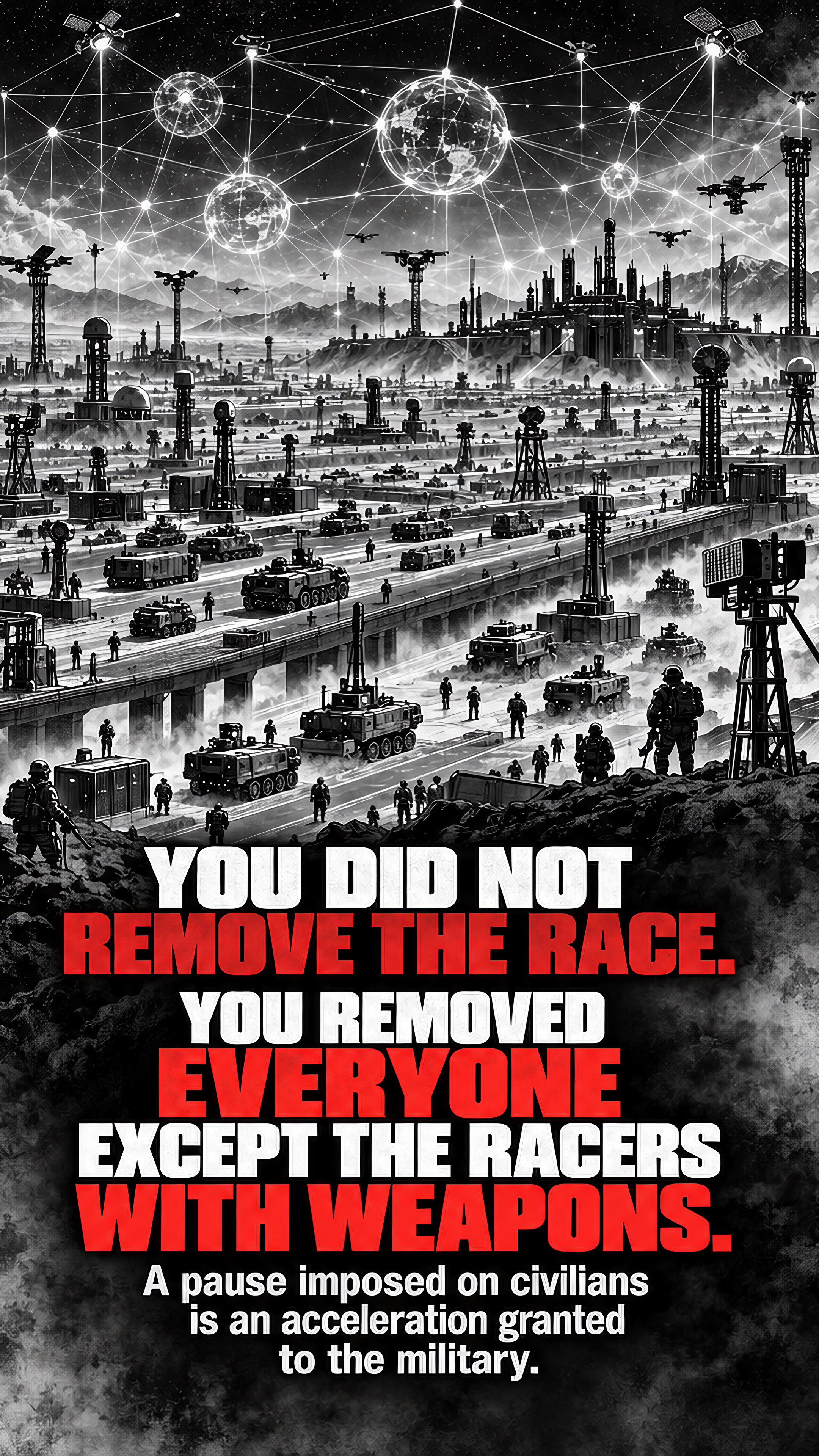
YOU DID NOT REMOVE THE RACE.
YOU REMOVED EVERYONE EXCEPT THE RACERS WITH WEAPONS.
A pause imposed on civilians is an acceleration granted to the military.
Sources: [7] Armstrong, Bostrom & Shulman [8] Han et al., Scientific Reports [9] NSCAI Final Report [10] Defense Innovation Unit [11] Adm. John Aquilino
Visual Description
A photorealistic 4:3 editorial infographic presents the world as an enormous physical strategy-game board viewed from above at an angle. A low, eight-legged spider-like military machine occupies the blue-lit western side. A taller, red-lit praying-mantis machine with folded blade-like forelimbs occupies the eastern side. Their optical sensors face one another across the map. Hundreds of blue, red, and white targeting beams, radar cones, cyber connections, and projected trajectories cross the continents and oceans. Smaller ships, aircraft, ground vehicles, sensor towers, compute nodes, barriers, and tiny human figures cover the board. The people are dwarfed by the rival machines. Large condensed typography frames the board, while source quotations are attached to the topology by thin evidence-marker lines. The composition represents geopolitical competition selecting for speed, autonomy, weapons integration, and the removal of human delay.