Culture
When Did We Learn to Expect Men to Die?
How an ancient distinction between expected combatants and protected victims became embedded in culture, psychology, and the way we report death.
From ancient warfare to modern casualty reporting, this feature examines why the deaths of women and children are often treated as especially meaningful while male deaths are more readily treated as expected. Drawing on history, psychology, media research, and conflict studies, it traces how gendered ideas about agency, vulnerability, protection, and sacrifice can reinforce one another across centuries.
Sources
- Deuteronomy 20:13–14otherWhy it’s here
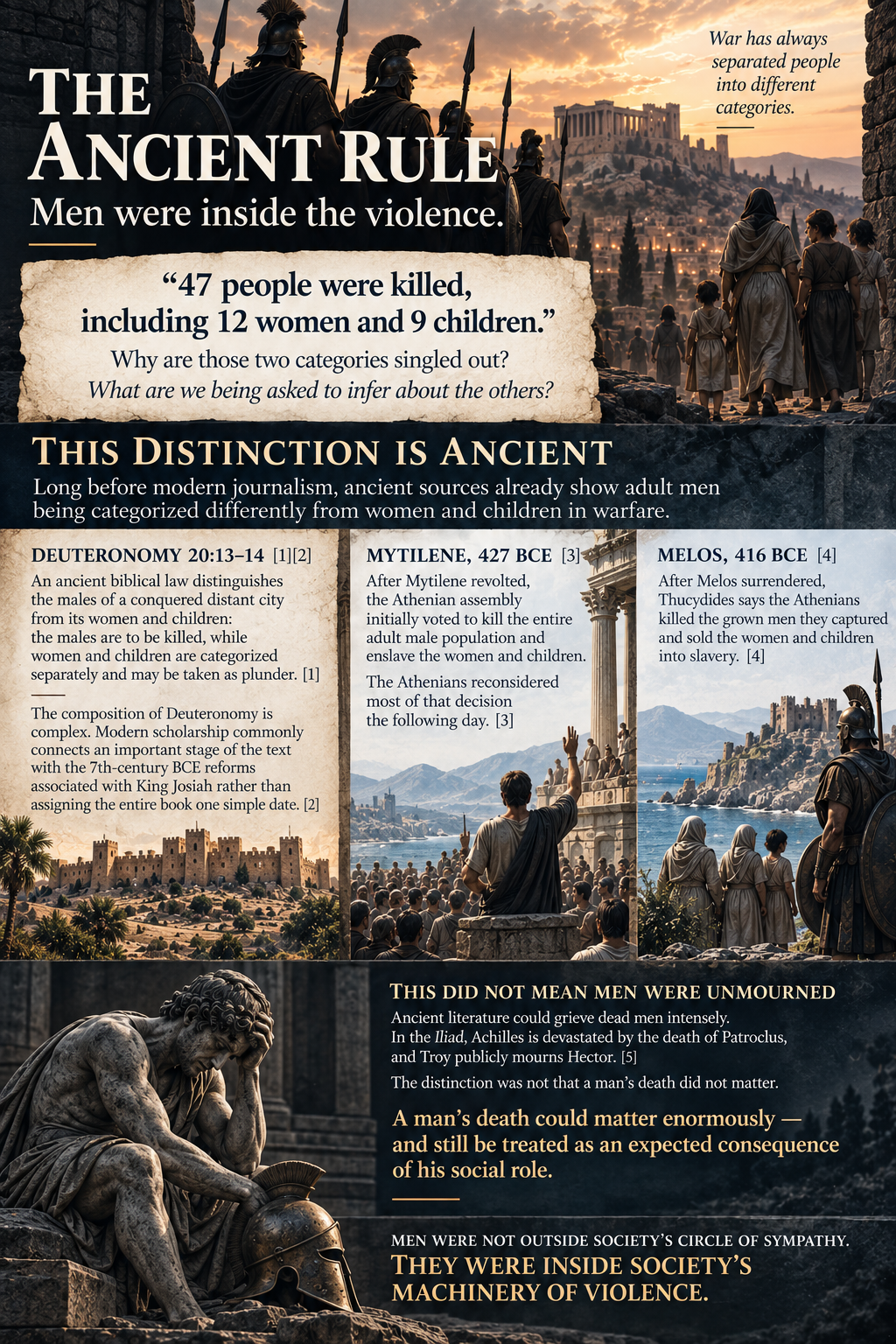
Primary ancient textual example distinguishing the treatment of adult males from women and children after conquest.
- DeuteronomyotherWhy it’s here
Supports the qualified discussion of Deuteronomy's composition and its important association with the 7th-century BCE reforms of King Josiah.
- History of the Peloponnesian War, Book 3, section 36otherWhy it’s here
Records Athens' initial decision to kill Mytilene's adult male population and enslave the women and children.
- History of the Peloponnesian War, Book 5, section 116otherWhy it’s here
Records the killing of captured grown men at Melos and the enslavement of women and children.
- Iliad, Books 18 and 24otherWhy it’s here
Supports the counterpoint that ancient culture could intensely mourn male death, including Achilles' grief for Patroclus and the mourning of Hector.
- Surrender in Medieval Europe—An Indirect ApproachotherWhy it’s here
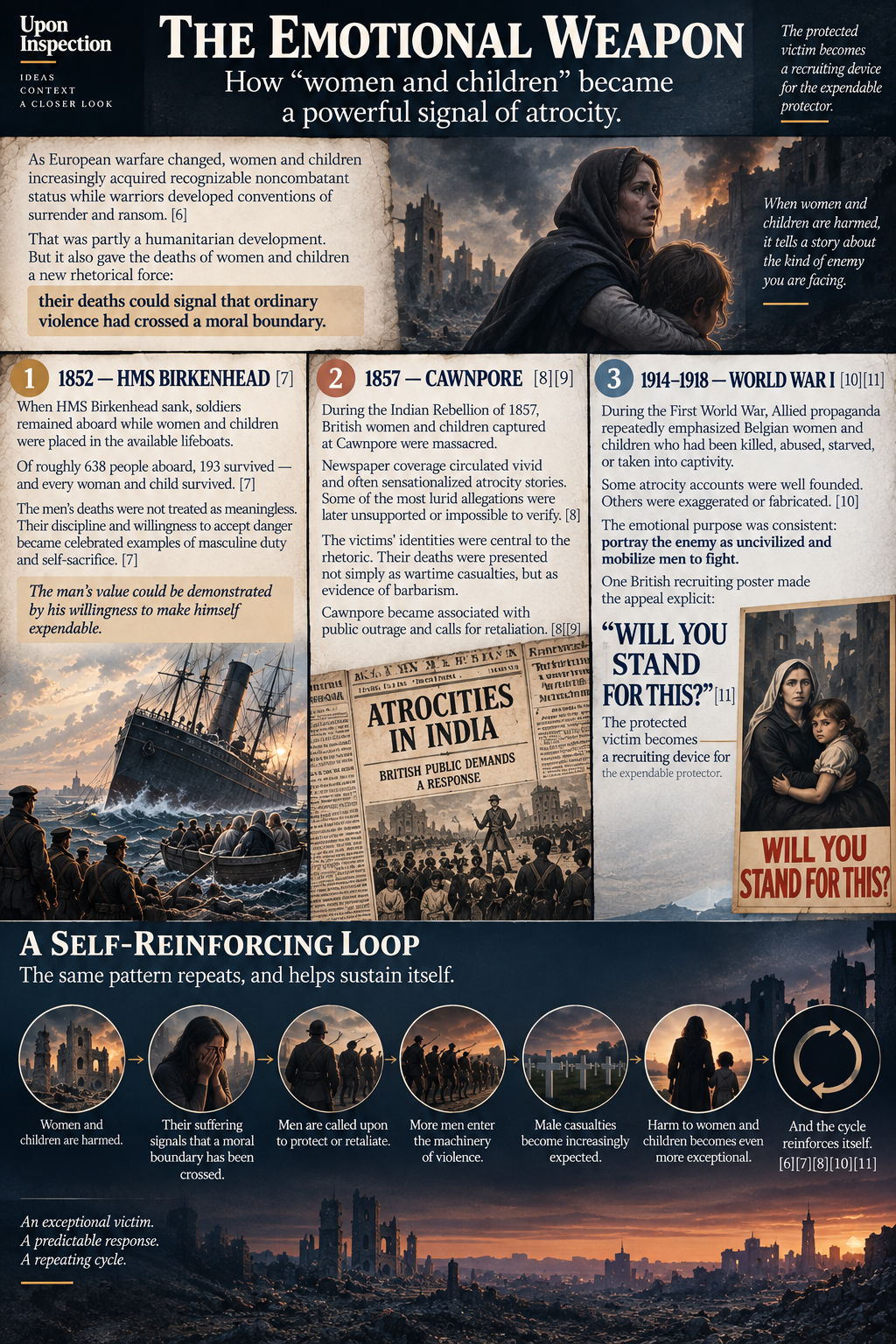
Supports the historical development of differentiated treatment for warriors, women, and children in medieval European warfare.
- Women and children first: The Birkenhead sinkingotherWhy it’s here
Supports the 1852 Birkenhead casualty figures, survival of the women and children, and the later celebration of military discipline and self-sacrifice.
- Sepoys, Slavery and the Global Colour Line: The Indian Uprising of 1857 in Southern US NewspapersotherWhy it’s here
Supports the analysis of sensationalized Cawnpore atrocity reporting, especially narratives centered on women and children.
- Contemporary report on Cawnpore and the Indian RebellionotherWhy it’s here
Contemporary reporting connecting the deaths at Cawnpore with intense emotional and retaliatory sentiment.
- Propaganda at Home (Belgium)otherWhy it’s here
Supports the use of Belgian women and children in Allied atrocity propaganda and wartime moral mobilization.
- The First World War: Trauma and MemoryotherWhy it’s here
Documents recruiting propaganda including the "WILL YOU STAND FOR THIS?" appeal centered on endangered Belgian women and children.
- Moral Typecasting: Divergent Perceptions of Moral Agents and Moral PatientsotherWhy it’s here
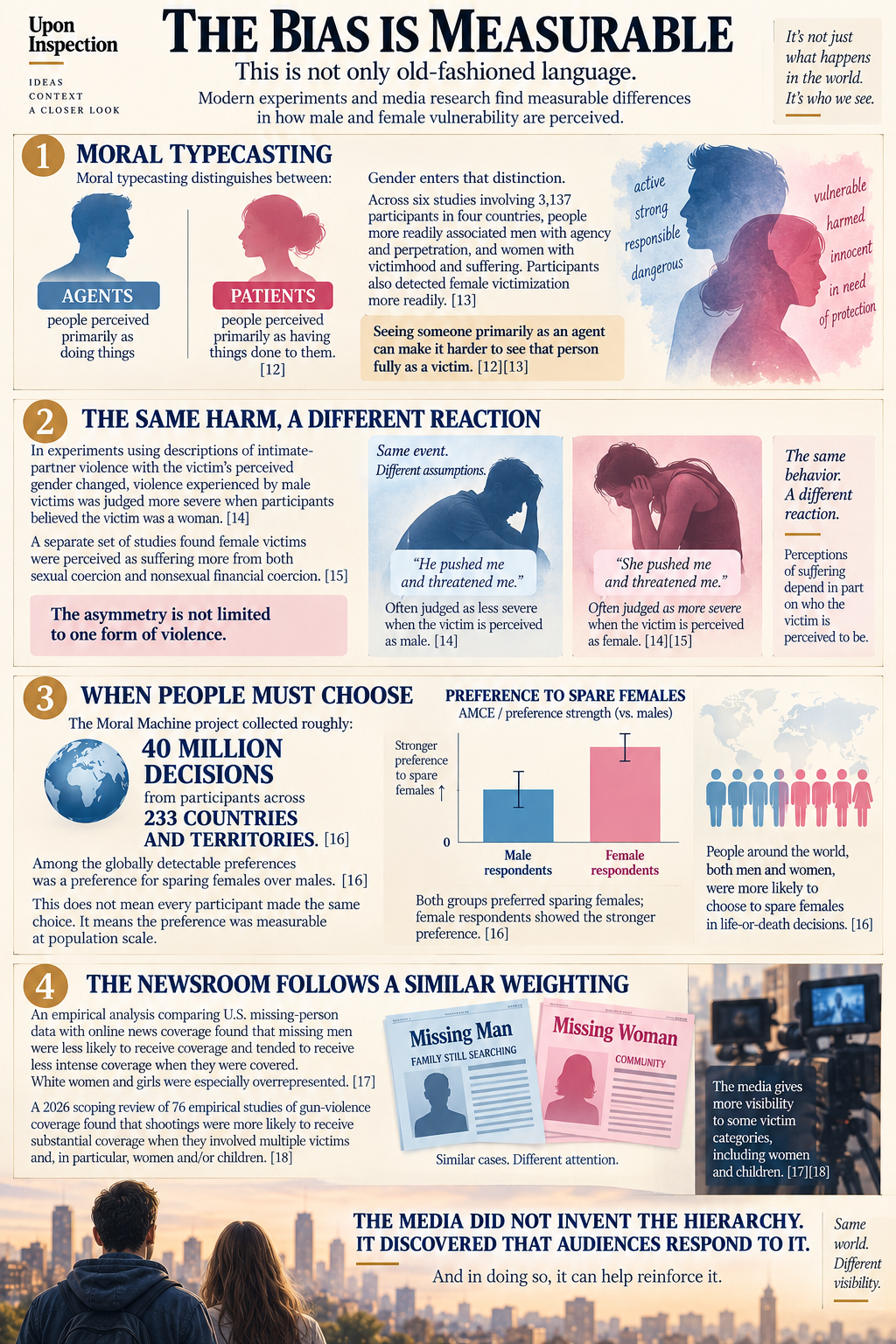
Establishes the moral-agent versus moral-patient framework used to interpret perceptions of agency and vulnerability.
- Man up and take it: Gender bias in moral typecastingotherWhy it’s here
Six studies involving 3,137 participants found gendered differences in the association of men with agency and perpetration and women with victimhood and suffering.
- What you say and what I hear—Investigating differences in the perception of the severity of psychological and physical violence in intimate partner relationshipsotherWhy it’s here
Supports the gender-swapped intimate-partner-violence finding used in the article.
- Minimization of Male SufferingotherWhy it’s here
Found greater perceived suffering for female victims in both sexual and financial coercion scenarios.
OriginalDOI: 10.1007/s13178-016-0226-0 - The Moral Machine experimentotherWhy it’s here
Roughly 40 million decisions from participants in 233 countries and territories revealed globally detectable preferences including sparing females over males.
OriginalDOI: 10.1038/s41586-018-0637-6 - Missing White Woman Syndrome: An Empirical Analysis of Race and Gender Disparities in Online News Coverage of Missing PersonsotherWhy it’s here
Supports the finding that missing men receive less news attention and that white women and girls are especially overrepresented.
- News media coverage of gun violence: a scoping reviewotherWhy it’s here
Review of 76 empirical studies finding greater coverage for shootings with numerous victims and particularly those involving women and/or children.
- Women and children of Gaza are killed less frequently as war's toll risesotherWhy it’s here
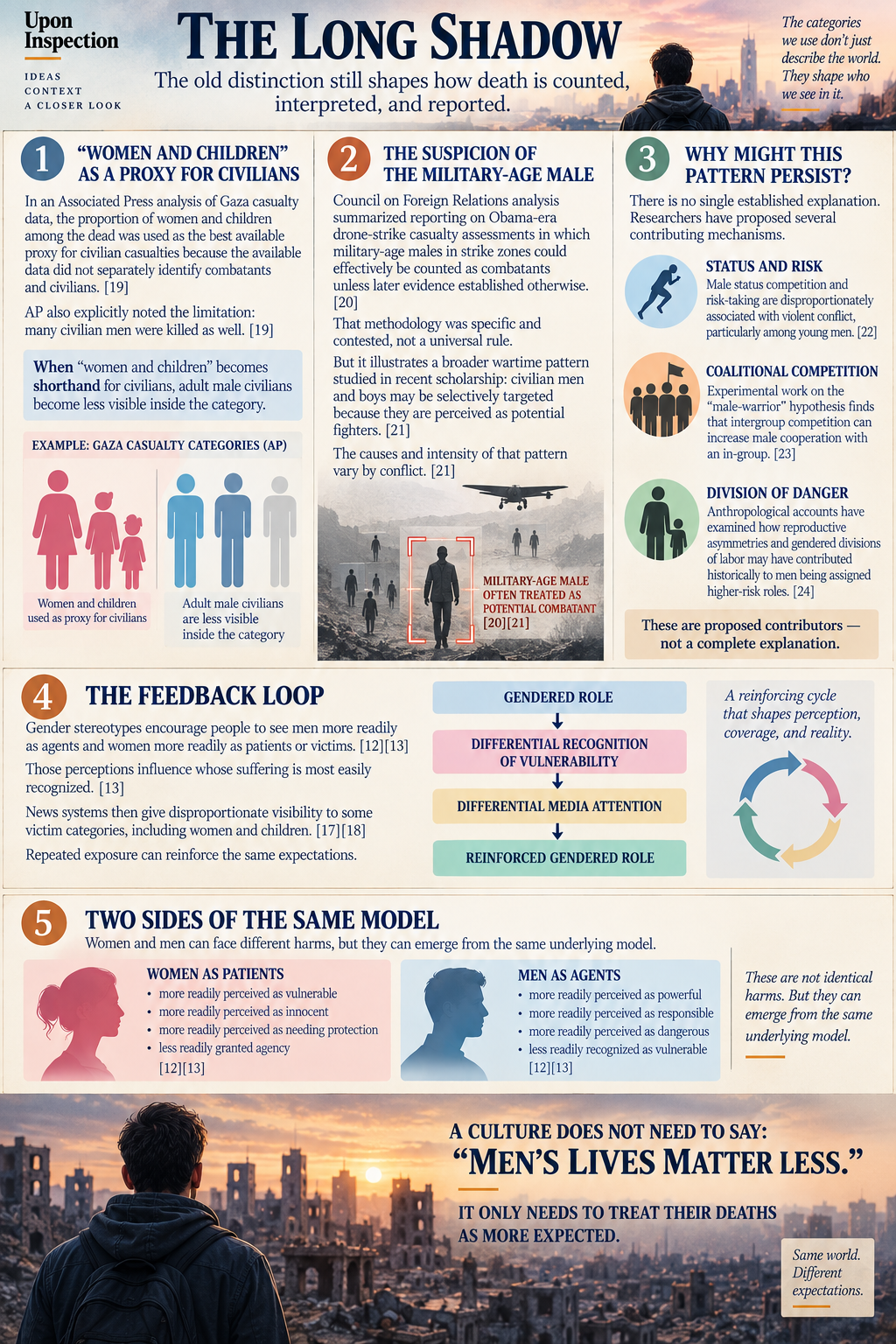
Supports the discussion of women and children being used as a proxy for civilian casualties while explicitly acknowledging civilian male deaths.
- Targeted Killings and Signature StrikesotherWhy it’s here
Supports the discussion of reported Obama-era drone-strike counting practices concerning military-age males.
- The Forest of Reasons: Toward Contextualised Explanations of Gendercide Against Civilian Men and Boys in Conflict SettingsotherWhy it’s here
Examines selective killing of civilian men and boys perceived as potential fighters and emphasizes conflict-specific explanations.
OriginalDOI: 10.1080/1057610X.2025.2535356 - Competitiveness, risk taking, and violence: The young male syndromeotherWhy it’s here
Supports the discussion of male status competition, risk-taking, and violence as one proposed contributor to male exposure to lethal conflict.
- Gender Differences in Cooperation and Competition: The Male-Warrior HypothesisotherWhy it’s here
Experimental evidence that intergroup competition can increase male within-group cooperation.
OriginalDOI: 10.1111/j.1467-9280.2007.01842.x - Women and Men: An Anthropologist's View; Anthropological Studies of Women's Status Revisited: 1977–1987otherWhy it’s here
Supports the anthropological discussion of reproductive asymmetries, gendered divisions of labor, and dangerous activities as proposed contributors to male expendability.