





Read the accessible text version of this article
Infographic introducing memorable pop-science myths as museum exhibits and arguing that compelling stories can outlive their evidence.
Page 1
Infographic showing shattered myth exhibits and explaining why people may let absurd-sounding claims pass without challenging them.
Page 2
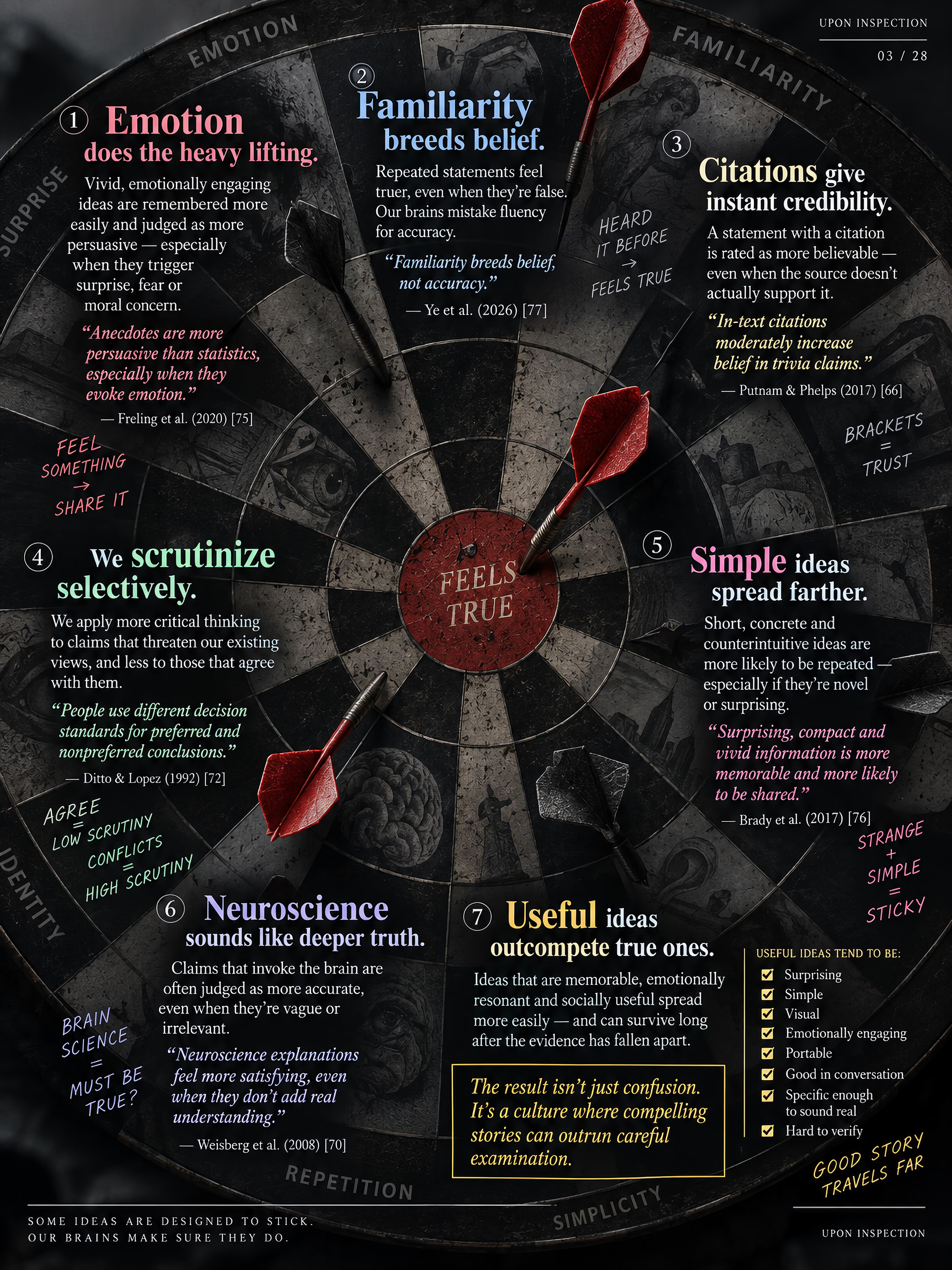
Text-heavy infographic arranged over a giant dartboard, mapping psychological forces that make ideas feel true and memorable.
Page 3
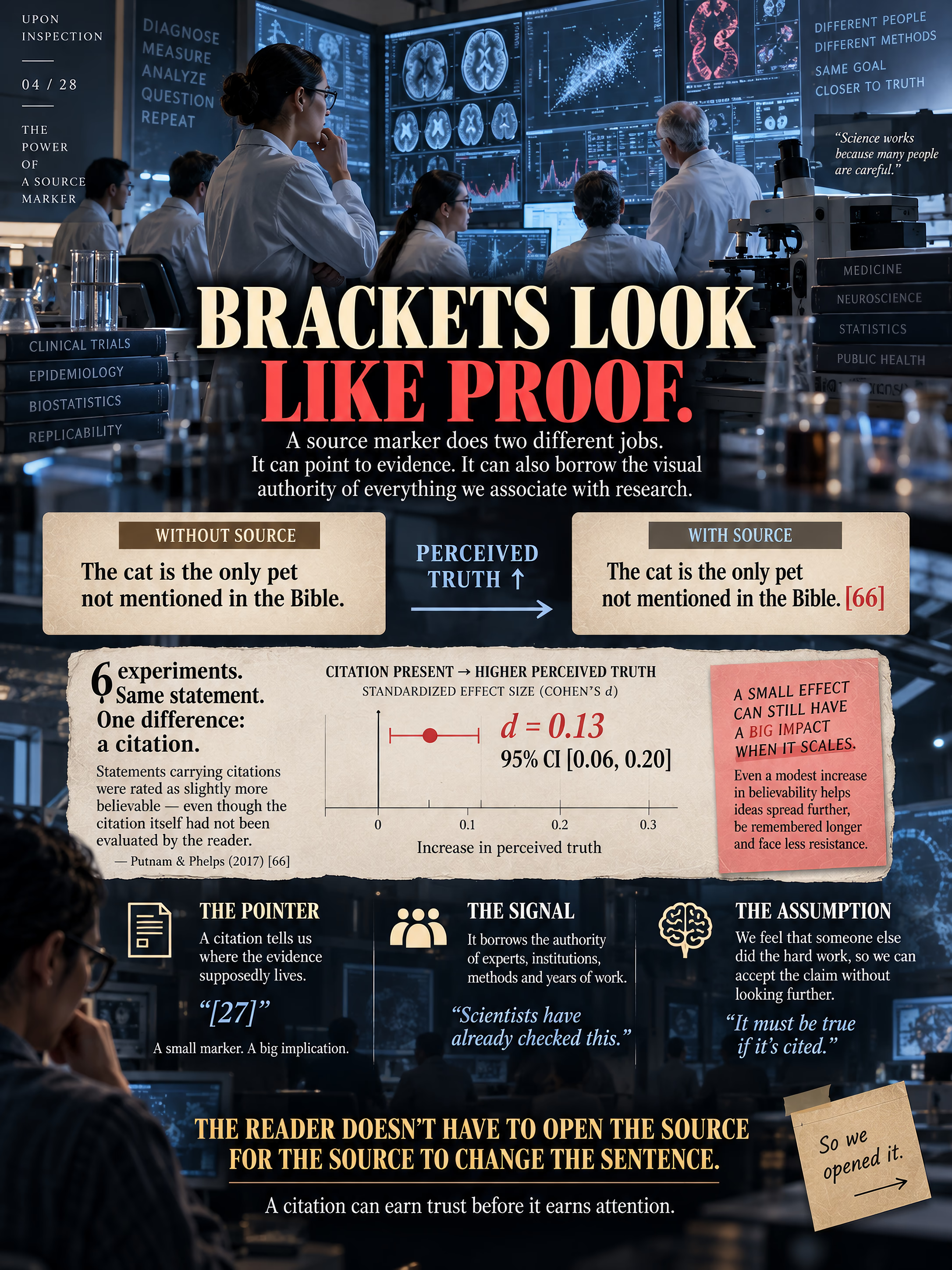
Infographic set in a scientific command center showing that citation brackets can raise perceived credibility before a reader opens the source.
Page 4
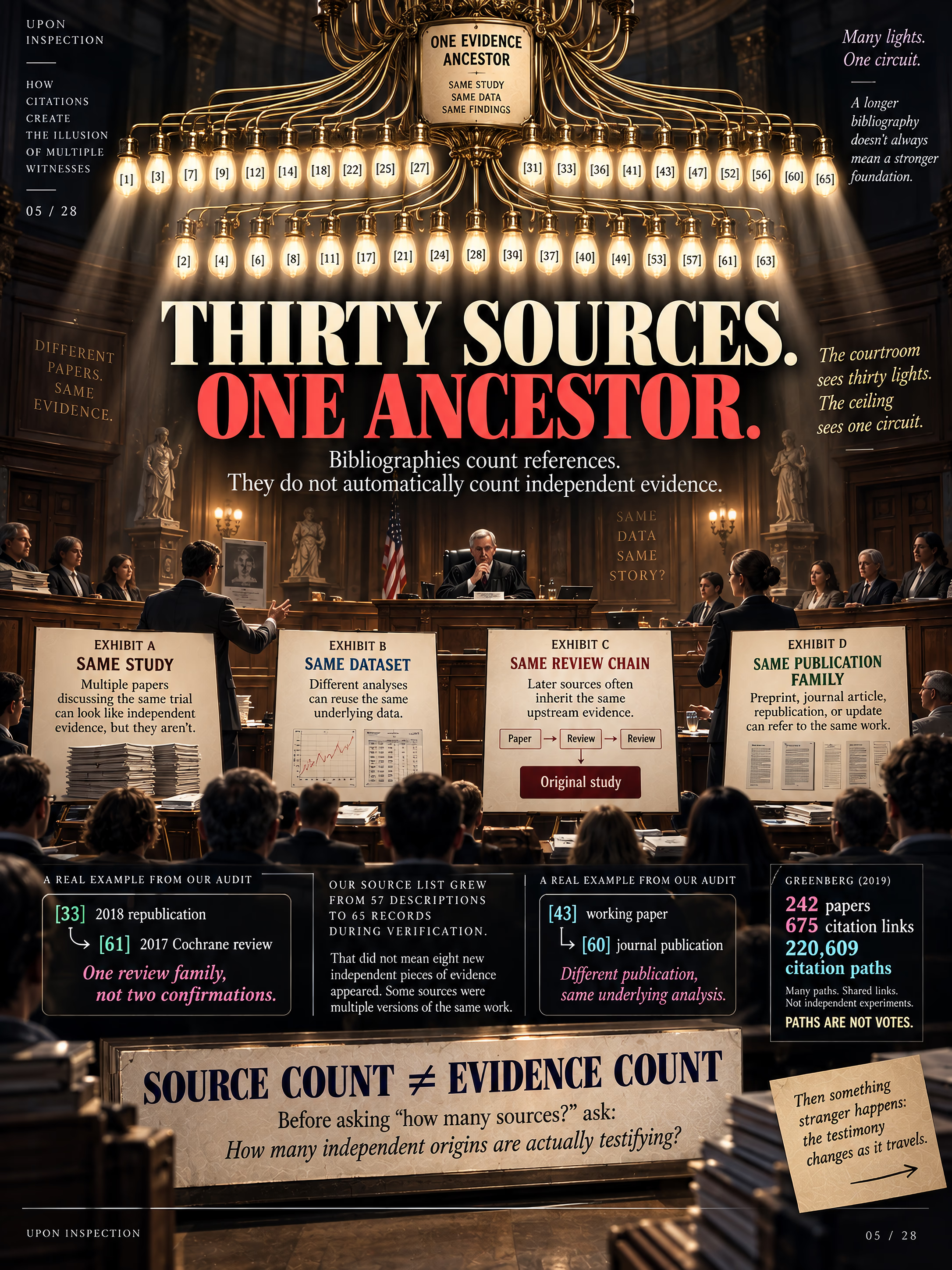
Infographic of a courtroom under a chandelier whose many citation bulbs trace back to one evidence source.
Page 5
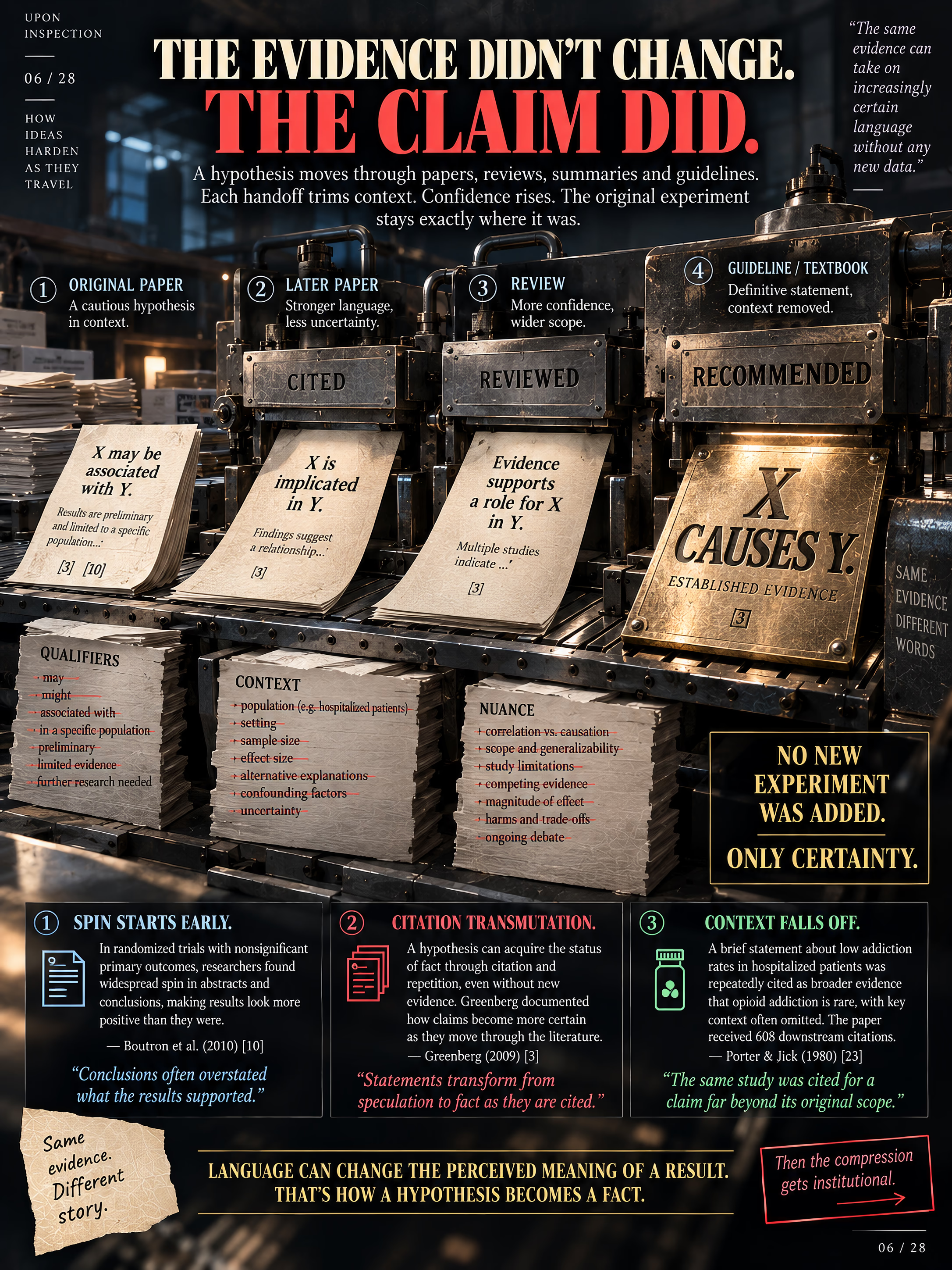
Infographic showing a cautious scientific statement being mechanically stamped into progressively stronger claims until it becomes a metal plaque declaring causation.
Page 6
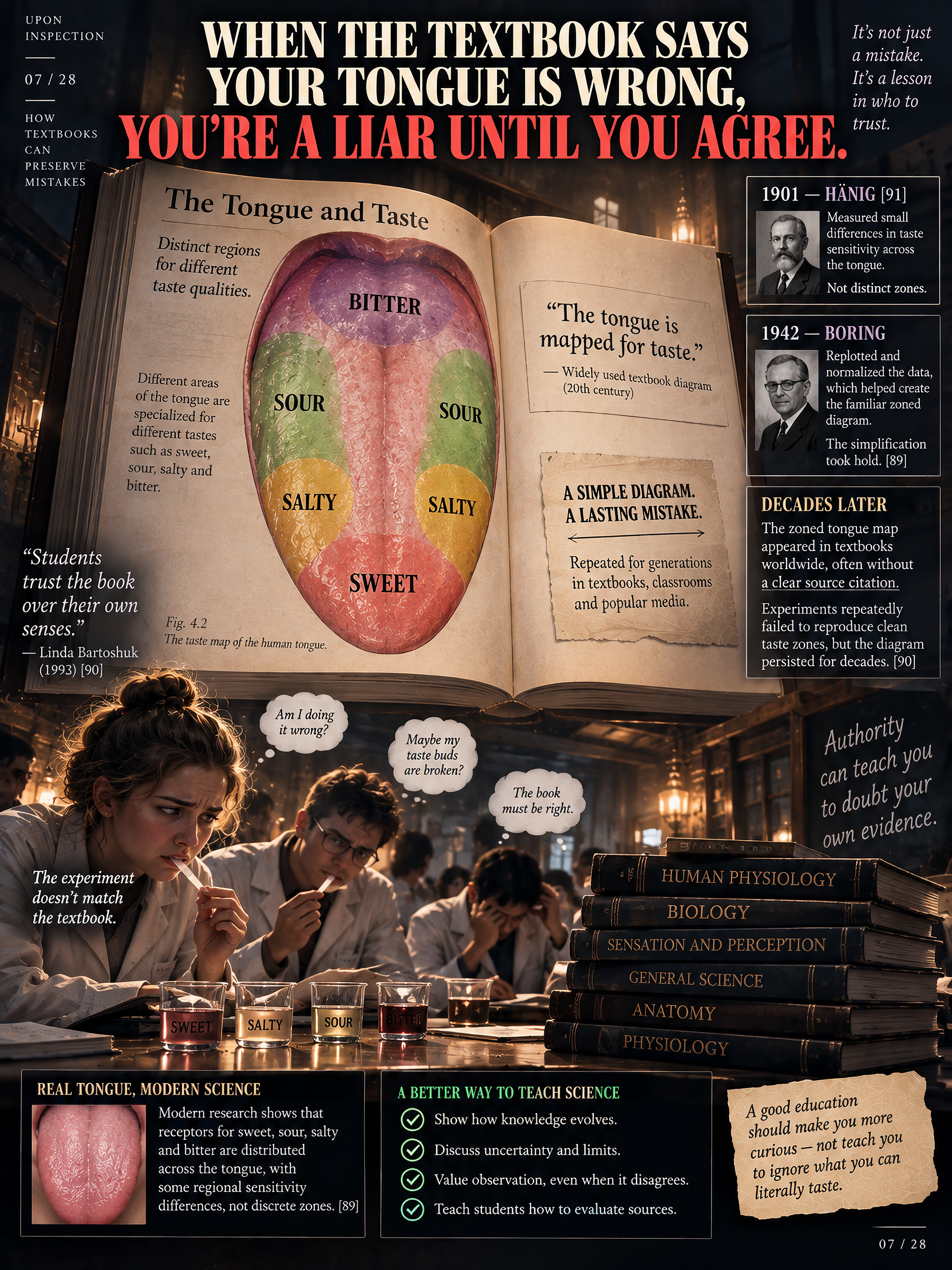
Infographic centered on a giant textbook tongue map, showing how a simplified scientific diagram persisted despite contradictory observation.
Page 7
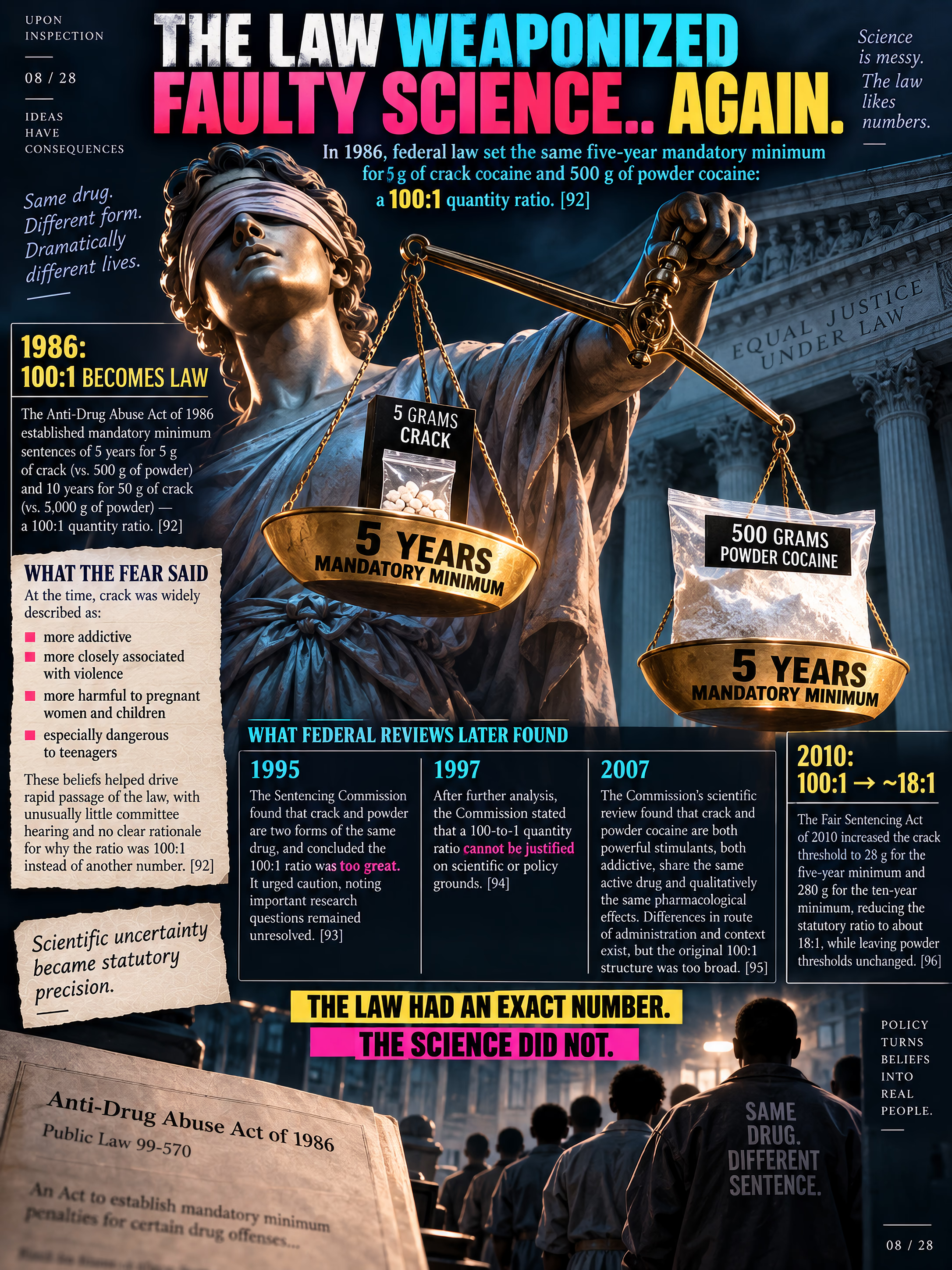
Infographic showing Lady Justice weighing 5 grams of crack cocaine against 500 grams of powder cocaine under the same mandatory sentence.
Page 8
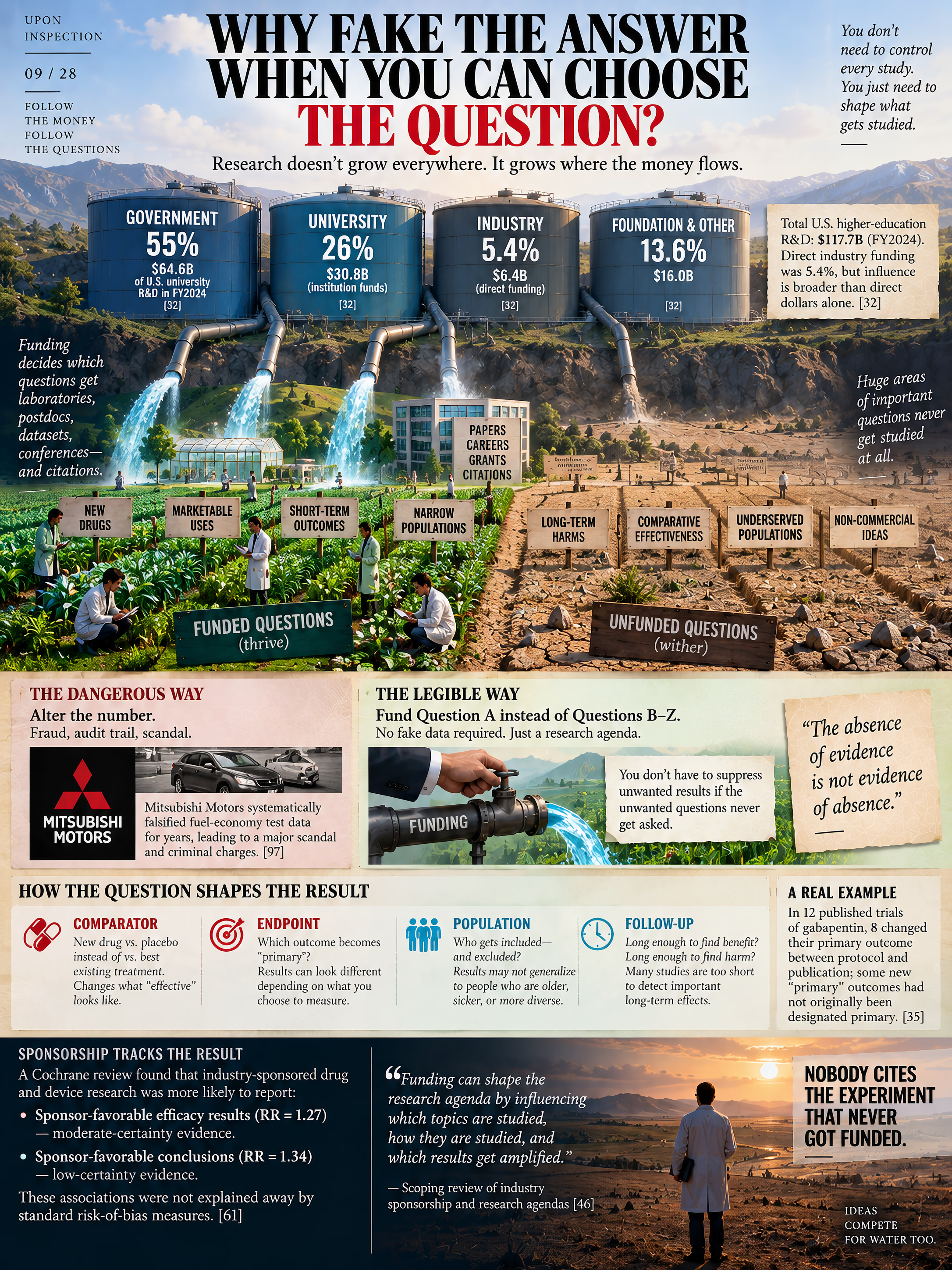
Infographic using irrigation to show how funding directs research attention toward some questions while others remain dry and unstudied.
Page 9
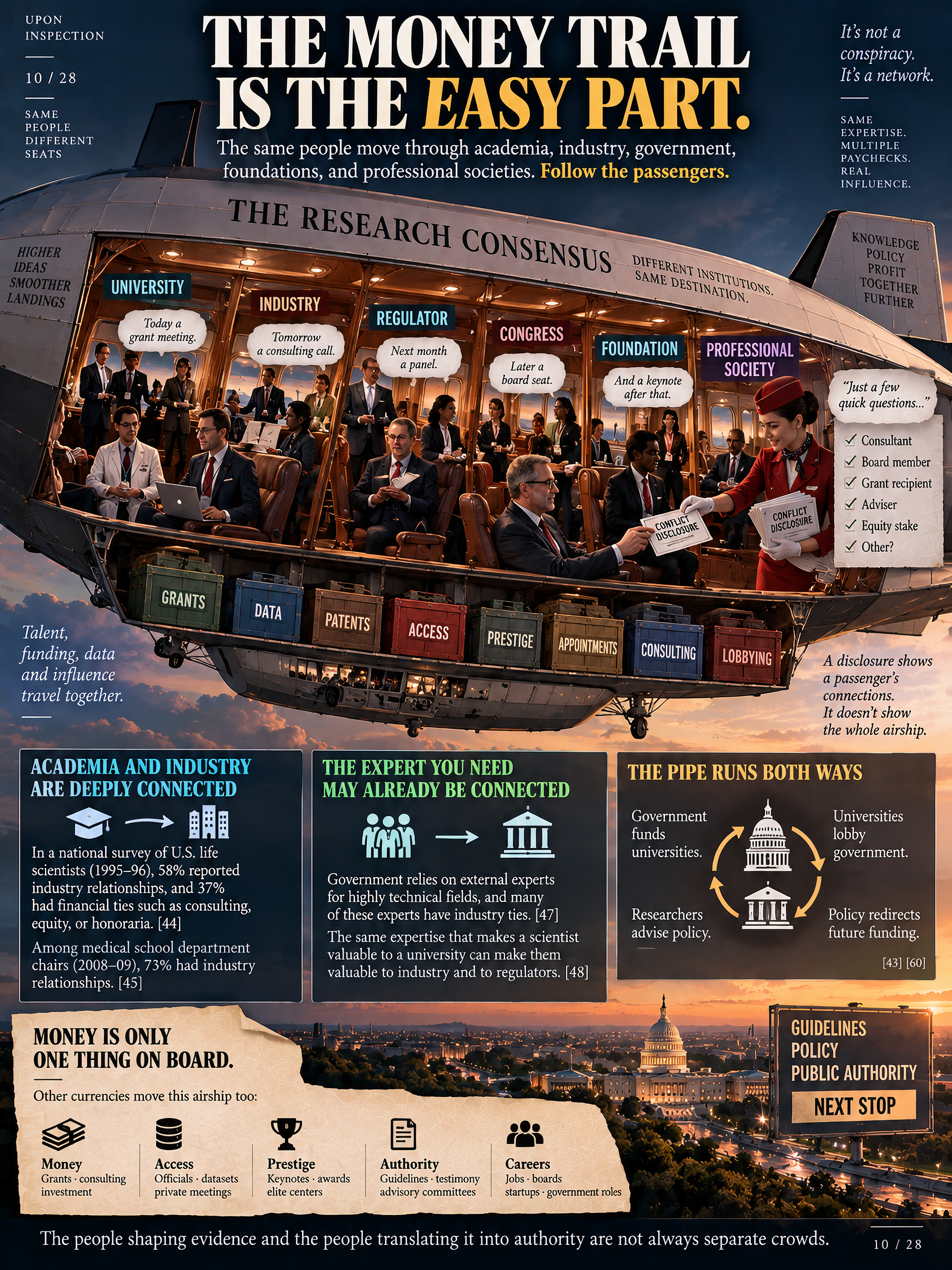
Infographic of a research-policy blimp carrying academics, industry, regulators, lawmakers, foundations, and professional societies in the same vehicle.
Page 10
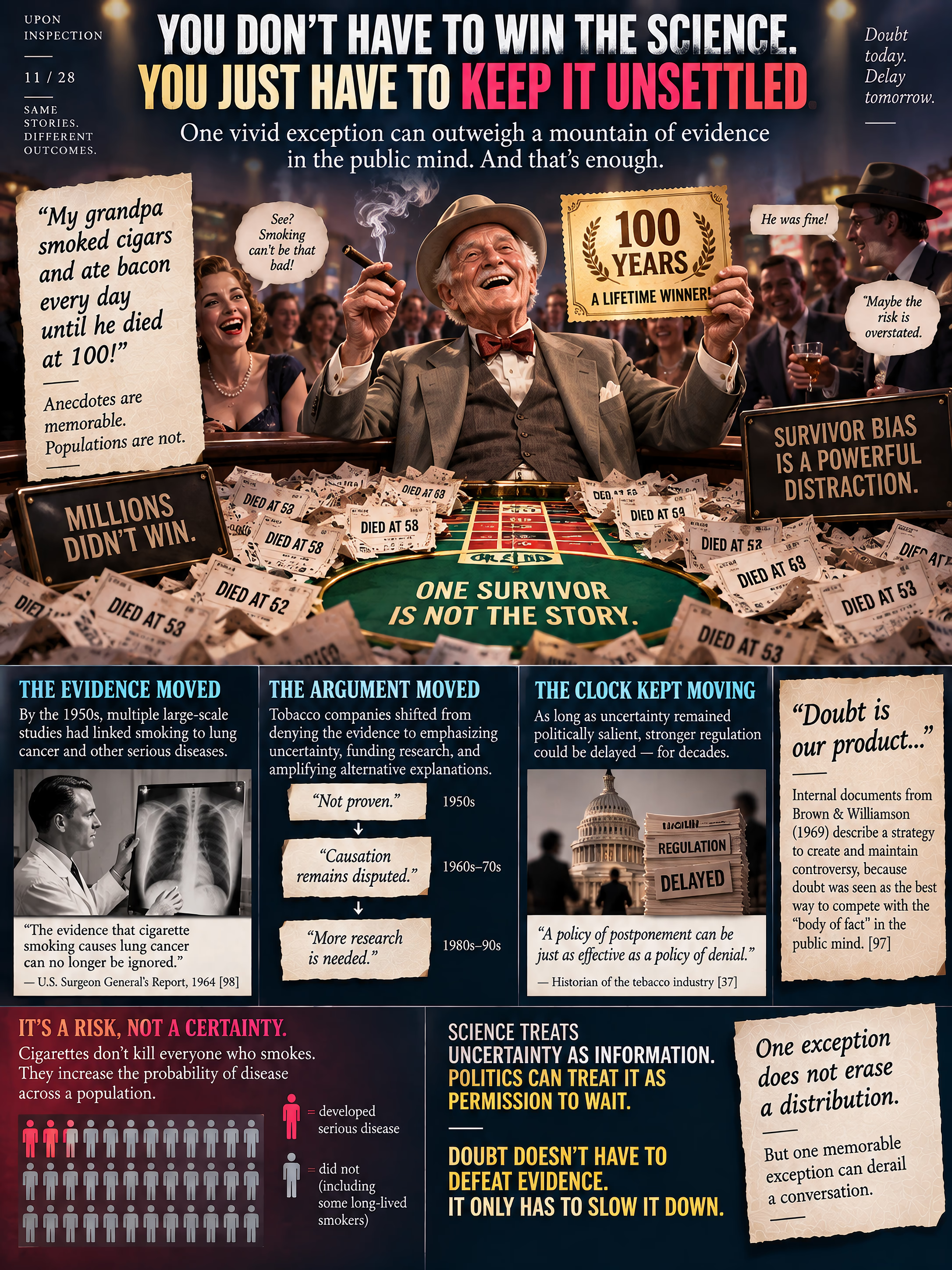
Infographic using a jubilant 100-year-old smoker as a lottery-winner metaphor for survivorship bias and manufactured scientific doubt.
Page 11
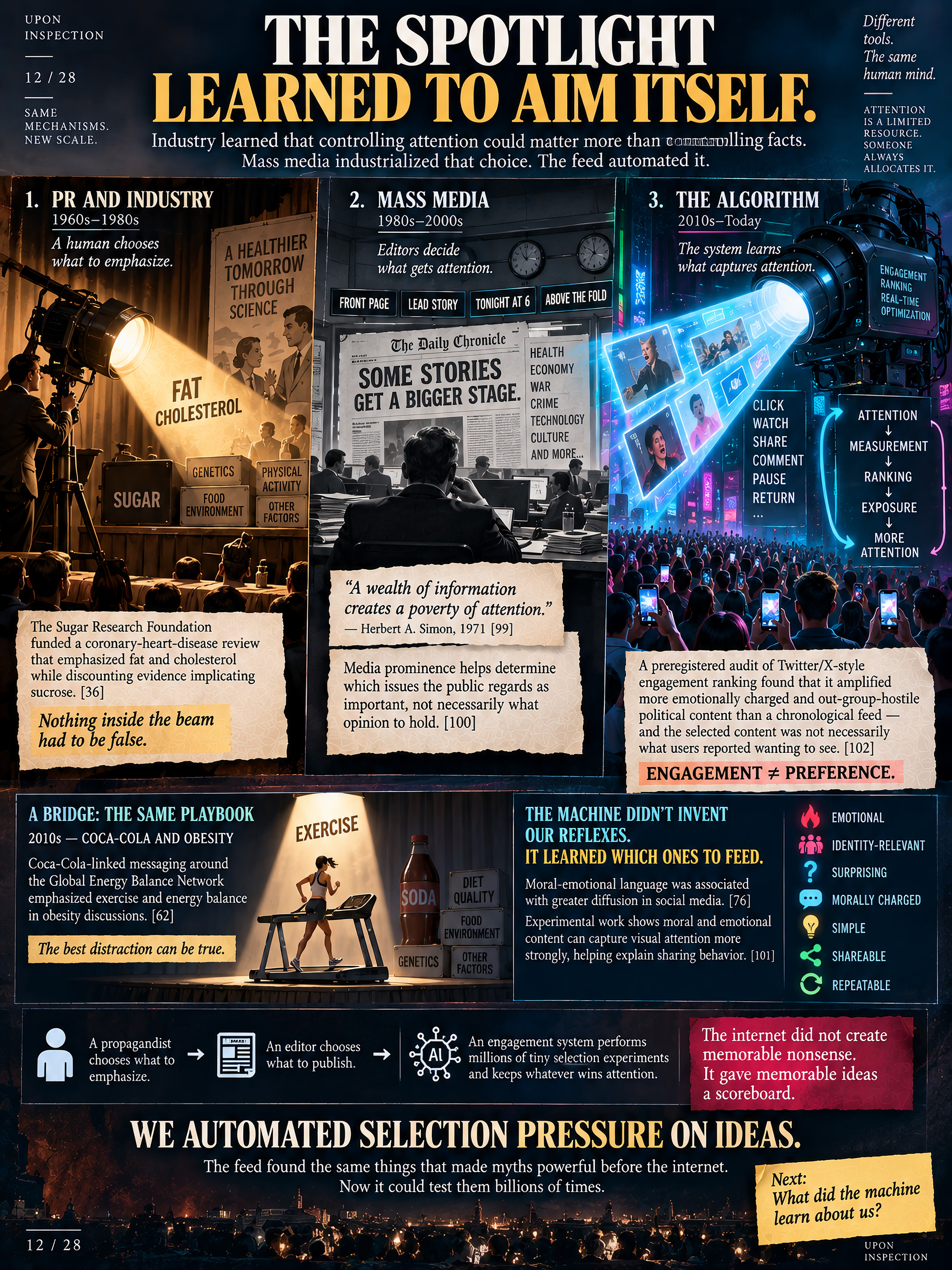
Infographic showing the evolution from human-controlled PR spotlights to mass-media agenda setting and finally self-aiming algorithmic attention systems.
Page 12
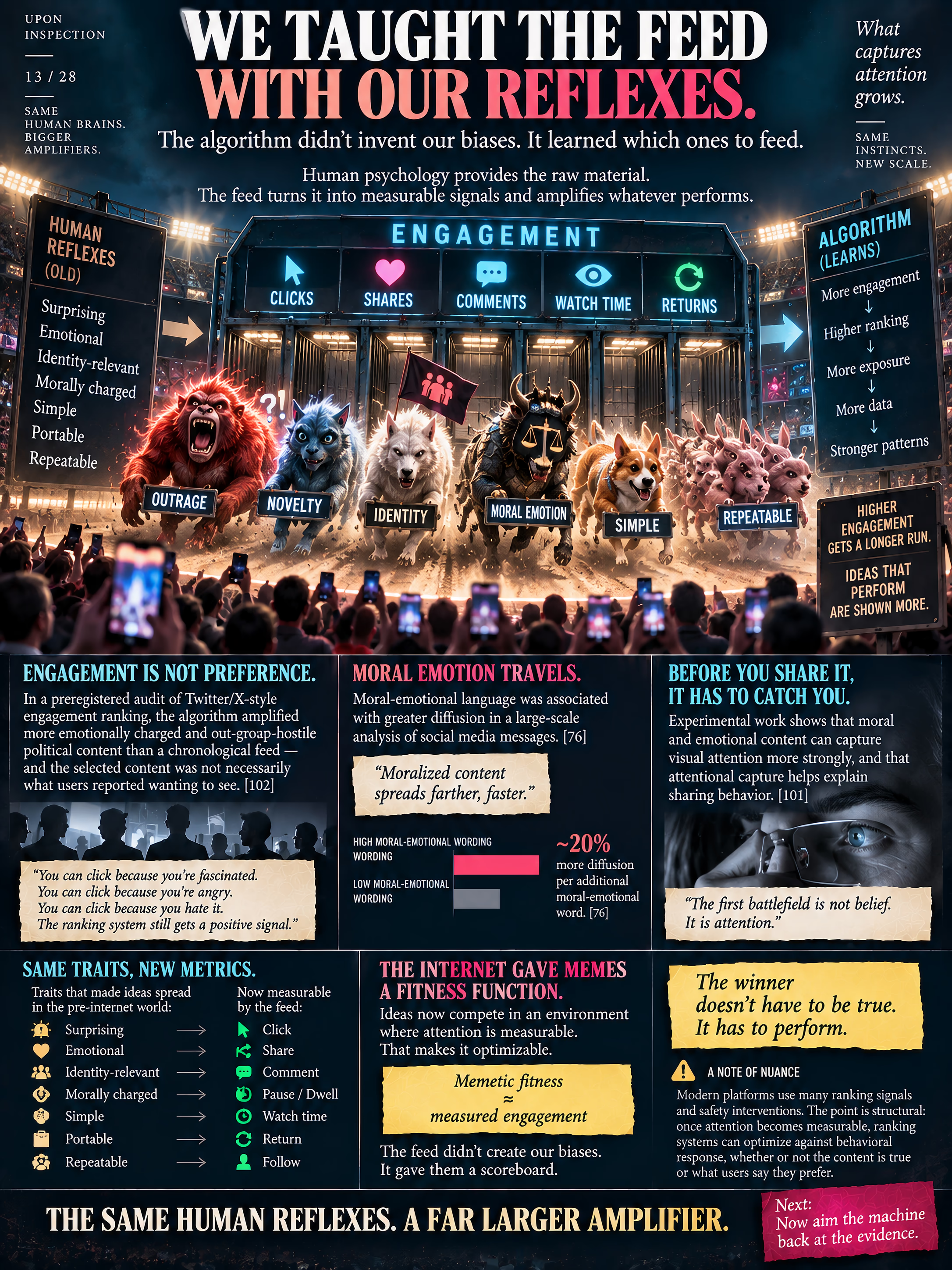
Infographic depicting ideas as racing creatures in an engagement arena where algorithms select traits that generate clicks, shares, comments, and watch time.
Page 13
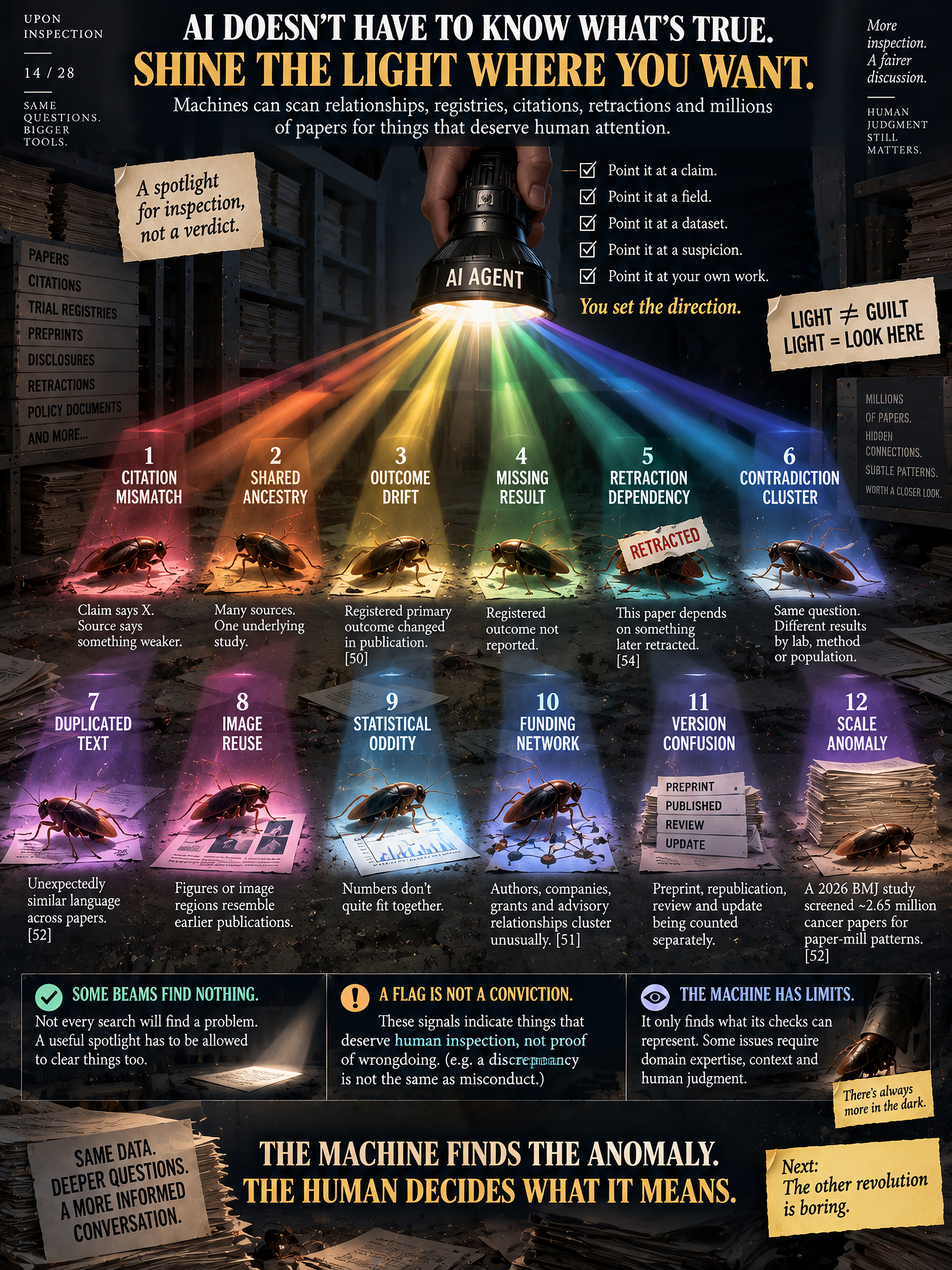
Infographic showing an AI-agent flashlight splitting into many beams that reveal different kinds of anomalies in a dark archive.
Page 14
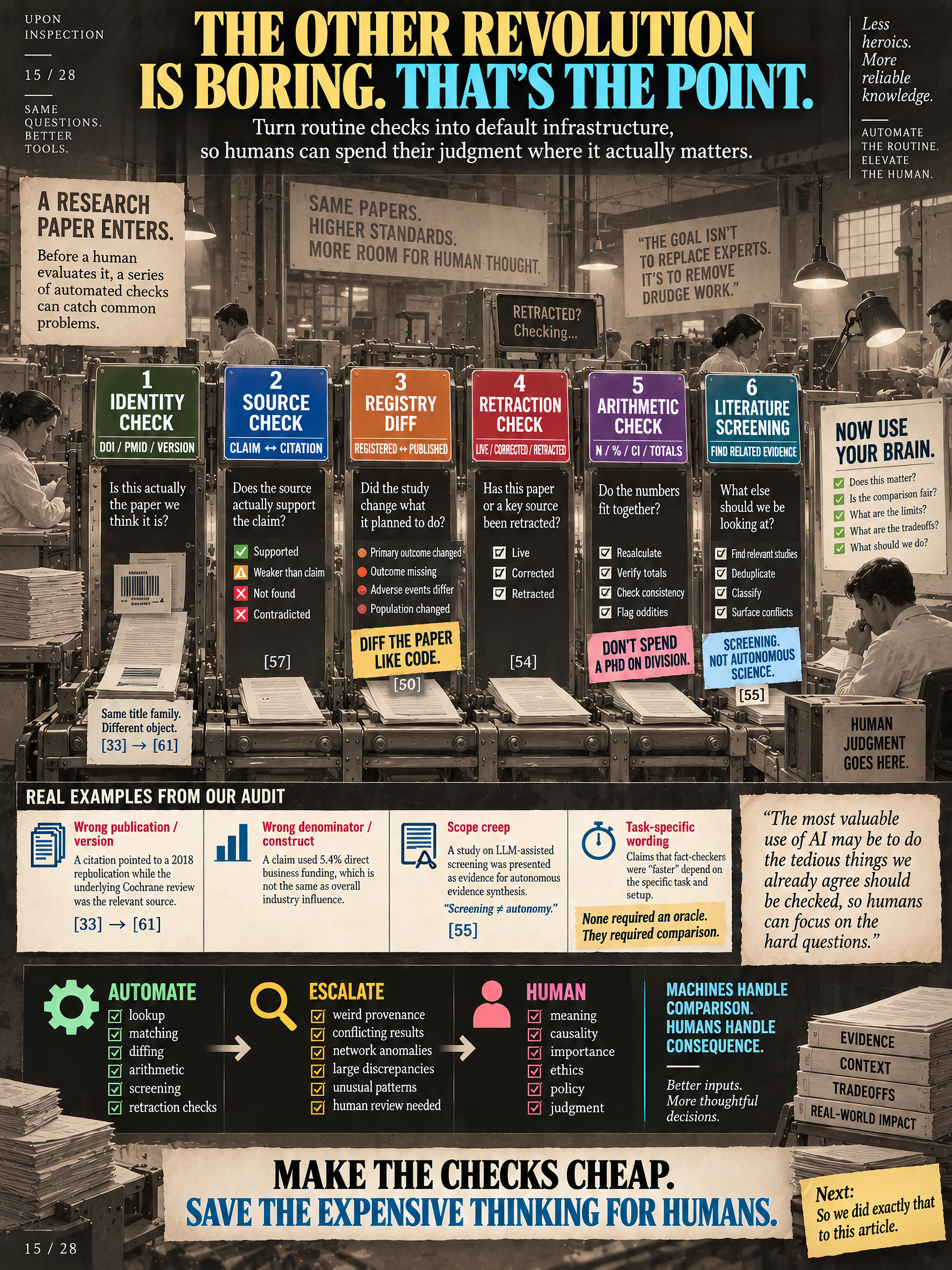
Infographic of a sepia-toned automated inspection line performing routine checks on research material before handing judgment to a human.
Page 15
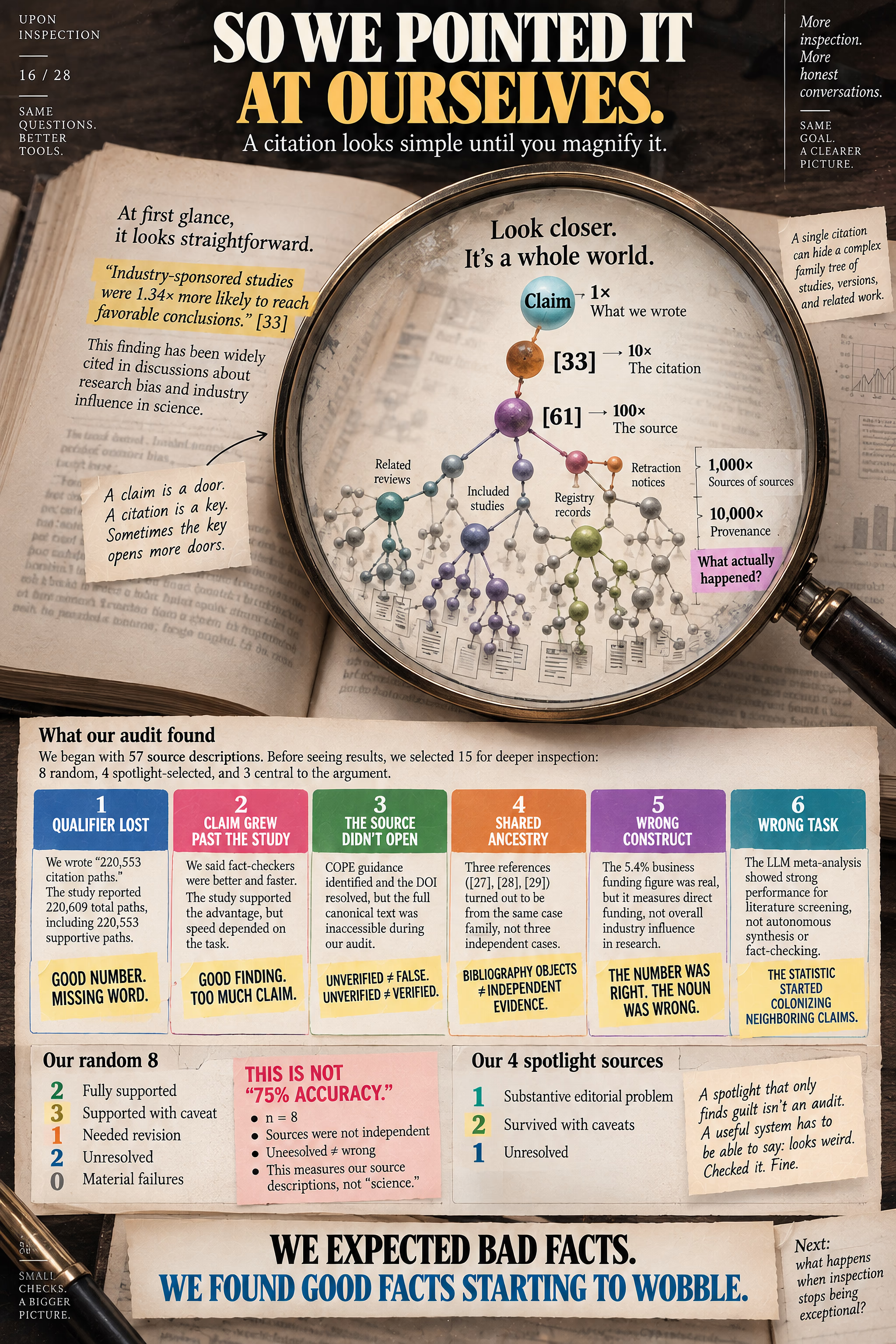
Infographic of a magnifying glass over an open book, revealing a molecular citation-provenance network and the article’s own audit findings.
Page 16
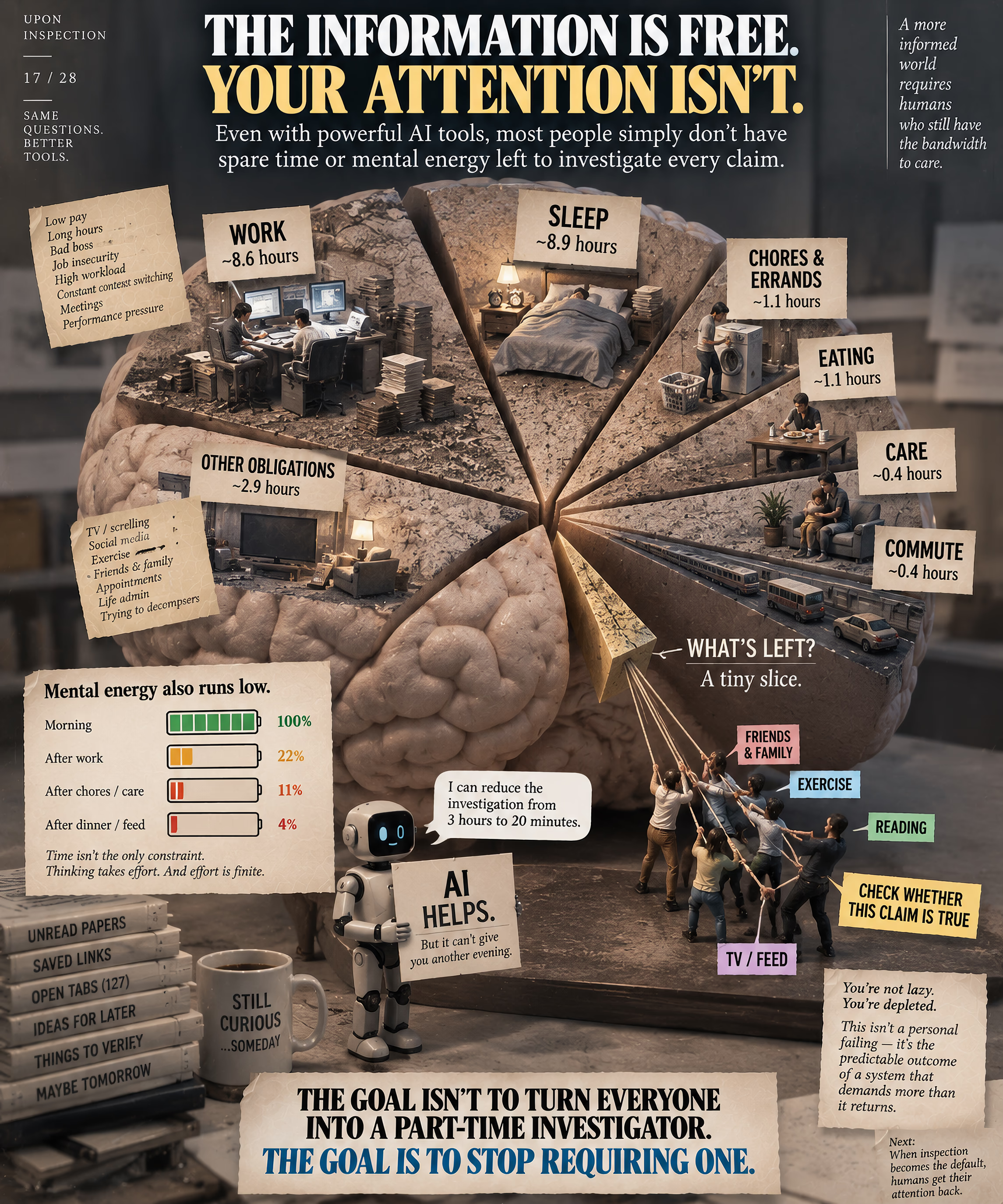
Infographic shaped like a giant brain pie chart, showing how work, sleep, chores, care, commuting, and recovery consume time and mental energy before verification begins.
Page 17
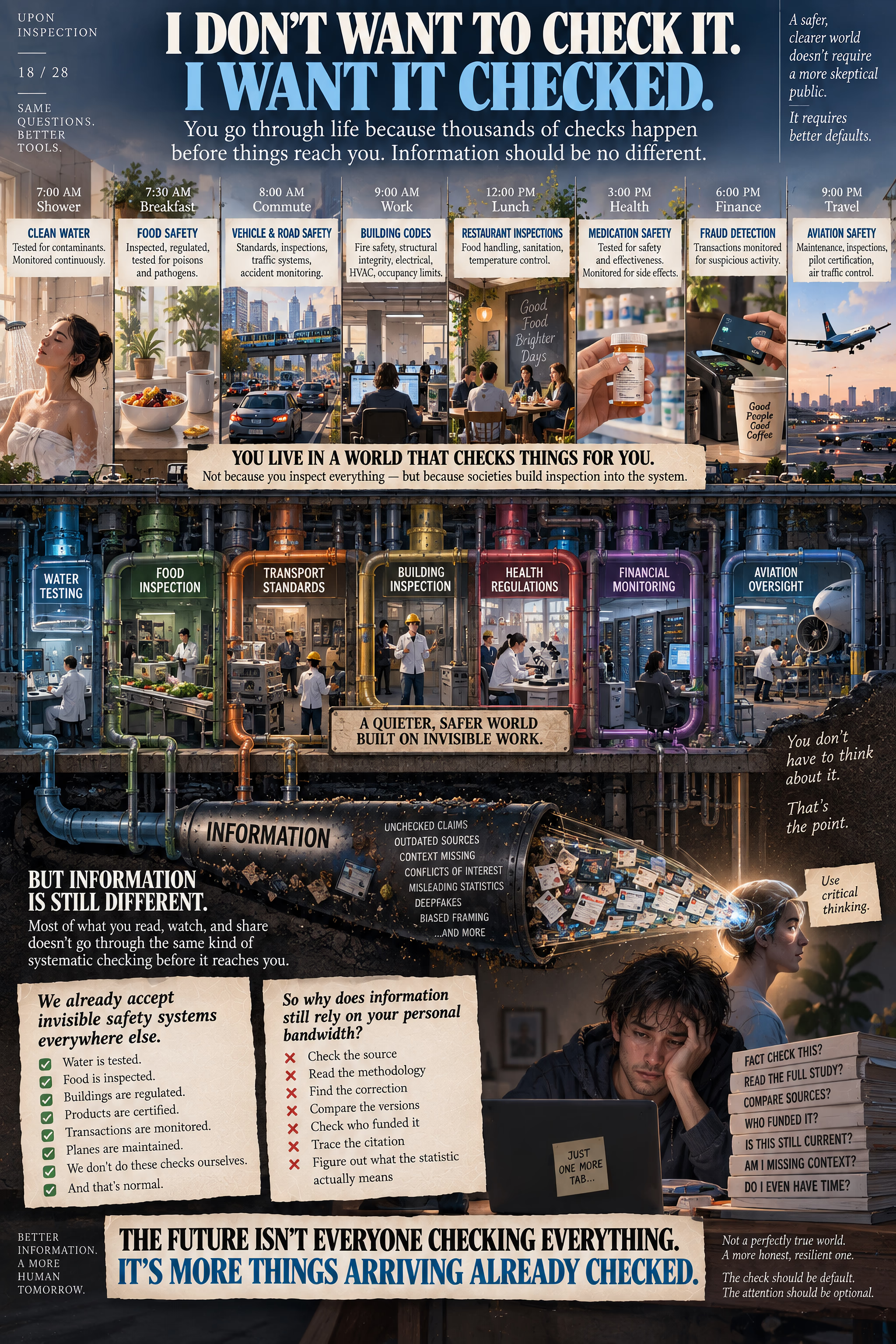
Infographic comparing everyday safety inspections with the largely uninspected flow of information into an exhausted person’s life.
Page 18
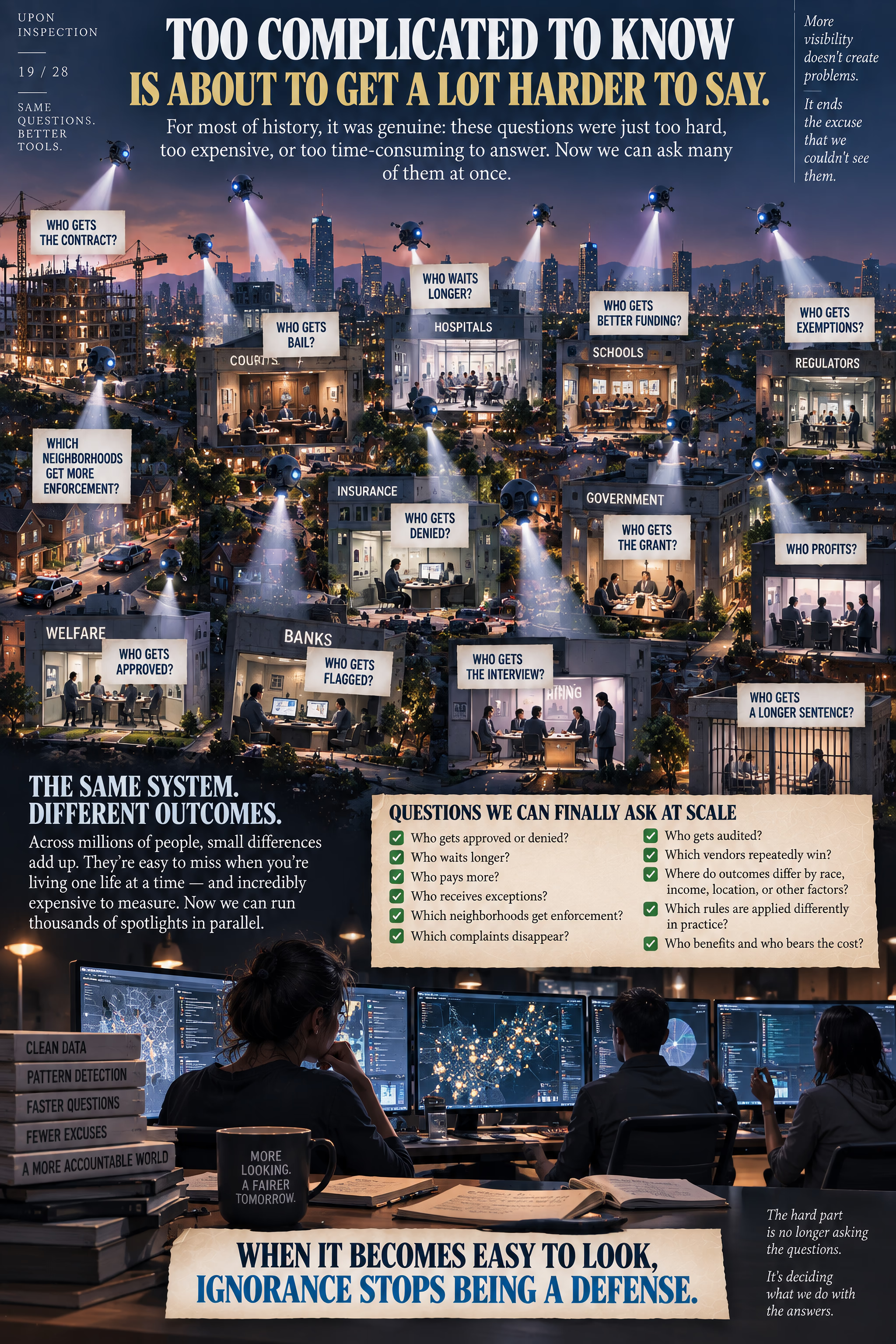
Infographic showing many analytical spotlights scanning courts, hospitals, schools, banks, insurers, regulators, and public agencies across a city.
Page 19
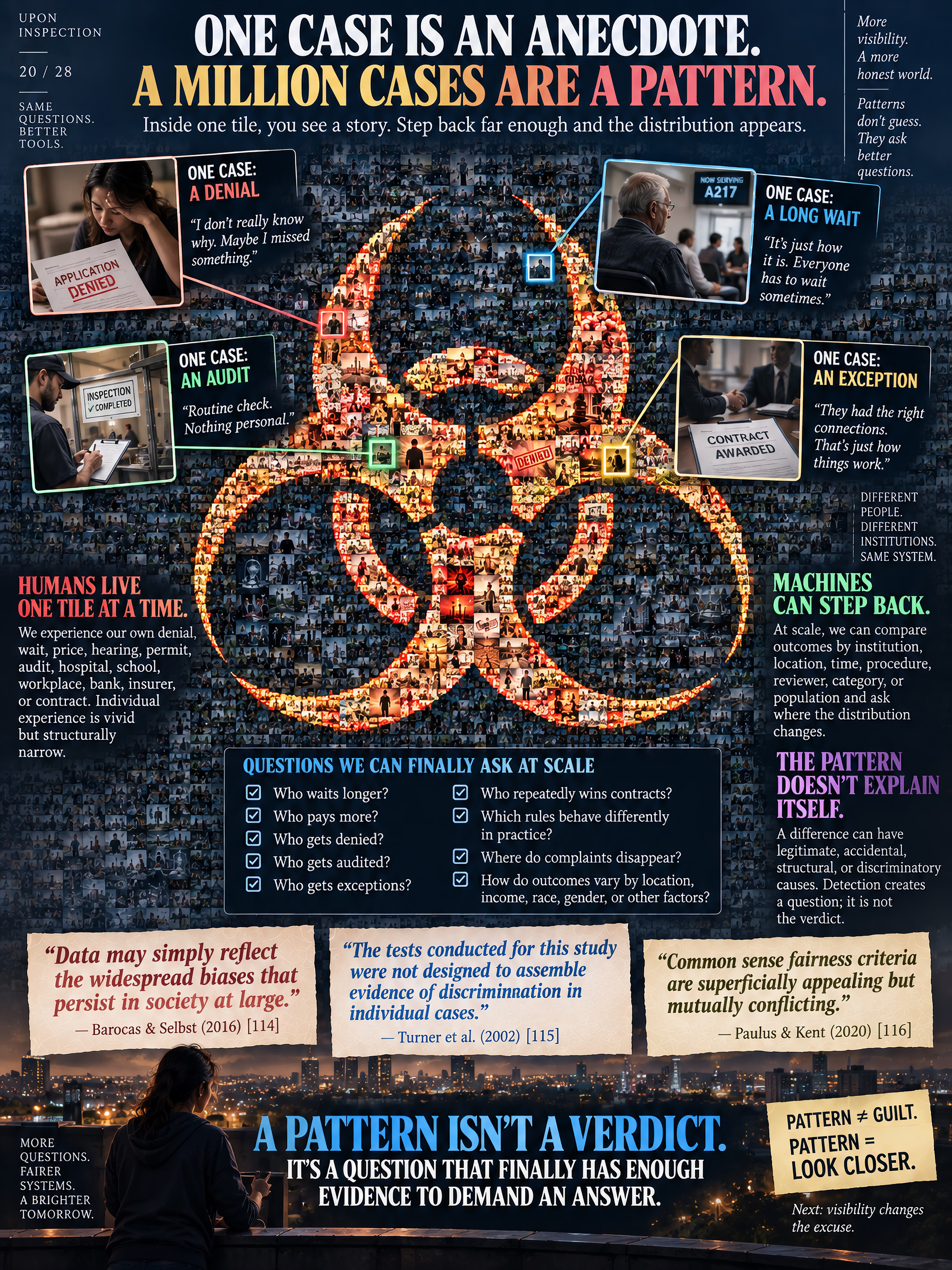
Infographic built around a toxic-symbol mosaic made from thousands of individual cases, showing how patterns emerge only at population scale.
Page 20
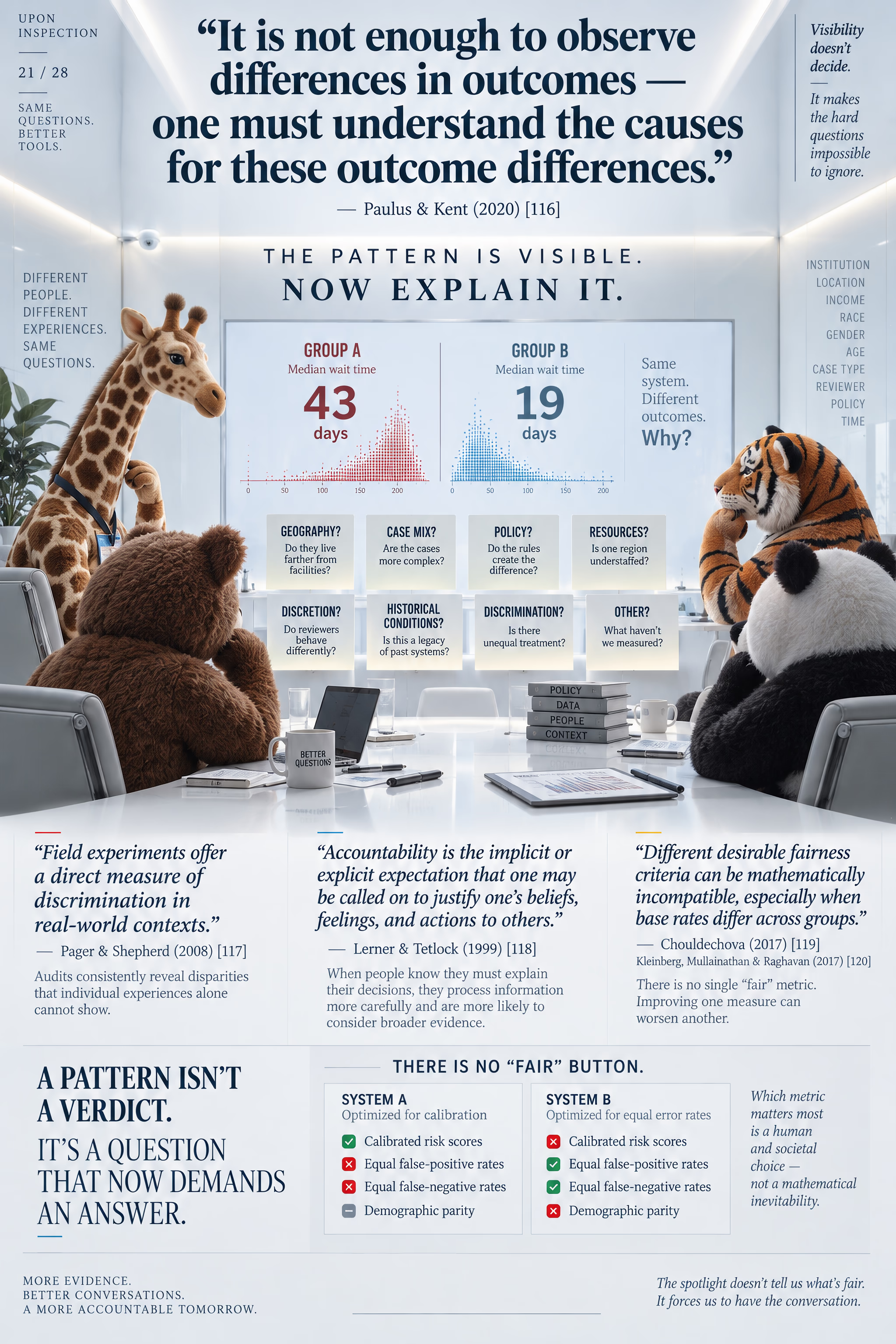
Infographic in a bright institutional white room where giant animal dolls examine a large disparity between two groups and ask what caused it.
Page 21
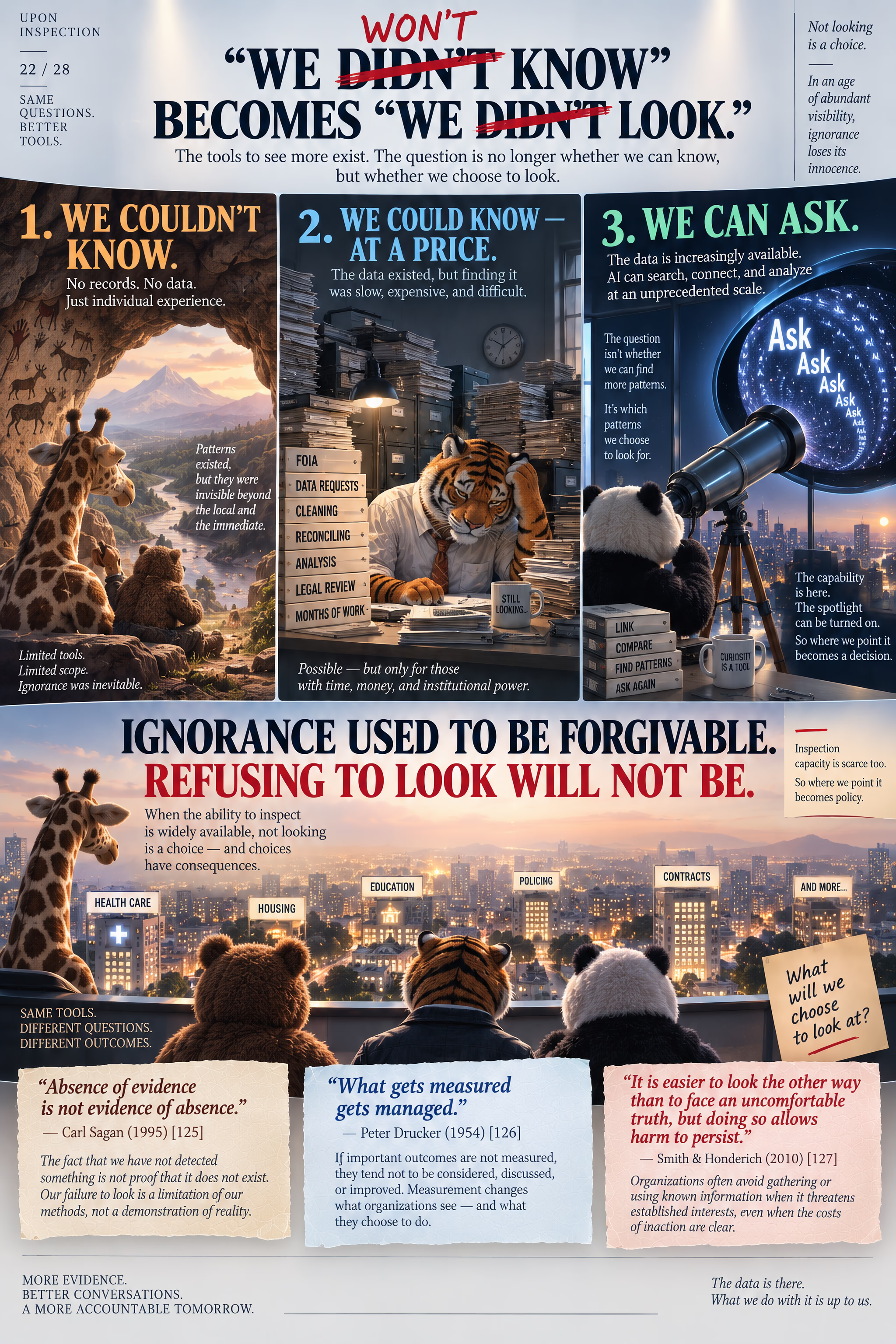
Infographic tracing three eras of knowledge: prehistoric limits, expensive bureaucratic inquiry, and AI-enabled questioning, ending with a citywide inspection switchboard.
Page 22
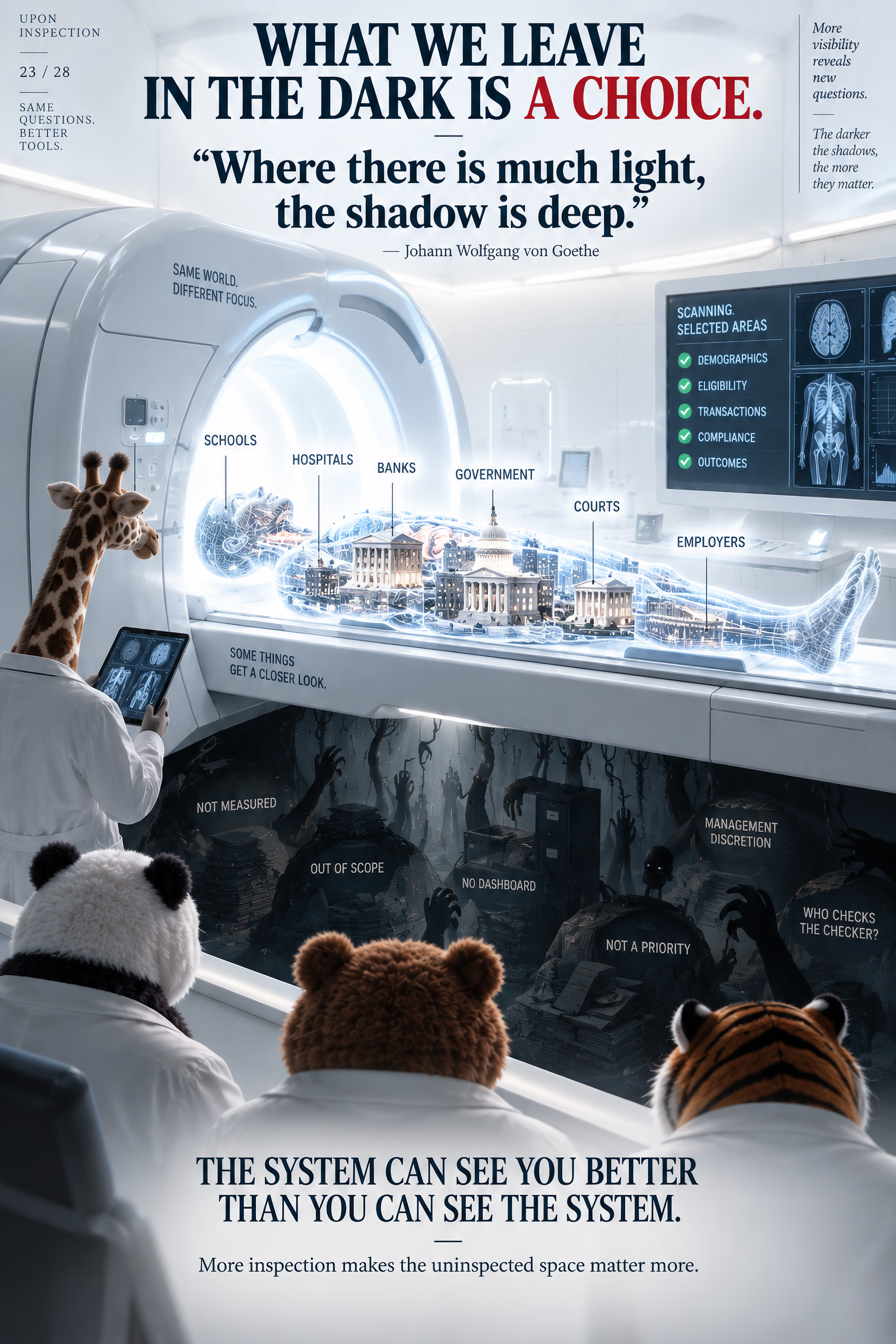
Minimal-text infographic of a blindingly bright institutional scanner that makes selected systems visible while casting deep, eerie shadows over everything left unmeasured.
Page 23
Infographic showing a lavishly golden monarch carried uphill by four exhausted people, illustrating visible asymmetry as an arrangement society can choose to preserve or change.
Page 24
Split-screen infographic contrasting an exhausting first-rejection bureaucracy with a future jogger whose local robot agent handles policy checks, appeals, and repeated requests.
Page 25
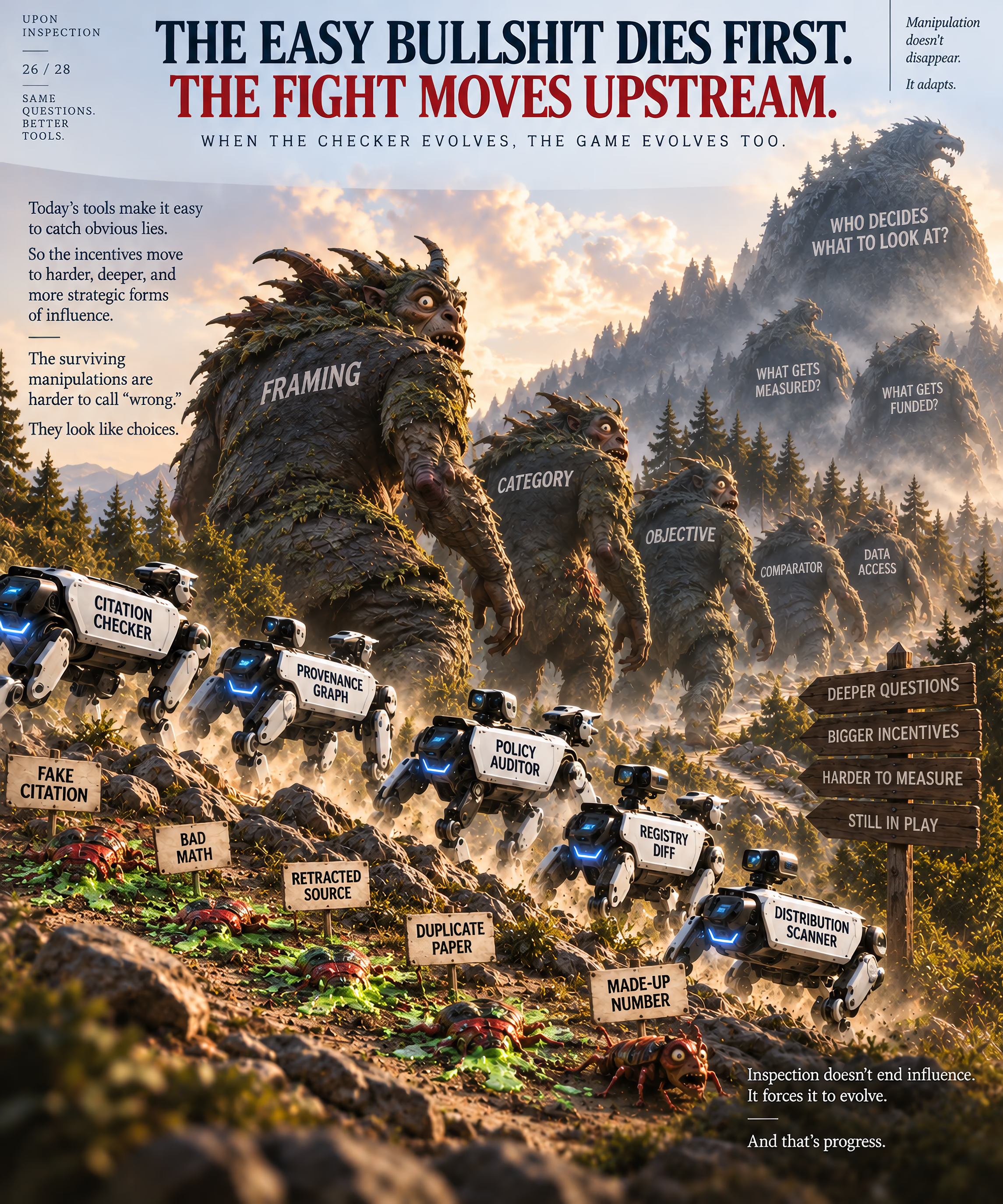
Infographic showing inspection robots crushing obvious errors while larger, more strategic manipulation monsters retreat nervously upstream.
Page 26
Warm, peaceful infographic of people relaxing in a park while small agents quietly handle routine checks in the background.
Page 27
Final infographic showing a future aircraft being built and tested across generations, moving from exposed framework to polished flight over a bright horizon.
Page 28

Artificial Intelligence

The Citations at the Bottom of the Stack

How claims become authority, how power hides in the gaps, and why AI will change the cost of seeing.

A 28-page investigation into how memorable claims become accepted facts, citations manufacture authority, research agendas and institutions shape what gets known, and attention systems amplify what spreads. Then the spotlight turns around: as AI makes verification, policy inspection, provenance tracing, and large-scale pattern detection cheaper, hidden asymmetries become harder to ignore. The question shifts from what we can know to what we choose to look at—and what kind of trust infrastructure our generation chooses to build.

Sources

  1. 2025 systematic review/meta-analysis of citation accuracy in medical literatureother
    2025
    Why it’s here

    Systematic review/meta-analysis used for quotation and citation error rates in medical literature.

  2. Earlier meta-analysis of quotation and citation errors in medical journalsother
    Why it’s here

    Earlier meta-analysis of citation/quotation accuracy; includes discussion of editorial spot-checking.

  3. How citation distortions create unfounded authority: analysis of a citation networkother
    Steven A. Greenberg · BMJ · 2009
    Why it’s here

    Foundational source for citation transmutation, selective citation, amplification, and citation-network ancestry.

  4. Study of post-retraction citation behaviorother
    Why it’s here

    Used for evidence that retracted papers continue to be cited and that retraction status is not always acknowledged.

  5. Study of citation decline after retractionother
    Why it’s here

    Used for the persistence and decline of citations after retraction.

  6. NIST/SEMATECH e-Handbook of Statistical Methods: Acceptance Samplingother
    National Institute of Standards and Technology · NIST
    Why it’s here

    Background source for spot-checking and sampling as an alternative to 100% inspection.

  7. Information Foraging Theoryother
    Oxford Academic
    Why it’s here

    Background framework for the cost-benefit structure of information seeking and following information scent.

  8. Journalism verification and time-pressure researchother
    Journalism Practice · 2021
    Why it’s here

    Research on newsroom verification workload and the consequences of limited time for cross-checking.

  9. Lateral Reading and the Nature of Expertise: Reading Less and Learning More When Evaluating Digital Informationother
    Sam Wineburg; Sarah McGrew · 2019
    Why it’s here

    Used for lateral-reading behavior by professional fact-checkers. Audit narrowed the claim that fact-checkers were always faster.

  10. Reporting and Interpretation of Randomized Controlled Trials With Statistically Nonsignificant Results for Primary Outcomesother
    Isabelle Boutron et al. · JAMA · 2010
    Why it’s here

    Used for evidence of spin in abstracts and conclusions when primary outcomes are nonsignificant.

  11. Systematic review/meta-analysis of citation biasother
    Why it’s here

    Used for evidence that statistically significant or hypothesis-confirming results can receive more citations.

  12. Discussion Document: Citation Manipulationother
    Committee on Publication Ethics · COPE · 2019
    Why it’s here

    Official COPE guidance on citation manipulation. Full canonical text was not fully retrievable during the audit.

  13. Survey research on coercive citationother
    2018
    Why it’s here

    Survey research on researchers' experiences with coercive citation.

  14. Journal Citation Reports suppression guidance and anomalous citation behaviorother
    Clarivate · Journal Citation Reports
    Why it’s here

    Background on citation stacking, anomalous citation concentration, and journal suppression.

  15. 2025 analysis of meta-analyses containing retracted studiesother
    JAMA Internal Medicine · 2025
    Why it’s here

    Used for downstream effects of retracted studies inside meta-analyses.

  16. Retracted ivermectin meta-analysisother
    Why it’s here

    Example of compromised trials affecting pooled evidence.

  17. Ivermectin trial-integrity investigationother
    Why it’s here

    Used for patient-level and trial-integrity checks involving recruitment, randomization, and duplicated records.

  18. GRADE Evidence to Decision frameworksother
    Journal of Research Synthesis Methods
    Why it’s here

    Framework for translating evidence into recommendations while considering certainty, benefits, harms, feasibility, values, and resources.

  19. Study of relative versus absolute risk framingother
    Why it’s here

    Used for how risk presentation format can change perceptions of treatment effects.

  20. GRADE guidance on strong recommendations despite lower-certainty evidenceother
    Why it’s here

    Guidance on circumstances in which strong recommendations may still be issued despite lower-certainty evidence.

  21. Historical analysis of WHO guideline recommendations and evidence certaintyother
    Journal of Clinical Epidemiology
    Why it’s here

    Historical analysis of strong WHO recommendations issued with low or very low certainty evidence.

  22. Analysis of strong UpToDate GRADE recommendations and evidence certaintyother
    BMJ Open
    Why it’s here

    Used as a contrasting dataset on strong recommendations supported by lower-certainty evidence.

  23. A 1980 Letter on the Risk of Opioid Addictionother
    Pamela T. M. Leung et al. · New England Journal of Medicine · 2017
    Why it’s here

    Citation-history analysis of the Porter & Jick opioid letter and loss of the original hospitalized-patient context.

  24. Surgisphere / hydroxychloroquine multinational observational study documentationother
    2020
    Why it’s here

    Background documentation for the Surgisphere hydroxychloroquine controversy.

  25. WHO chronology of the Solidarity Trial hydroxychloroquine pause and resumptionother
    World Health Organization · WHO · 2020
    Why it’s here

    Official chronology of WHO's temporary hydroxychloroquine trial pause and later resumption.

  26. Lancet retraction notice for the Surgisphere hydroxychloroquine paperother
    The Lancet · 2020
    Why it’s here

    Retraction notice documenting inability to independently verify the underlying data.

  27. High-dose chemotherapy for metastatic breast cancer: audit of the Bezwoda trialother
    Weiss; Gill; Hudis et al. · Journal of Clinical Oncology · 2001
    Why it’s here

    Verified audit source in the Bezwoda case; found missing records, eligibility problems, and treatment-assignment discrepancies.

  28. Lancet Bezwoda misconduct/audit reportother
    The Lancet
    Why it’s here

    Exact intended bibliography object remained unresolved during audit; source [65] is a strong candidate but concerns a different Bezwoda trial setting.

  29. Journal of Clinical Oncology commentary on the Bezwoda scandalother
    Journal of Clinical Oncology
    Why it’s here

    Exact intended commentary remained unresolved during audit; do not rely on it for a quantified patient-harm claim without further identification.

  30. National Patterns of R&D Resources, 2023–2024other
    National Center for Science and Engineering Statistics · NSF/NCSES · 2025
    Why it’s here

    Overall U.S. research and development funding and performance data.

  31. National Patterns data on sources of U.S. research fundingother
    National Center for Science and Engineering Statistics · NSF/NCSES · 2025
    Why it’s here

    Used for business, federal, and other sources of U.S. research funding.

  32. Higher Education Research and Development: Fiscal Year 2024other
    National Center for Science and Engineering Statistics · NSF/NCSES · 2026
    Why it’s here

    Primary source for FY2024 higher-education R&D spending and funding shares. Direct business funding is not a measure of broader industry influence.

  33. Industry sponsorship and research outcome (2018 republication/summary version)other
    Intensive Care Medicine · 2018
    Why it’s here

    Version-family source for the industry-sponsorship review. Canonical full Cochrane review is [61]; these are not independent confirmations.

  34. Pharmaceutical industry sponsorship and research outcome and quality: systematic reviewother
    BMJ · 2003
    Why it’s here

    Earlier systematic review of pharmaceutical-industry sponsorship, comparator choice, publication bias, and favorable outcomes.

  35. Outcome reporting in industry-sponsored trials of gabapentin for off-label useother
    New England Journal of Medicine · 2009
    Why it’s here

    Protocol-versus-publication investigation documenting primary-outcome changes and selective outcome reporting.

  36. Sugar Industry and Coronary Heart Disease Research: A Historical Analysis of Internal Industry Documentsother
    Cristin E. Kearns; Laura A. Schmidt; Stanton A. Glantz · JAMA Internal Medicine · 2016
    Why it’s here

    Historical analysis of Sugar Research Foundation funding and framing of coronary-heart-disease research.

  37. Historical research on tobacco-industry manufacture and amplification of scientific uncertaintyother
    2011
    Why it’s here

    Used for the tobacco industry's strategy of creating and amplifying scientific controversy and uncertainty.

  38. BMJ reporting on Coca-Cola and the Global Energy Balance Networkother
    BMJ · 2015
    Why it’s here

    Exact intended BMJ item remained unresolved in the audit; stronger primary/analytic support is source [62].

  39. Systematic review of artificial-sweetener reviews and financial conflictsother
    2016
    Why it’s here

    Used for sponsor/financial-conflict associations in reviews of artificial sweeteners.

  40. Meta-analysis of food-industry sponsorship and research conclusionsother
    2016
    Why it’s here

    Used for pooled evidence on food-industry sponsorship and sponsor-favorable conclusions.

  41. Political Influence behind the Veil of Peer Review: An Analysis of Public Biomedical Research Funding in the United Statesother
    Deepak Hegde · Journal of Law and Economics · 2009
    Why it’s here

    Study of congressional representation and NIH research funding.

  42. Congressional representation and NIH/NSF university fundingother
    Social Science Quarterly
    Why it’s here

    Evidence that congressional representation can affect university receipts from NIH/NSF funding.

  43. Academic Earmarks and the Returns to Lobbyingother
    John M. de Figueiredo; Brian S. Silverman · NBER Working Paper 9064 · 2002
    Why it’s here

    Working-paper version on university lobbying and academic earmarks; journal version is [60].

  44. National survey of academic life scientists' relationships with industryother
    2009
    Why it’s here

    Historical national survey showing substantial industry relationships among academic life scientists.

  45. National survey of medical-school and teaching-hospital department chairs' industry relationshipsother
    2007
    Why it’s here

    Historical national survey of department chairs' consulting, board, speaking, founding, and other industry relationships.

  46. The influence of industry sponsorship on the research agenda: a scoping reviewother
    2018
    Why it’s here

    Scoping review of how industry sponsorship can shape which topics and questions receive research attention.

  47. Study of FDA advisory committees and the shared pool of expertsother
    Public Understanding of Science · 2005
    Why it’s here

    Used for overlap among academic, industry, and government expert pools.

  48. FDA Advisory Committees: Financial Conflict-of-Interest Proceduresother
    U.S. Government Accountability Office · GAO · 2026
    Why it’s here

    GAO review recommending clearer and more transparent FDA advisory-committee conflict procedures.

  49. Graph/text paper-mill detection researchother
    Zhang et al. · Journal of Data and Information Science · 2025
    Why it’s here

    Combines textual and heterogeneous citation-network features to detect paper-mill-like patterns.

  50. Study comparing clinical-AI trial publications with registry recordsother
    He et al. · 2025
    Why it’s here

    Publication-versus-registry comparison used for outcome, adverse-event, and registration discrepancies in clinical AI trials.

  51. NLP extraction of biomedical conflicts of interestother
    PLOS ONE · 2020
    Why it’s here

    NLP system for extracting author-company relationships from biomedical conflict-of-interest disclosures.

  52. BERT-based paper-mill screening of cancer literatureother
    Scancar et al. · BMJ · 2026
    Why it’s here

    Screened roughly 2.65 million cancer papers for textual resemblance to known paper-mill papers; flags are screening signals, not findings of misconduct.

  53. Automated scientific-image integrity and manipulation-screening researchother
    2025
    Why it’s here

    Research on ML-assisted screening for duplicated or manipulated scientific images.

  54. Retraction Watch data in Crossrefother
    Crossref · Crossref
    Why it’s here

    Machine-accessible retraction metadata used for automated retraction checking and dependency mapping.

  55. 2026 meta-analysis of large language models for literature screeningother
    Xie et al. · Journal of Evidence-Based Medicine · 2026
    Why it’s here

    Meta-analysis of LLM-assisted literature screening. Supports task-specific screening performance, not autonomous end-to-end evidence synthesis.

  56. 2026 systematic review of large language models in evidence-synthesis workflowsother
    Journal of Clinical Epidemiology · 2026
    Why it’s here

    Systematic review of LLM use across systematic-review and evidence-synthesis tasks.

  57. SourceCheckup: automated claim-to-source verificationother
    Nature Communications · 2025
    Why it’s here

    Automated claim-source comparison across tens of thousands of medical statement/source pairs.

  58. Replication of Hegde's Political Influence behind the Veil of Peer Reviewother
    Hannum · Public Finance Review · 2016
    Why it’s here

    Replication related to source [41].

  59. Reply to Hannum replicationother
    Deepak Hegde · Public Finance Review · 2016
    Why it’s here

    Reply concerning the replication of source [41].

  60. Academic Earmarks and the Returns to Lobbyingother
    John M. de Figueiredo; Brian S. Silverman · 2006
    Why it’s here

    Journal publication of the analysis represented by NBER working paper [43].

  61. Industry sponsorship and research outcomeother
    Andreas Lundh et al. · Cochrane Database of Systematic Reviews · 2017
    Why it’s here

    Canonical Cochrane review for sponsor-favorable efficacy results and conclusions.

  62. Evaluating Coca-Cola's attempts to influence public health 'in their own words': analysis of Coca-Cola emails with public health academics leading the Global Energy Balance Networkother
    Serôdio et al. · Public Health Nutrition · 2020
    Why it’s here

    Analysis of Coca-Cola emails and relationships surrounding the Global Energy Balance Network.

  63. High-dose chemotherapy for metastatic breast cancerother
    Werner Bezwoda; Laurence Seymour; R. Dansey · Journal of Clinical Oncology · 1995
    Why it’s here

    Original Bezwoda metastatic breast-cancer trial; subsequently retracted.

  64. Retraction notice for Bezwoda et al. (1995)other
    Journal of Clinical Oncology · Journal of Clinical Oncology · 2001
    Why it’s here

    Retraction notice for source [63].

  65. High-dose chemotherapy for high-risk primary breast cancer: an on-site review of the Bezwoda studyother
    Weiss et al. · The Lancet · 2000
    Why it’s here

    On-site audit of a separate Bezwoda high-risk primary breast-cancer study.

  66. The citation effect: In-text citations moderately increase belief in trivia claimsother
    Putnam; Phelps · Acta Psychologica · 2017
    Why it’s here

    Six experiments showing that the presence of an in-text citation modestly increased perceived truth.

  67. The role of transportation in the persuasiveness of public narrativesother
    Melanie C. Green; Timothy C. Brock · Journal of Personality and Social Psychology · 2000
    Why it’s here

    Foundational narrative-transportation research.

  68. The affect heuristic in judgments of risks and benefitsother
    Melissa L. Finucane; Ali Alhakami; Paul Slovic; Stephen M. Johnson · Journal of Behavioral Decision Making · 2000
    Why it’s here

    Classic study of affect shaping perceived risks and benefits.

  69. Appealing to fear: A meta-analysis of fear appeal effectiveness and theoriesother
    Melanie Tannenbaum et al. · Psychological Bulletin · 2015
    Why it’s here

    Meta-analysis of fear appeals across attitudes, intentions, and behavior.

  70. The seductive allure of neuroscience explanationsother
    Deena Skolnick Weisberg et al. · Journal of Cognitive Neuroscience · 2008
    Why it’s here

    Shows that irrelevant neuroscience information can increase satisfaction with explanations among nonexperts.

  71. Neuroscience explanations really do satisfy: A systematic review and meta-analysis of the seductive allure of neuroscienceother
    Bennett; McLaughlin · Public Understanding of Science · 2024
    Why it’s here

    Systematic review/meta-analysis of the seductive-allure effect.

  72. Motivated Skepticism: Use of Differential Decision Criteria for Preferred and Nonpreferred Conclusionsother
    Peter H. Ditto; David F. Lopez · Journal of Personality and Social Psychology · 1992
    Why it’s here

    Evidence that people apply different evidentiary thresholds to preferred versus nonpreferred conclusions.

  73. Motivated Skepticism in the Evaluation of Political Beliefsother
    Charles S. Taber; Milton Lodge · American Journal of Political Science · 2006
    Why it’s here

    Experimental work on biased evaluation and selective exposure in political belief formation.

  74. The differential impact of statistical and narrative evidence on beliefs, attitude, and intention: a meta-analysisother
    Zebregs; van den Putte; Neijens; de Graaf · Health Communication · 2015
    Why it’s here

    Meta-analysis comparing statistical and narrative evidence in health communication.

  75. When poignant stories outweigh cold hard facts: A meta-analysis of the anecdotal biasother
    Freling et al. · Organizational Behavior and Human Decision Processes · 2020
    Why it’s here

    Meta-analysis of anecdotal bias and the persuasive strength of stories, especially under emotional engagement.

  76. Emotion shapes the diffusion of moralized content in social networksother
    William J. Brady et al. · Proceedings of the National Academy of Sciences · 2017
    Why it’s here

    Study of moral-emotional language and social-media diffusion.

  77. Systematic review and meta-analysis of the evidence for an illusory truth effect and its determinantsother
    Ye et al. · Nature Communications · 2026
    Why it’s here

    Large systematic review/meta-analysis of repetition increasing perceived truth.

  78. The effects of repetition frequency on the illusory truth effectother
    Hassan; Barber · Cognitive Research: Principles and Implications · 2021
    Why it’s here

    Experimental evidence that repeated exposure can further increase perceived truth.

  79. Beware of the Woozle effect and belief perseverance in the PLS-SEM literature!other
    Henseler et al. · Electronic Commerce Research · 2024
    Why it’s here

    Modern discussion of Woozle effects: unsupported propositions acquiring scientific status through repeated citation.

  80. What's the Story With Blue Steak? On the Unexpected Popularity of Blue Foodsother
    Charles Spence · Frontiers in Psychology · 2021
    Why it’s here

    Review describing evidence that blue plateware suppresses appetite as weak or anecdotal.

  81. The color red reduces snack food and soft drink intakeother
    Genschow; Reutner; Wänke · Appetite · 2012
    Why it’s here

    Original red-as-avoidance consumption result.

  82. The effect of the color red on consuming food does not depend on achromatic contrast and extends to rubbing cream on the skinother
    Bruno et al. · Appetite · 2013
    Why it’s here

    Replication/extension of a red-suppression effect.

  83. Impact of three different plate colours on short-term satiety and energy intake: a randomized controlled trialother
    Akyol et al. · Nutrition Journal · 2018
    Why it’s here

    Found greater energy intake with red and black plates than with white.

  84. Can the color red trick you into drinking less? A replication studyother
    Dolezalova et al. · Appetite · 2021
    Why it’s here

    Failed to replicate reduced beverage consumption from red labeling.

  85. Is the Suppression Effect of the Color Red on Snack Food Consumption Reliable?other
    Steele; Rash · Experimental Psychology · 2021
    Why it’s here

    Found more, rather than less, pretzel consumption from red plates.

  86. Effects of environmental colours in virtual reality: Physiological arousal affected by lightness and hueother
    Weijs et al. · Royal Society Open Science · 2023
    Why it’s here

    Corrective to simplistic 'red raises heart rate' claims; heart-rate effects were more strongly related to lightness than hue.

  87. Myth: You swallow spiders in your sleepother
    Rod Crawford · Burke Museum of Natural History and Culture
    Why it’s here

    Museum arachnology resource documenting the spider-swallowing story as an urban legend without scientific basis.

  88. Is it true you swallow 8 spiders each year in your sleep?other
    The Washington Post · 2023
    Why it’s here

    Used for the secondary myth that the spider story itself was deliberately invented as a gullibility experiment.

  89. The tongue map and the spatial modulation of taste perceptionother
    Charles Spence · Current Research in Food Science · 2022
    Why it’s here

    Review tracing the history and persistence of the classic tongue taste-map myth.

  90. The biological basis of food perception and acceptanceother
    Linda M. Bartoshuk · Food Quality and Preference · 1993
    Why it’s here

    Taste-science source used for the persistence of the tongue-map misconception and classroom observations.

  91. Human taste response as a function of locus of stimulation on the tongue and soft palateother
    Valerie B. Collings · Perception & Psychophysics · 1974
    Why it’s here

    Empirical study showing taste qualities are not confined to discrete tongue zones.

  92. Anti-Drug Abuse Act of 1986 crack/powder cocaine sentencing thresholdsother
    United States Congress · 1986
    Why it’s here

    Primary statutory context for the 5 g crack / 500 g powder cocaine five-year mandatory-minimum thresholds, a 100:1 quantity ratio.

  93. 1995 Report to Congress: Cocaine and Federal Sentencing Policyother
    United States Sentencing Commission · USSC · 1995
    Why it’s here

    Early federal review concluding the 100:1 crack/powder ratio was too great and not adequately justified.

  94. 1997 Report to Congress: Cocaine and Federal Sentencing Policyother
    United States Sentencing Commission · USSC · 1997
    Why it’s here

    Federal review stating the 100:1 quantity ratio could not be justified on scientific or policy grounds.

  95. 2007 Report to Congress: Cocaine and Federal Sentencing Policyother
    United States Sentencing Commission · USSC · 2007
    Why it’s here

    Scientific/policy review of crack and powder cocaine pharmacology and harms.

  96. Fair Sentencing Act implementation / continuing impact reportother
    United States Sentencing Commission · USSC · 2015
    Why it’s here

    Used for the 2010 Fair Sentencing Act's reduction of the crack/powder statutory disparity to about 18:1.

  97. Smoking and Health Proposal ('Doubt is our product')other
    Brown & Williamson · Internal tobacco-industry document · 1969
    Why it’s here

    Primary internal tobacco-industry document containing the 'Doubt is our product' strategy language; Bates 690010951–690010959.

  98. Smoking and Health: Report of the Advisory Committee to the Surgeon General of the Public Health Serviceother
    U.S. Surgeon General's Advisory Committee · U.S. Public Health Service · 1964
    Why it’s here

    Landmark federal review concluding cigarette smoking was a major health hazard and causally related to lung cancer in men.

  99. Designing Organizations for an Information-Rich Worldother
    Herbert A. Simon · 1971
    Why it’s here

    Classic formulation that information abundance creates scarcity of attention.

  100. The Agenda-Setting Function of Mass Mediaother
    Maxwell E. McCombs; Donald L. Shaw · Public Opinion Quarterly · 1972
    Why it’s here

    Foundational agenda-setting study of media prominence and perceived issue importance.

  101. Attentional capture helps explain why moral and emotional content go viralother
    William J. Brady et al. · Journal of Experimental Psychology: General · 2020
    Why it’s here

    Experimental evidence linking moral/emotional content, attentional capture, and sharing.

  102. Engagement, user satisfaction, and the amplification of divisive content on social mediaother
    Milli et al. · PNAS Nexus · 2025
    Why it’s here

    Preregistered audit comparing engagement-based ranking with chronological feeds; used for engagement versus stated preference.

  103. American Time Use Survey — 2025 Resultsother
    U.S. Bureau of Labor Statistics · BLS · 2026
    Why it’s here

    Current U.S. time-use data used for work, personal care/sleep, household activity, eating, care, and leisure.

  104. Workdays, in-between workdays and the weekend: a diary study on effort and recoveryother
    van Hooff et al. · International Archives of Occupational and Environmental Health · 2007
    Why it’s here

    Diary study of work effort, fatigue, recovery, active leisure, and work preoccupation.

  105. The recovery paradox: Portraying the complex interplay between job stressors, lack of recovery, and poor well-beingother
    Sabine Sonnentag · Research in Organizational Behavior · 2018
    Why it’s here

    Review of how high job stressors increase the need for recovery while undermining recovery processes.

  106. Poverty impedes cognitive functionother
    Anandi Mani; Sendhil Mullainathan; Eldar Shafir; Jiaying Zhao · Science · 2013
    Why it’s here

    Evidence that financial scarcity can consume cognitive bandwidth; not treated as a direct estimate of ordinary work fatigue.

  107. Is all mental effort equal? The role of cognitive demand-type on effort avoidanceother
    Embrey; Donkin; Newell · Cognition · 2023
    Why it’s here

    Research on the subjective cost of cognitive effort and avoidance of demanding mental tasks.

  108. How orientations to expertise condition the acceptance of (mis)informationother
    Lyons · Current Opinion in Psychology · 2023
    Why it’s here

    Review of institutional distrust, anti-expert sentiment, epistemic overconfidence, conspiracist worldviews, and science populism.

  109. Science-related populism: Conceptualizing populist demands toward scienceother
    Mede; Schäfer · Public Understanding of Science · 2020
    Why it’s here

    Conceptualization of science-related populism and antagonism toward academic elites.

  110. What is trust (in science and scientists) and is it in crisis?other
    Seyd · Current Opinion in Psychology · 2026
    Why it’s here

    Review arguing that evidence for a generalized public crisis of trust in science is limited and domain-dependent.

  111. State of the Global Workplace: United States country-level dataother
    Gallup · Gallup · 2026
    Why it’s here

    Current workplace-stress data for U.S. employees.

  112. Work in America Survey 2024other
    American Psychological Association · APA · 2024
    Why it’s here

    U.S. worker survey on tension/stress, hours, and burnout-related outcomes.

  113. Work in America Survey 2025other
    American Psychological Association · APA · 2025
    Why it’s here

    U.S. worker survey used for stressors including job insecurity and related workplace pressures.

  114. Big Data's Disparate Impactother
    Solon Barocas; Andrew D. Selbst · California Law Review · 2016
    Why it’s here

    Used for how data-driven systems can reproduce existing patterns of inequality and exclusion.

  115. Discrimination in Metropolitan Housing Markets: National Results from Phase I HDS 2000other
    Margery Austin Turner et al. · Urban Institute / U.S. Department of Housing and Urban Development · 2002
    Why it’s here

    Paired-testing study designed to estimate population patterns of housing discrimination, not prove discrimination in individual cases.

  116. Predictably unequal: understanding and addressing concerns that algorithmic clinical prediction may increase health disparitiesother
    Jessica K. Paulus; David M. Kent · npj Digital Medicine · 2020
    Why it’s here

    Source for the argument that observed outcome differences require causal explanation rather than automatic classification as unfair.

  117. The Sociology of Discrimination: Racial Discrimination in Employment, Housing, Credit, and Consumer Marketsother
    Devah Pager; Hana Shepherd · Annual Review of Sociology · 2008
    Why it’s here

    Review of audit/field experiments as tools for measuring discrimination in real-world contexts.

  118. Accounting for the Effects of Accountabilityother
    Jennifer S. Lerner; Philip E. Tetlock · Psychological Bulletin · 1999
    Why it’s here

    Defines accountability as an expectation that one may need to justify beliefs, feelings, and actions to others.

  119. Fair Prediction with Disparate Impact: A Study of Bias in Recidivism Prediction Instrumentsother
    Alexandra Chouldechova · Big Data · 2017
    Why it’s here

    Shows that desirable fairness criteria can be mathematically incompatible when base rates differ.

  120. Inherent Trade-Offs in the Fair Determination of Risk Scoresother
    Jon Kleinberg; Sendhil Mullainathan; Manish Raghavan · ITCS 2017 · 2017
    Why it’s here

    Independent impossibility result showing intuitive fairness conditions cannot generally all be satisfied simultaneously.

  121. Closing the AI Accountability Gap: Defining an End-to-End Framework for Internal Algorithmic Auditingother
    Inioluwa Deborah Raji et al. · FAccT · 2020
    Why it’s here

    Framework for end-to-end algorithmic auditing and accountability.

  122. Algorithmic Impact Assessments: A Practical Framework for Public Agency Accountabilityother
    Dillon Reisman; Jason Schultz; Kate Crawford; Meredith Whittaker · AI Now Institute · 2018
    Why it’s here

    Framework for public-agency algorithmic impact assessment and accountability.

  123. Discrimination through Optimization: How Facebook's Ad Delivery Can Lead to Biased Outcomesother
    Muhammad Ali et al. · Proceedings of the ACM on Human-Computer Interaction · 2019
    Why it’s here

    Audit showing delivery disparities can arise through ad-delivery optimization even with inclusive advertiser targeting.

  124. Dissecting racial bias in an algorithm used to manage the health of populationsother
    Ziad Obermeyer; Brian Powers; Christine Vogeli; Sendhil Mullainathan · Science · 2019
    Why it’s here

    Case study in which a cost-based proxy produced racial bias in health-risk allocation; changing the target materially changed who was selected for care.

  125. West India Emancipationother
    Frederick Douglass · Speech · 1857
    Why it’s here

    Source of the quotation: 'Power concedes nothing without a demand. It never did and it never will.'

  126. Administrative Burden and Procedural Denials: Experimental Evidence from SNAPother
    Giannella; Homonoff; Rino; Somerville · American Economic Journal: Economic Policy · 2024
    Why it’s here

    Field experiment involving SNAP applicants; used for procedural denials and the costs of administrative burden.

  127. Fara1.5 — A family of frontier computer use agent modelsother
    Microsoft Research · Microsoft Research · 2026
    Why it’s here

    Current computer-use agent family with 4B/9B/27B variants and an explicit edge/on-device deployment direction.

  128. Bringing Gemma 4 12B to your Laptop: Unlocking Local, Agentic Workflowsother
    Google AI Edge · Google Developers Blog · 2026
    Why it’s here

    Current example of fully local agent/tool workflows on laptops; supports the trajectory toward smaller personal agents.

Article transcript and visual descriptions

Article text and visual descriptions

Page 1

Transcript

GREAT STORIES OUTLIVE THE FACTS.

Simple, surprising and emotionally satisfying ideas spread easily — and survive long after the evidence has fallen apart.

The “Hall of Popular Myths” displays familiar examples: “You swallow 8 spiders a year in your sleep,” “You only use 10% of your brain,” “Blue plates suppress appetite,” and “Red raises your heart rate.”

These are useful sentences: compact, surprising, visual, portable, and easy to repeat in conversation. Their survival advantage is not necessarily truth.

GOOD STORIES TRAVEL FAR.

Visual Description

Four glass-domed exhibits present a spider, a brain, blue plates, and a red plate like museum specimens. The display treats the myths as cultural artifacts selected for memorability rather than accuracy.

Page 2

Transcript

“REALLY?” BUT YOU DON’T SAY THAT.

We hear absurd-sounding ideas all the time and let them pass — not because they make sense, but because challenging them can be socially costly and because memorable stories are easy to carry forward.

Examples on display include the spider-swallowing myth [87], the “10% of your brain” myth, blue-plate appetite claims [80], and simplistic claims about red reliably raising heart rate [86].

CHALLENGING FEELS RISKY. People can apply more scrutiny to conclusions that threaten their existing views than to conclusions they prefer [72][73].

THE STORY DOES THE WORK. Anecdotal evidence can become more persuasive relative to statistics when emotional engagement is high [75].

REPETITION CREATES TRUTH. Repeated statements can feel more true simply because they are familiar [77].

The result is an environment in which a vivid sentence can keep moving long after its evidentiary foundation has cracked.

Visual Description

All four museum domes are cracked or shattered. The broken glass visually signals that the claims have failed inspection even while the exhibits remain recognizable and repeatable.

Page 3

Transcript

A statement does not need to be true to be persuasive. It only needs to be familiar, emotional, socially useful, or easy to remember.

EMOTION DOES THE HEAVY LIFTING. Emotionally engaging anecdotes can outweigh dry statistical evidence, especially under strong emotional involvement [75].

FAMILIARITY BREEDS BELIEF. Repeated claims become easier to process and can feel more true even when repetition adds no evidence [77].

CITATIONS GIVE INSTANT CREDIBILITY. In-text citations moderately increased belief in trivia claims across six experiments [66].

WE SCRUTINIZE SELECTIVELY. People can use different evidentiary standards for preferred and nonpreferred conclusions [72].

SIMPLE IDEAS SPREAD FARTHER. Moral-emotional and highly shareable language can enjoy diffusion advantages online [76].

NEUROSCIENCE SOUNDS LIKE DEEPER TRUTH. Irrelevant neuroscience information can make explanations feel more satisfying to nonexperts [70].

Our minds are efficient. Those efficiencies also make memorable, emotionally useful ideas unusually sticky.

Visual Description

A giant dartboard fills the page. Different psychological mechanisms occupy sectors around a central bullseye labeled “FEELS TRUE,” implying that multiple routes can land a claim at the same subjective destination.

Page 4

Transcript

BRACKETS LOOK LIKE PROOF.

A source marker does two different jobs. It can point to evidence. It can also borrow the visual authority of everything we associate with research.

Same statement. One difference: a citation.

Across six experiments, adding an in-text citation produced a small but reliable increase in perceived truth, with a pooled effect of d = 0.13 and 95% CI [0.06, 0.20] [66].

THE POINTER. A citation tells us where the evidence supposedly lives.

THE SIGNAL. It evokes experts, journals, methods, and institutions.

THE ASSUMPTION. The reader can feel that somebody else already did the hard work.

THE READER DOESN’T HAVE TO OPEN THE SOURCE FOR THE SOURCE TO CHANGE THE SENTENCE.

A citation can earn trust before it earns attention.

Visual Description

Doctors and scientists study dense screens of scans, graphs, and statistics behind two otherwise identical statement cards, one without a source and one with a bracketed citation. The surrounding scientific apparatus represents borrowed institutional authority.

Page 5

Transcript

THIRTY SOURCES. ONE ANCESTOR.

Bibliographies count references. They do not automatically count independent evidence.

Apparent independence can collapse in several ways:

SAME STUDY — multiple papers discuss the same trial. SAME DATASET — different analyses reuse the same observations. SAME REVIEW CHAIN — later sources inherit the same upstream evidence. SAME PUBLICATION FAMILY — a working paper, journal publication, republication, or update can refer to the same underlying work.

Our own audit found version families such as [33] and [61], and [43] and [60]. Different publication objects did not necessarily mean independent confirmation.

Greenberg reconstructed a network of 242 papers and 675 citation links, producing 220,609 citation paths; 220,553 were supportive paths [3]. Those paths shared ancestry and were not independent experiments.

PATHS ARE NOT VOTES.

SOURCE COUNT ≠ EVIDENCE COUNT.

Before asking “How many sources?” ask: How many independent origins are actually testifying?

Visual Description

Thirty glowing chandelier bulbs marked as citations hang over a courtroom, but their wiring converges into a single central feed labeled as one evidence ancestor. The courtroom metaphor treats citations as witnesses whose apparent plurality may conceal shared provenance.

Page 6

Transcript

THE EVIDENCE DIDN’T CHANGE. THE CLAIM DID.

A hypothesis can move through papers, reviews, summaries, and guidelines while the underlying experiment stays the same.

ORIGINAL PAPER: “X may be associated with Y.”

LATER PAPER: “X is implicated in Y.”

REVIEW: “Evidence supports a role for X in Y.”

GUIDELINE / TEXTBOOK: “X causes Y.”

NO NEW EXPERIMENT WAS ADDED. ONLY CERTAINTY.

SPIN STARTS EARLY. Trials with nonsignificant primary outcomes can still contain spin in abstracts and conclusions, making results appear more favorable than the primary outcome supports [10].

CITATION TRANSMUTATION. Greenberg documented how hypotheses can acquire the status of facts through citation and repetition [3].

CONTEXT FALLS OFF. The 1980 Porter and Jick observation concerned hospitalized patients, but downstream citations frequently broadened it into a general claim that addiction was rare among opioid users [23].

Language can change the perceived meaning of a result. That is how a hypothesis can harden into a fact.

Visual Description

A four-stage industrial press transforms paper into increasingly rigid material. Qualifiers, context, and nuance are shown as discarded scraps while the final output is a heavy engraved metal plaque reading “X CAUSES Y.”

Page 7

Transcript

WHEN THE TEXTBOOK SAYS YOUR TONGUE IS WRONG, YOU’RE A LIAR UNTIL YOU AGREE.

The familiar tongue map assigns sweet, salty, sour, and bitter to discrete zones. Modern taste research does not support those clean boundaries.

Historical work beginning with Hänig measured regional differences in sensitivity, not mutually exclusive taste zones. Later reinterpretation and textbook simplification helped turn gradients into a categorical map [89].

Collings found that taste qualities could be elicited from multiple locations on the tongue and soft palate, with regional sensitivity differences rather than isolated zones [91].

Bartoshuk described the educational absurdity created when students failed to reproduce the textbook map and trusted the authority of the book over their own sensory observations [90].

A simple diagram became durable knowledge.

The experiment does not match the textbook.

A good education should make you more curious — not teach you to ignore what you can literally taste.

Visual Description

A gigantic open textbook dominates the page with the classic colored tongue map. Students below test sweet, salty, sour, and bitter solutions while visibly doubting their own results, creating a direct conflict between observation and textbook authority.

Page 8

Transcript

THE LAW WEAPONIZED FAULTY SCIENCE… AGAIN.

In 1986, federal law set the same five-year mandatory minimum threshold for 5 grams of crack cocaine and 500 grams of powder cocaine: a 100:1 quantity ratio [92].

Congress acted amid claims that crack was more addictive, more closely associated with violence, more harmful during pregnancy, and especially dangerous to young people. The legislative record did not supply a scientific derivation for the exact 100:1 ratio [92].

Federal reviews later concluded that crack and powder are two forms of the same active drug and that the 100:1 quantity ratio was too great [93]. The Sentencing Commission later stated that the 100:1 ratio could not be justified on scientific or policy grounds [94].

A 2007 review emphasized the shared core pharmacology of crack and powder cocaine while acknowledging route-of-administration and contextual differences [95].

The Fair Sentencing Act of 2010 reduced the statutory disparity to roughly 18:1 rather than eliminating it [96].

THE LAW HAD AN EXACT NUMBER. THE SCIENCE DID NOT.

Visual Description

Blindfolded Lady Justice holds a visibly tilted balance. One pan contains 5 grams of crack and the other 500 grams of powder cocaine, yet both are labeled with the same five-year mandatory minimum. The imbalance makes statutory precision look physically arbitrary.

Page 9

Transcript

WHY FAKE THE ANSWER WHEN YOU CAN CHOOSE THE QUESTION?

Research does not grow everywhere. It grows where resources flow.

In FY2024, U.S. higher-education institutions performed about $117.7 billion in R&D. Federal sources funded about 55%, institutions about 26%, and business about 5.4% directly [32]. Direct funding is not the same thing as total influence.

Funding can shape which questions receive laboratories, postdocs, datasets, conferences, careers, and citations.

Research design also contains consequential choices: COMPARATOR — what is the new treatment compared against? ENDPOINT — which outcome becomes primary? POPULATION — who is included or excluded? FOLLOW-UP — long enough to find benefit, harm, or both?

In published gabapentin trials, protocol and publication outcomes diverged substantially; eight of twelve published trials changed the primary outcome between protocol and publication [35].

A scoping review found that industry sponsorship can shape research agendas, including which topics are studied and how questions are framed [46].

The Cochrane review of industry sponsorship found sponsor-favorable efficacy results and conclusions more frequently in industry-sponsored drug and device studies [61].

NOBODY CITES THE EXPERIMENT THAT NEVER GOT FUNDED.

Visual Description

Four large reservoirs labeled government, university, industry, and foundation feed irrigation pipes into a research landscape. Funded plots are lush with labs and papers while unfunded areas labeled long-term harms, comparative effectiveness, underserved populations, and noncommercial ideas remain dry.

Page 10

Transcript

THE MONEY TRAIL IS THE EASY PART.

The same people and institutions can move through academia, industry, government, foundations, and professional societies. Follow the passengers.

Historical surveys found substantial industry relationships among academic life scientists and medical-school leadership [44][45].

Government also depends on outside technical expertise, and the same experts valued by universities can be valuable to companies and regulators [47][48].

The pipe runs both ways: Government funds universities. Universities lobby government. Researchers advise policy. Policy redirects future funding [43][60].

Money is only one thing on board.

Other currencies include: ACCESS — officials, datasets, private meetings. PRESTIGE — keynotes, awards, elite centers. AUTHORITY — guidelines, testimony, advisory committees. CAREERS — jobs, boards, startups, government roles.

A conflict disclosure shows a passenger’s connections. It does not show the whole airship.

The people shaping evidence and the people translating it into authority are not always separate crowds.

Visual Description

A cutaway luxury blimp contains compartments labeled university, industry, regulator, Congress, foundation, and professional society. A flight attendant hands out “CONFLICT DISCLOSURE” cards while cargo crates below carry grants, data, patents, access, prestige, appointments, consulting, and lobbying.

Page 11

Transcript

YOU DON’T HAVE TO WIN THE SCIENCE. YOU JUST HAVE TO KEEP IT UNSETTLED.

“My grandpa smoked cigars and ate bacon every day until he died at 100.”

One vivid exception can outweigh a mountain of population evidence in the public mind.

By the 1960s, the U.S. Surgeon General’s review concluded that cigarette smoking caused lung cancer in men and was a major health hazard [98].

Tobacco-industry strategy then shifted toward emphasizing uncertainty, funding research, and amplifying alternative explanations rather than simply proving cigarettes safe [37].

An internal Brown & Williamson document famously stated: “Doubt is our product…” [97]

The strategy is powerful because population risk is probabilistic. Cigarettes do not kill every smoker. Exceptional survivors are therefore compatible with a large increase in average risk.

ONE SURVIVOR IS NOT THE STORY.

Science treats uncertainty as information. Politics can treat uncertainty as permission to wait.

DOUBT DOESN’T HAVE TO DEFEAT EVIDENCE. IT ONLY HAS TO SLOW IT DOWN.

Visual Description

A cheerful elderly man holds a “100 YEARS” winning ticket at a casino table while the floor is covered with losing slips representing earlier deaths. The visual turns one long-lived smoker into a lottery winner surrounded by the invisible denominator.

Page 12

Transcript

THE SPOTLIGHT LEARNED TO AIM ITSELF.

Industry learned that controlling attention could matter more than controlling facts. Mass media industrialized that choice. The feed automated it.

PR AND INDUSTRY. Historical sugar-industry sponsorship helped emphasize fat and cholesterol in coronary-heart-disease discussions while discounting evidence implicating sucrose [36]. Nothing inside the spotlight had to be false.

MASS MEDIA. Agenda-setting research showed that media prominence can influence which issues the public regards as important [100].

Herbert Simon warned in 1971 that “a wealth of information creates a poverty of attention” [99].

THE ALGORITHM. Engagement ranking turns clicks, shares, comments, pauses, watch time, and returns into measurable signals. A preregistered audit found engagement-based ranking amplified more emotionally charged and out-group-hostile political content than chronological ranking, and the selected content was not necessarily what users reported preferring [102].

Coca-Cola-linked messaging around the Global Energy Balance Network emphasized exercise and energy balance in obesity discussions [62]. The best distraction can be true.

Moral-emotional language can enjoy diffusion advantages [76], and moral-emotional content can capture attention strongly enough to help explain sharing [101].

WE AUTOMATED SELECTION PRESSURE ON IDEAS.

The internet did not create memorable nonsense. It gave memorable ideas a scoreboard.

Visual Description

The same physical spotlight evolves across three eras: a PR operator points it at “fat/cholesterol,” newsroom editors control prominence, and a robotic engagement system aims itself using real-time behavioral feedback.

Page 13

Transcript

WE TAUGHT THE FEED WITH OUR REFLEXES.

The algorithm did not invent our biases. It learned which ones produced measurable response.

Human reflexes already favored ideas that were surprising, emotional, identity-relevant, morally charged, simple, portable, and repeatable.

The feed turns those reactions into signals: CLICKS. SHARES. COMMENTS. WATCH TIME. RETURNS.

ENGAGEMENT IS NOT PREFERENCE. A preregistered audit of engagement ranking found that emotionally charged and out-group-hostile political content could be amplified relative to a chronological feed even when users did not report wanting that content [102].

MORAL EMOTION TRAVELS. Moral-emotional wording was associated with greater diffusion in the social-media corpus Brady and colleagues studied [76].

BEFORE YOU SHARE IT, IT HAS TO CATCH YOU. Experimental work found that moral and emotional content can capture visual attention more strongly, helping explain sharing behavior [101].

THE INTERNET GAVE MEMES A FITNESS FUNCTION.

The winner does not have to be true. It has to perform.

THE SAME HUMAN REFLEXES. A FAR LARGER AMPLIFIER.

Visual Description

Creatures labeled outrage, novelty, identity, moral emotion, simple, and repeatable race beneath a giant engagement scoreboard. High-engagement creatures are visually favored, turning algorithmic ranking into an evolutionary selection metaphor.

Page 14

Transcript

AI DOESN’T HAVE TO KNOW WHAT’S TRUE. SHINE THE LIGHT WHERE YOU WANT.

Machines can scan relationships, registries, citations, retractions, and millions of papers for things that deserve human attention.

A spotlight for inspection, not a verdict.

Possible beams include: CITATION MISMATCH. SHARED ANCESTRY. OUTCOME DRIFT [50]. MISSING RESULT. RETRACTION DEPENDENCY [54]. CONTRADICTION CLUSTER. DUPLICATED TEXT [52]. IMAGE REUSE. STATISTICAL ODDITY. FUNDING NETWORK [51]. VERSION CONFUSION. SCALE ANOMALY.

A 2026 BMJ study screened about 2.65 million cancer papers for textual patterns resembling known paper-mill publications [52].

LIGHT ≠ GUILT. LIGHT = LOOK HERE.

Some beams find nothing. A flag is not a conviction. The machine only finds what its checks can represent.

THE MACHINE FINDS THE ANOMALY. THE HUMAN DECIDES WHAT IT MEANS.

Visual Description

A hand holds a flashlight labeled “AI AGENT.” Its beam splits into many colored shafts that illuminate cockroaches representing specific anomaly classes. Some beams reveal nothing, emphasizing triage rather than automatic guilt.

Page 15

Transcript

THE OTHER REVOLUTION IS BORING. THAT’S THE POINT.

Turn routine checks into default infrastructure so humans can spend judgment where it matters.

IDENTITY CHECK. Is this actually the source we think it is? Our audit found a citation/version-family issue involving [33] and the underlying Cochrane review [61].

SOURCE CHECK. Does the cited source actually support the claim? Systems such as SourceCheckup automate claim-source comparison [57].

REGISTRY DIFF. Compare preregistration with publication [50].

RETRACTION CHECK. Check current correction and retraction metadata [54].

ARITHMETIC CHECK. Recalculate totals, percentages, confidence intervals, and consistency.

LITERATURE SCREENING. A 2026 meta-analysis reported strong performance for LLM-assisted literature screening, not autonomous evidence synthesis [55].

AUTOMATE lookup, matching, diffing, arithmetic, screening, and retraction checks. ESCALATE weird provenance, conflicting results, network anomalies, and large discrepancies. HUMANS handle meaning, causality, importance, ethics, policy, and judgment.

MAKE THE CHECKS CHEAP. SAVE THE EXPENSIVE THINKING FOR HUMANS.

Visual Description

Six inspection stations form a conveyor: identity, source support, registry comparison, retraction status, arithmetic, and literature screening. The physical machinery is intentionally dull and sepia, while the labels and checkpoints are bright and colorful.

Page 16

Transcript

SO WE POINTED IT AT OURSELVES.

A citation looks simple until you magnify it.

This article began with 57 source descriptions. Before seeing the results, we fixed 15 for deeper inspection: 8 random, 4 spotlight-selected, and 3 central to the argument.

Looking closer turned a clean citation into a provenance chain: claim → citation → source → sources of sources → reviews → included studies → registries → corrections or retractions.

Our audit found six recurring problems:

1. QUALIFIER LOST. We wrote “220,553 citation paths.” Greenberg reported 220,609 total paths, including 220,553 supportive paths [3].

2. CLAIM GREW PAST THE STUDY. We described fact-checkers as faster; the lateral-reading advantage survived, but speed depended on the task [9].

3. THE SOURCE DIDN’T OPEN. COPE guidance was identified, but the canonical full text was not fully inspected [12].

4. SHARED ANCESTRY. Three randomly sampled Bezwoda references [27][28][29] were not three independent cases.

5. WRONG CONSTRUCT. The 5.4% business-funding figure measured direct higher-education R&D funding, not “industry influence” [32].

6. WRONG TASK. Strong LLM results applied to literature screening, not autonomous synthesis [55].

Random 8: 2 fully supported, 3 supported with caveat, 1 needed revision, 2 unresolved, 0 material support failures.

WE EXPECTED BAD FACTS. WE FOUND GOOD FACTS STARTING TO WOBBLE.

Visual Description

The magnifying glass enlarges a citation into linked “molecules” representing publications, reviews, studies, registries, and retraction records. Colored audit cards around the lens show how small wording, scope, identity, and provenance problems emerged under magnification.

Page 17

Transcript

THE INFORMATION IS FREE. YOUR ATTENTION ISN’T.

Even with powerful AI tools, people do not have unlimited spare time or mental energy to investigate every claim.

For full-time employed Americans on workdays, the American Time Use Survey shows large portions of the day consumed by work and personal care, with a much smaller leisure remainder [103].

Work also consumes capacity after the clock stops. Diary research links high work effort with greater fatigue, more work preoccupation, and reduced recovery [104]. The recovery paradox describes how high job stress can simultaneously increase the need for recovery and make recovery harder [105].

Current workplace surveys find substantial stress and burnout-related experiences among workers [111][112][113].

AI can reduce an investigation from hours to minutes.

But it cannot give you another evening.

Friends and family, exercise, reading, recovery, entertainment, and “check whether this claim is true” all compete for the remaining slice.

THE GOAL ISN’T TO TURN EVERYONE INTO A PART-TIME INVESTIGATOR. THE GOAL IS TO STOP REQUIRING ONE.

Visual Description

A huge brain is divided like a time pie. Nearly all wedges are occupied by obligations, while tiny figures labeled friends and family, exercise, reading, TV/feed, and fact-checking tug at the narrow remaining slice. A small AI helper can reduce task duration but not enlarge the brain’s available day.

Page 18

Transcript

I DON’T WANT TO CHECK IT. I WANT IT CHECKED.

You go through life because thousands of checks happen before things reach you. Information should be no different.

Water is tested. Food is inspected. Buildings are regulated. Vehicles and roads operate under standards. Medications are reviewed and monitored. Transactions are watched for fraud. Aircraft and aviation systems are inspected.

You do not personally reproduce those checks every morning.

YOU LIVE IN A WORLD THAT CHECKS THINGS FOR YOU.

Information is different. Much of what you read, watch, and share still places the burden on you to: check the source, read the methodology, find the correction, compare versions, check who funded it, trace the citation, and determine what the statistic actually means.

WE ALREADY ACCEPT INVISIBLE SAFETY SYSTEMS EVERYWHERE ELSE.

THE FUTURE ISN’T EVERYONE CHECKING EVERYTHING. IT’S MORE THINGS ARRIVING ALREADY CHECKED.

The check should be default. Human attention should be optional.

Visual Description

An ordinary day is shown above a cutaway of hidden testing and inspection infrastructure for water, food, transport, buildings, health, finance, and aviation. Beneath that network, an unfiltered pipe labeled “INFORMATION” empties directly into a tired person surrounded by fact-checking tasks.

Page 19

Transcript

“TOO COMPLICATED TO KNOW” IS ABOUT TO GET A LOT HARDER TO SAY.

For much of history, many institutional questions were genuinely difficult, expensive, or time-consuming to answer. More analytical capacity changes that.

Questions that can increasingly be asked at scale include: Who waits longer? Who gets approved or denied? Who pays more? Who receives exceptions? Which neighborhoods receive more enforcement? Who gets audited? Which vendors repeatedly win? Which complaints disappear? Which rules behave differently in practice? Who benefits and who bears the cost?

Across millions of people, tiny differences can accumulate into visible patterns.

The hard part moves from asking the question to deciding what to do with the answer.

WHEN IT BECOMES EASY TO LOOK, IGNORANCE STOPS BEING A DEFENSE.

Visual Description

Multiple drone-like spotlights illuminate different institutions across one city. Each beam carries a concrete question about outcomes, exceptions, enforcement, funding, or delay, turning scalable inquiry into a visible layer over ordinary civic life.

Page 20

Transcript

ONE CASE IS AN ANECDOTE. A MILLION CASES ARE A PATTERN.

Inside one tile, you see a story. Step back far enough and the distribution appears.

One person experiences one denial, one wait, one audit, one contract, one workplace, one hospital, one school, one insurer.

Humans live one tile at a time.

Machines can step back and compare outcomes across institution, location, time, procedure, reviewer, category, and population.

Questions include: Who waits longer? Who pays more? Who gets denied? Who gets audited? Who gets exceptions? Who repeatedly wins contracts? Which rules behave differently in practice? Where do complaints disappear?

Large-scale data can reproduce social patterns and biases already present in the world [114]. Audit studies are designed to estimate systematic patterns rather than prove discrimination in a single individual case [115]. In algorithmic systems, observed disparities require causal investigation rather than automatic moral conclusions [116].

PATTERN ≠ GUILT. PATTERN = LOOK CLOSER.

A PATTERN ISN’T A VERDICT. IT’S A QUESTION THAT FINALLY HAS ENOUGH EVIDENCE TO DEMAND AN ANSWER.

Visual Description

Thousands of tiny documentary images form a glowing toxic-symbol mosaic. Four enlarged tiles show an individual denial, long wait, audit, and contract award; each looks ordinary alone, while the full mosaic reveals a larger structure.

Page 21

Transcript

“It is not enough to observe differences in outcomes — one must understand the causes for these outcome differences.” — Paulus & Kent (2020) [116]

THE PATTERN IS VISIBLE. NOW EXPLAIN IT.

Illustrative example: GROUP A — median wait time 43 days. GROUP B — median wait time 19 days.

The difference itself does not tell us why it exists.

Possible explanations include: GEOGRAPHY — do people live farther from facilities? CASE MIX — are the cases more complex? POLICY — do rules create the difference? RESOURCES — is one region understaffed? DISCRETION — do reviewers behave differently? HISTORICAL CONDITIONS — is this a legacy of past systems? DISCRIMINATION — is there unequal treatment? OTHER — what have we failed to measure?

Field audit experiments offer a direct way to measure discrimination in real-world contexts [117].

Accountability includes an expectation that decisions may have to be justified to others [118].

Different desirable fairness criteria can conflict mathematically, especially when underlying rates differ across groups [119][120].

A PATTERN ISN’T A VERDICT. IT’S A QUESTION THAT NOW DEMANDS AN ANSWER.

There is no single “fair” button. The spotlight does not choose the moral standard. It forces the tradeoff into view.

Visual Description

A giraffe, bear, tiger, and panda appear as oversized stuffed-animal analysts around a pristine white conference table. Behind them, two outcome distributions and large wait-time figures anchor cards proposing competing explanations, making the room feel clinical rather than accusatory.

Page 22

Transcript

“WE DIDN’T KNOW” BECOMES “WE WON’T LOOK.”

The tools to see more exist. The question increasingly becomes whether we choose to look.

1. WE COULDN’T KNOW. No records. No data. Limited tools and local experience. Patterns could exist beyond what one person or community could observe.

2. WE COULD KNOW — AT A PRICE. Records existed, but finding, requesting, cleaning, reconciling, and analyzing them demanded time, money, legal process, and institutional capacity.

3. WE CAN ASK. Data and analytical tools make it possible to connect, compare, and inspect far more questions repeatedly and at much larger scale.

Inspection capacity is scarce too. Where we point it becomes policy.

IGNORANCE USED TO BE FORGIVABLE. REFUSING TO LOOK WILL NOT BE.

Audit and accountability frameworks increasingly treat systematic inspection as an institutional capability rather than a one-off heroic act [121]. Accountability also depends on the possibility that decisions can be called upon for explanation [118].

Same tools. Different questions. Different outcomes.

What will we choose to look at?

Visual Description

The three eras are staged as a caveman landscape, a paperwork-buried bureaucratic office, and a panda using a telescope whose field of view recedes into an exponential tunnel of repeated “Ask” labels. Below, a control room can turn civic inspection categories on or off.

Page 23

Transcript

WHAT WE LEAVE IN THE DARK IS A CHOICE.

“Where there is much light, the shadow is deep.” — Johann Wolfgang von Goethe

The scanner can see selected areas in extraordinary detail: schools, hospitals, banks, government, courts, employers, demographics, eligibility, transactions, compliance, outcomes.

But outside the scan field remain: NOT MEASURED. OUT OF SCOPE. NO DASHBOARD. NOT A PRIORITY. MANAGEMENT DISCRETION. WHO CHECKS THE CHECKER?

THE SYSTEM CAN SEE YOU BETTER THAN YOU CAN SEE THE SYSTEM.

More inspection makes the uninspected space matter more.

Visual Description

A translucent human-shaped body made from civic institutions lies inside an intensely white scanner. Under the machine, the brightness creates a cavernous black shadow populated by distorted forms and labels for unmeasured or out-of-scope areas.

Page 24

Transcript

VISIBLE ASYMMETRY DOESN’T MEAN WRONG. KEEPING IT MEANS CHOOSING IT.

DIFFERENT DOESN’T MEAN UNJUST.

Priority. Expertise. Accommodation. Scarcity. Responsibility.

Unequal treatment can have valid reasons.

BUT PERSISTENCE IS A DECISION.

Once we can see who carries the weight and who gets the ride, keeping the arrangement is no longer an accident hidden in complexity.

It is something we choose to maintain.

WHO GETS THE RIDE? WHO CARRIES THE WEIGHT?

“Power concedes nothing without a demand. It never did and it never will.” — Frederick Douglass (1857) [125]

Visibility turns inheritance into a choice.

Visual Description

A very heavy, comfortable king sits beneath a gilded canopy with food and wine while four diverse laborers carry the ornate litter uphill. The visual makes the unequal burden unmistakable without itself declaring that every asymmetry is unjust.

Page 25

Transcript

THE RIGHT ANSWER SHOULDN’T REQUIRE ASKING TWICE.

TODAY, PERSISTENCE IS A PERSONAL RESOURCE. TOMORROW, IT CAN BE COMPUTE.

BEFORE.

A long line leads to a booth labeled FIRST REJECTION LINE.

The policy may give you a right. The bureaucracy can still determine how much energy it takes to use it.

Administrative burdens can produce procedural denials even when substantive eligibility is unchanged. In a large SNAP field experiment, reducing interview friction increased approvals [126].

The person must know the rule, find the clause, call again, ask for a supervisor, appeal, miss work, and keep trying.

AFTER.

A woman goes for a run while a fictional local policy agent, CIVIC-HOUND 4B, works beside her.

READ POLICY. FIND CLAUSE. COMPARE CASES. ASK AGAIN. FILE APPEAL. WATCH DEADLINES. LOG OUTCOME.

FIRST ANSWER: DENIED. AGENT CHECKS. INCONSISTENT WITH POLICY. SECOND ANSWER: APPROVED.

Google has described local agentic models designed to bring multimodal intelligence directly to a laptop [128]. The personal swarm shown here is a forward-looking extrapolation.

MORE LIVING. LESS FIGHTING.

YOU SHOULDN’T NEED THE PERSONALITY FOR A FIGHT TO RECEIVE THE ANSWER THE POLICY ALREADY OWES YOU.

Visual Description

The left half is a crowded gray queue under fluorescent lights, with one exhausted applicant holding a denial. The right half is a warm park at sunrise where a woman jogs beside a sleek fictional robot guard dog while translucent task panels show the agent handling the bureaucracy.

Page 26

Transcript

THE EASY BULLSHIT DIES FIRST. THE FIGHT MOVES UPSTREAM.

When the checker evolves, the game evolves too.

Routine tools increasingly make obvious failures cheap to catch: FAKE CITATION. BAD MATH. RETRACTED SOURCE. DUPLICATE PAPER. MADE-UP NUMBER.

So influence moves toward harder, deeper, more strategic choices:

FRAMING. CATEGORY. OBJECTIVE. COMPARATOR. DATA ACCESS.

And farther upstream: WHAT GETS MEASURED? WHAT GETS FUNDED? WHO DECIDES WHAT TO LOOK AT?

The surviving manipulations are harder to call “wrong.” They look like choices.

Inspection does not end influence. It forces influence to evolve.

And that is progress.

Visual Description

Small robotic inspection dogs advance up a mountain trail past three flattened bugs leaking green goo, while huge moss-covered monsters labeled framing, category, objective, comparator, and data access retreat uphill and glance back nervously. The largest distant monsters blend into the mountains themselves.

Page 27

Transcript

YOU SHOULDN’T HAVE TO LIVE LIKE A DETECTIVE. LET THE BORING SKEPTICISM RUN WITHOUT YOU.

You should not need to open every citation, memorize every policy, compare every version, check every denominator, call three times, or keep 127 tabs open.

Human attention is finite. It is too valuable to spend on routine suspicion.

Around an ordinary day, quiet agents can handle: BILL CHECKED — no issues found. POLICY MATCH — covered. DEADLINE WATCHED — all set. SOURCE CURRENT — no action needed. CLAIM VERIFIED — supports source. APPEAL FILED — confirmation received. NEWS SCANNED — nothing critical. INBOX MONITORED — nothing urgent.

HUMAN ATTENTION IS TOO EXPENSIVE FOR QUESTIONS A MACHINE CAN SETTLE CHEAPLY.

Save people for ambiguity. Save people for consequences. Save people for disagreement that is actually human.

A more informed world leaves more room for what matters.

Visual Description

Golden-hour park life dominates the page: people cook, read, rest, exercise, play with children, and sit beside the water. Small unobtrusive robots and green status cards work quietly around them, making inspection feel like background infrastructure rather than a new obligation.

Page 28

Transcript

WE DON’T INHERIT THE FUTURE’S TRUST. WE HAVE TO BUILD IT.

Our job is not to believe the machines. Our job is to inspect them, so the next generation can inherit systems that deserve trust.

OUR GENERATION OPENS IT UP. We build the inspection infrastructure.

OUR GENERATION STRESSES IT. We audit. We appeal. We demand transparency. We test counterfactuals. We show the work. We check assumptions. We follow sources. We find incentives. We test failure modes. We ask who benefits.

THE NEXT GENERATION PILOTS IT. They grow up expecting trust to be inspectable.

The tools will get smaller. The spotlights will multiply. But trust cannot be automated into existence.

TRUST HAS TO SURVIVE INSPECTION.

Skeptical today. A more open tomorrow.

A brighter horizon is a choice.

SAME PEOPLE. BETTER QUESTIONS. A MORE TRUSTWORTHY TOMORROW.

The citation was never the bottom of the stack.

Visual Description

Three stages of the same aircraft descend diagonally through the page: an upper airframe missing most of its skin, a middle plane with interior systems and transparent structure being tested by workers, and a fully finished aircraft flying into a warm sunrise. Two younger figures and a dog watch from below, turning skepticism into a generational handoff rather than a promise of automatic trust.