




Article transcript and visual descriptions
Article text and visual descriptions
Page 1
Transcript
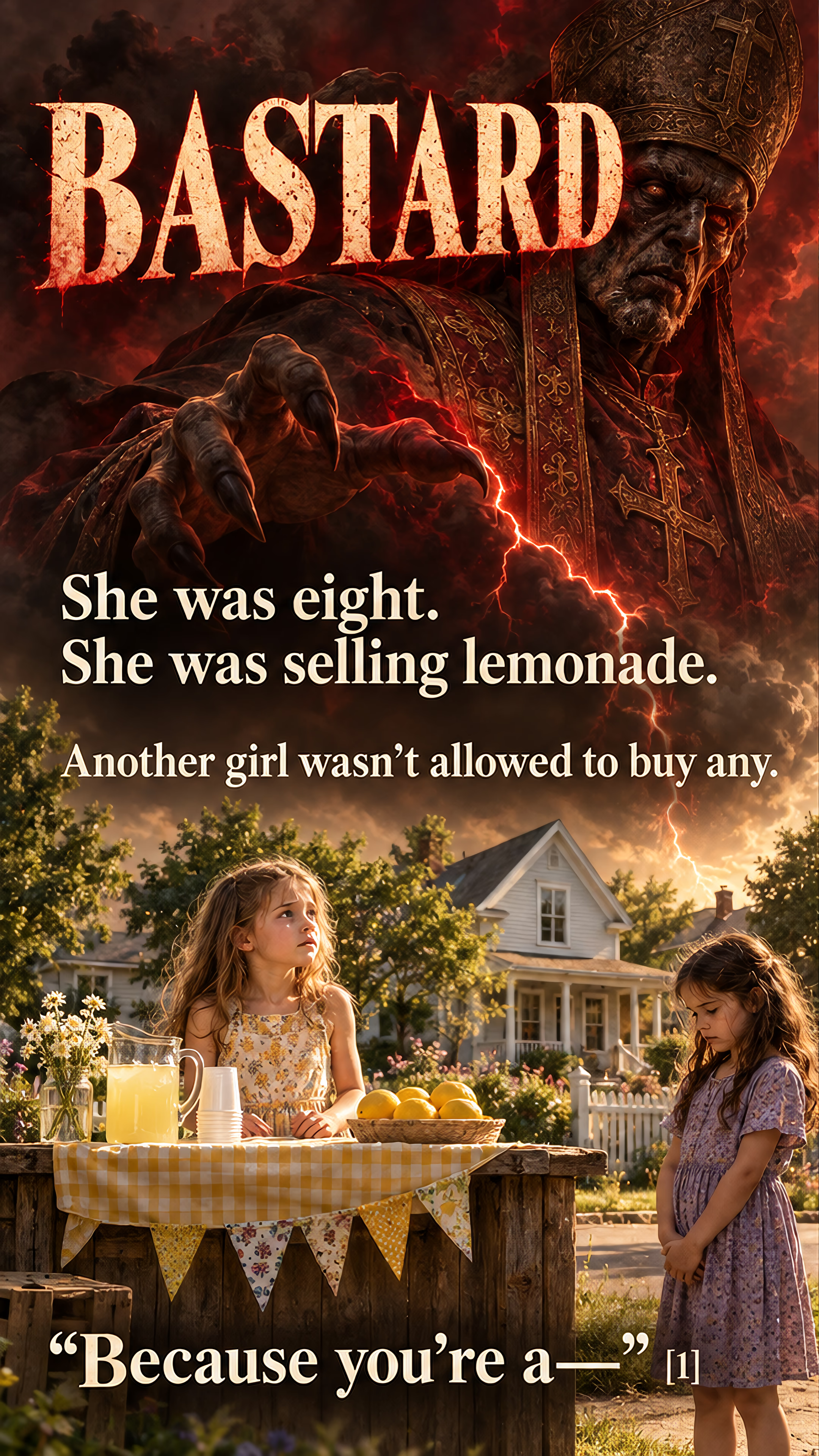
BASTARD
She was eight. She was selling lemonade. Another girl wasn’t allowed to buy any.
“Because you’re a—” [1]
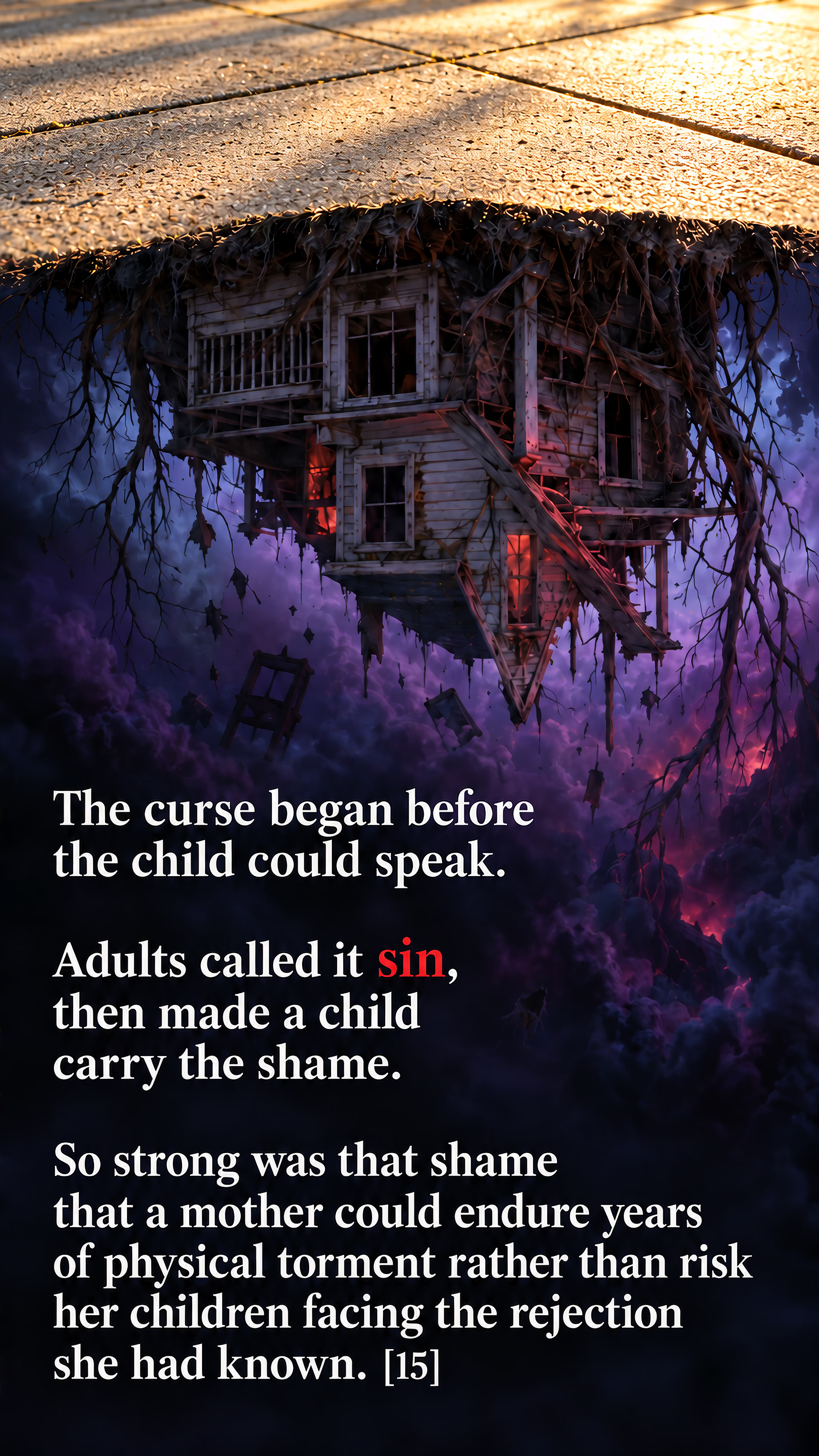
The curse began before the child could speak.
Adults called it sin, then made a child carry the shame.
So strong was that shame that a mother could endure years of physical torment rather than risk her children facing the rejection she had known. [15]
Visual Description
Two adjoining illustrated scenes. On the left, a girl tends a lemonade stand in front of a suburban house while another girl stands nearby. Their surroundings retain warm, ordinary daylight. Above them, an enormous red-brown demon wearing a bishoplike mitre fills the sky; a red lightning crack cuts toward the scene below. The headline BASTARD dominates the top. On the right, the approved image begins with a close-up of sunlit pavement and sidewalk, with no house above ground. Beneath the pavement, an inverted, decaying house hangs into a blue-purple shadow world with red highlights. Cream text descends through the darkness, with sin emphasized in red. The demon and buried house depict inherited stigma intruding on an apparently peaceful childhood.
Page 2
Transcript
BASTARD
She was eight. She was selling lemonade. Another girl wasn’t allowed to buy any.
“Because you’re a—” [1]
The curse began before the child could speak.
Adults called it sin, then made a child carry the shame.
So strong was that shame that a mother could endure years of physical torment rather than risk her children facing the rejection she had known. [15]
Visual Description
Two adjoining illustrated scenes. On the left, a girl tends a lemonade stand in front of a suburban house while another girl stands nearby. Their surroundings retain warm, ordinary daylight. Above them, an enormous red-brown demon wearing a bishoplike mitre fills the sky; a red lightning crack cuts toward the scene below. The headline BASTARD dominates the top. On the right, the approved image begins with a close-up of sunlit pavement and sidewalk, with no house above ground. Beneath the pavement, an inverted, decaying house hangs into a blue-purple shadow world with red highlights. Cream text descends through the darkness, with sin emphasized in red. The demon and buried house depict inherited stigma intruding on an apparently peaceful childhood.
Page 3
Transcript
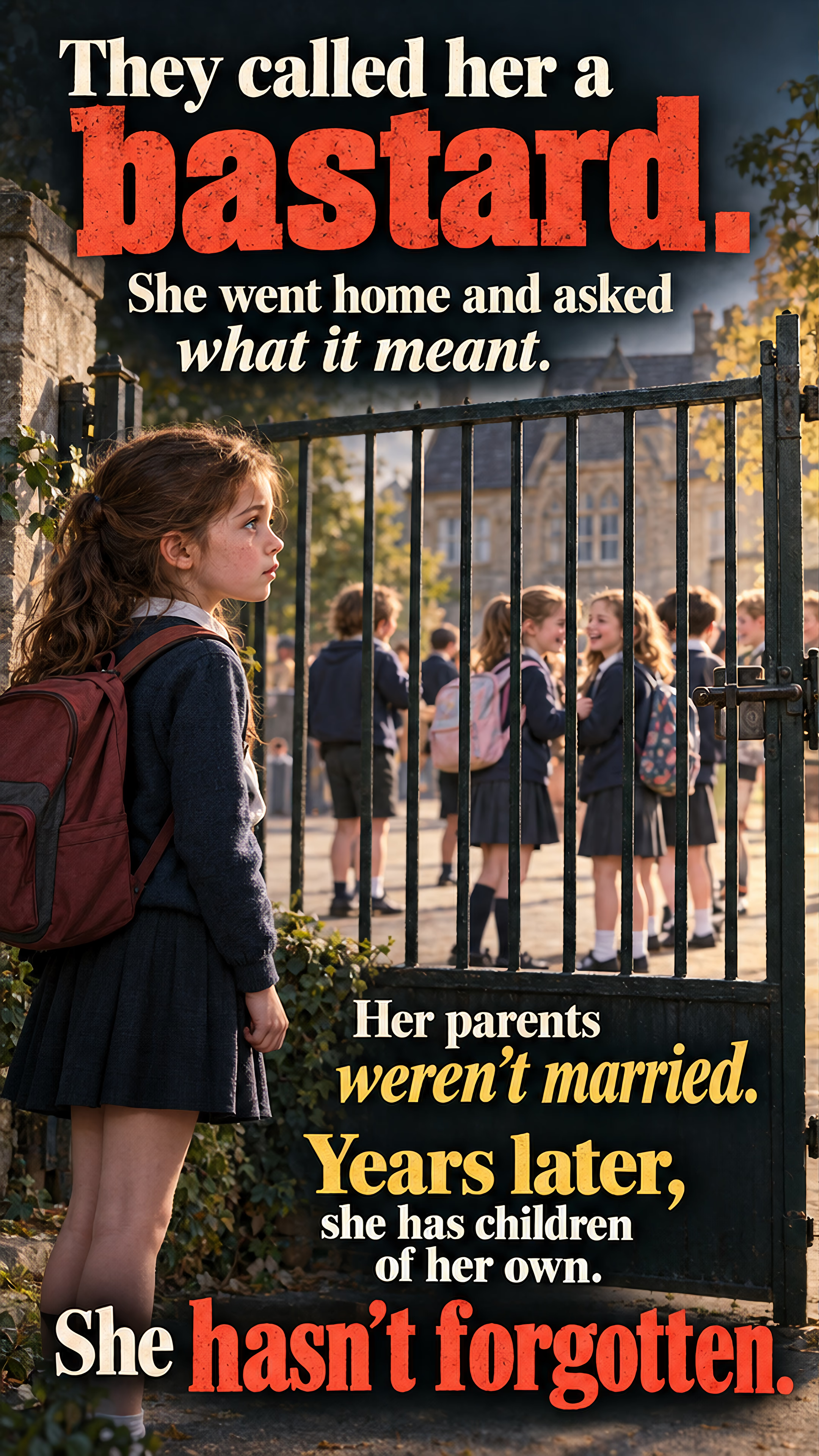
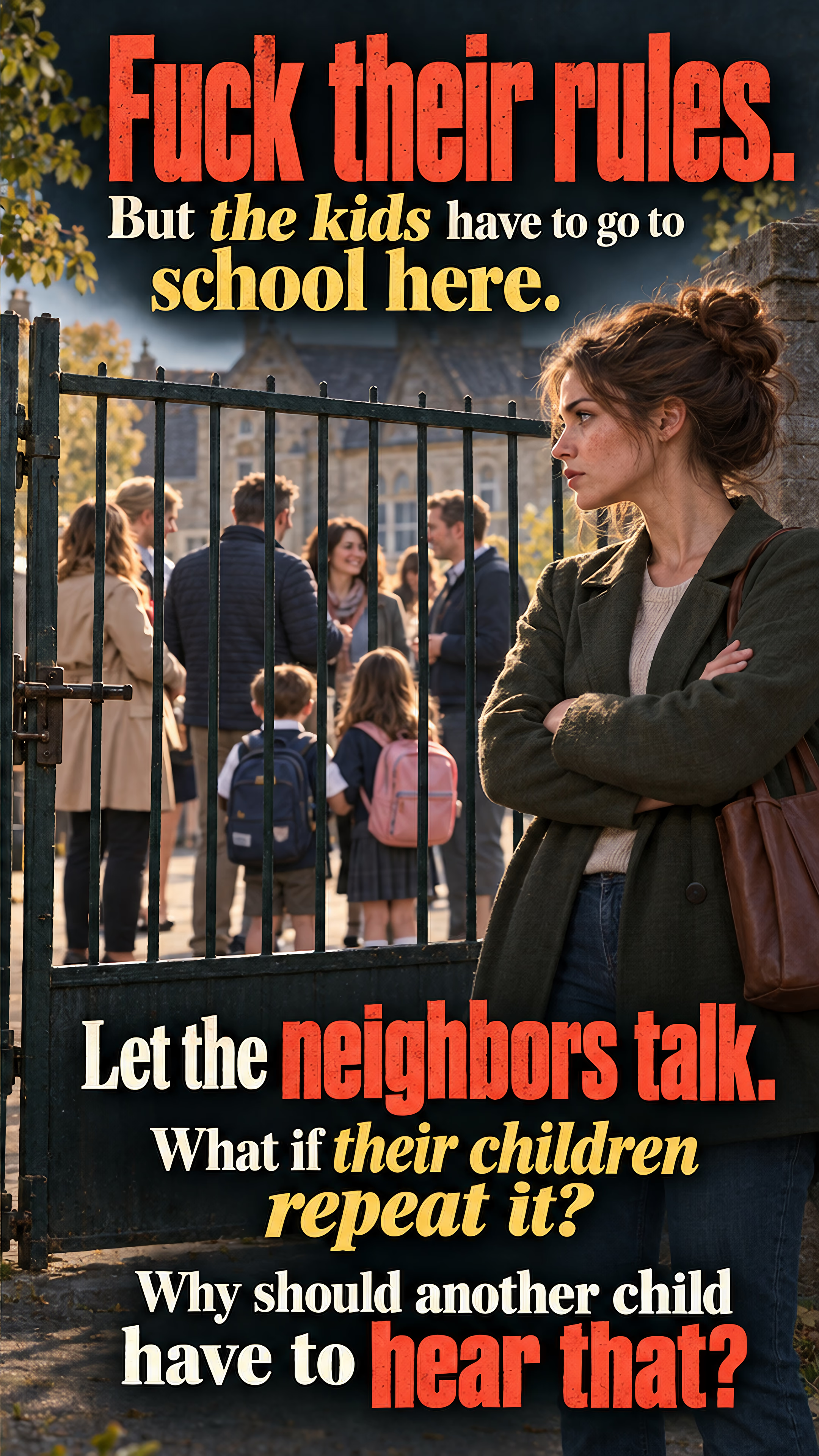
They called her a bastard. She went home and asked what it meant.
Her parents weren’t married. Years later, she has children of her own.
She hasn’t forgotten.
Fuck their rules. But the kids have to go to school here.
Let the neighbors talk. What if their children repeat it? Why should another child have to hear that?
Visual Description
A closed black iron school gate anchors both scenes. At left, a girl with a red backpack stands outside, looking right through the bars at a group of children. At right, a woman with a shoulder bag stands outside the same gate, facing left with her arms crossed. Mostly adults, with two children, gather beyond it. The repeated gate connects childhood rejection with an adult's concern for the next generation. Large red words alternate with cream and yellow type of different sizes. The adult's defiant statements sit beside smaller questions about the consequences for her children. These are illustrative scenes, not documentary photographs.
Page 4
Transcript
They called her a bastard. She went home and asked what it meant.
Her parents weren’t married. Years later, she has children of her own.
She hasn’t forgotten.
Fuck their rules. But the kids have to go to school here.
Let the neighbors talk. What if their children repeat it? Why should another child have to hear that?
Visual Description
A closed black iron school gate anchors both scenes. At left, a girl with a red backpack stands outside, looking right through the bars at a group of children. At right, a woman with a shoulder bag stands outside the same gate, facing left with her arms crossed. Mostly adults, with two children, gather beyond it. The repeated gate connects childhood rejection with an adult's concern for the next generation. Large red words alternate with cream and yellow type of different sizes. The adult's defiant statements sit beside smaller questions about the consequences for her children. These are illustrative scenes, not documentary photographs.
Page 5
Transcript
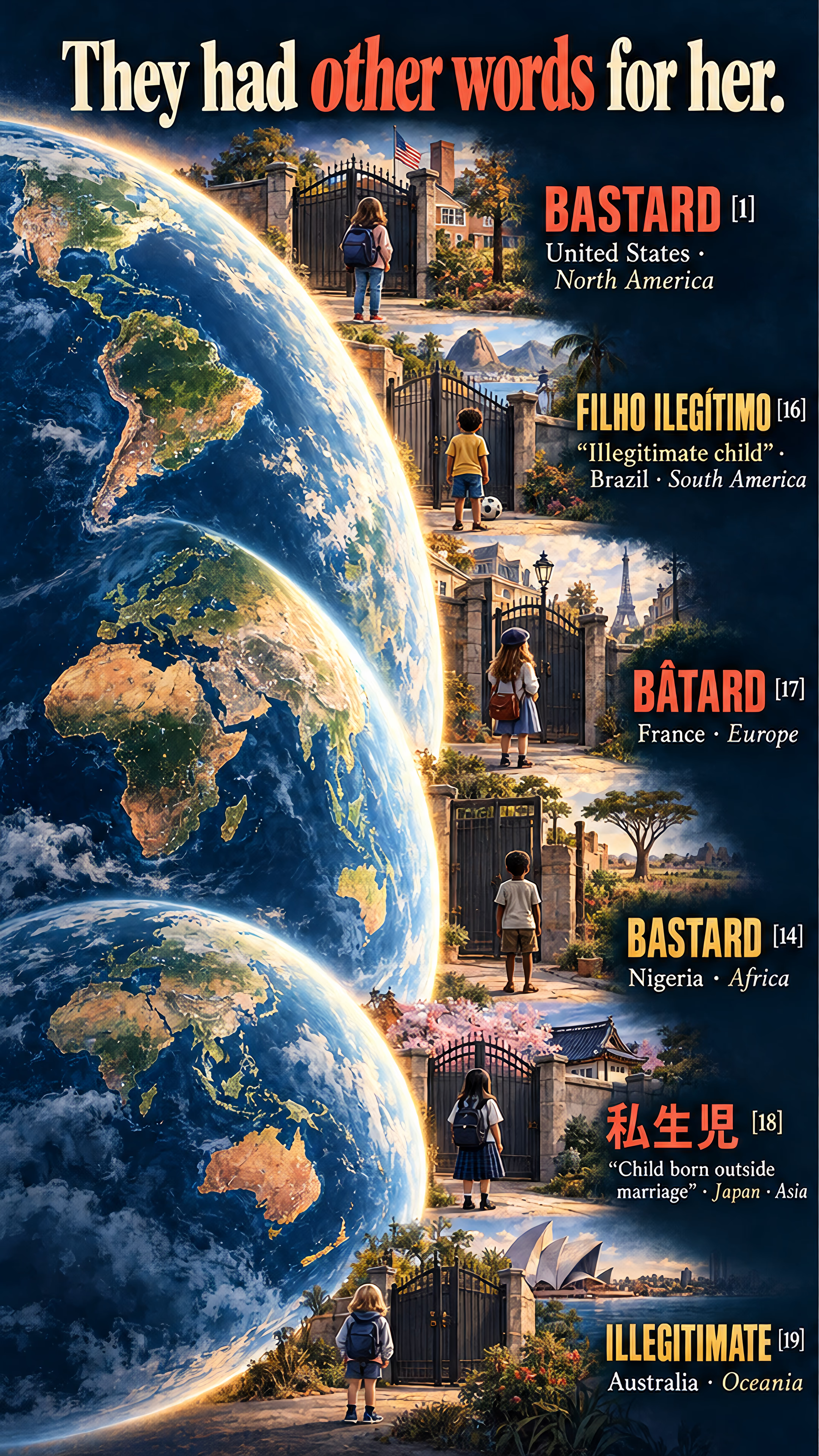
They had other words for her.
BASTARD [1] United States · North America
FILHO ILEGÍTIMO [16] “Illegitimate child” · Brazil · South America
BÂTARD [17] France · Europe
BASTARD [14] Nigeria · Africa
私生児 [18] “Child born outside marriage” · Japan · Asia
ILLEGITIMATE [19] Australia · Oceania
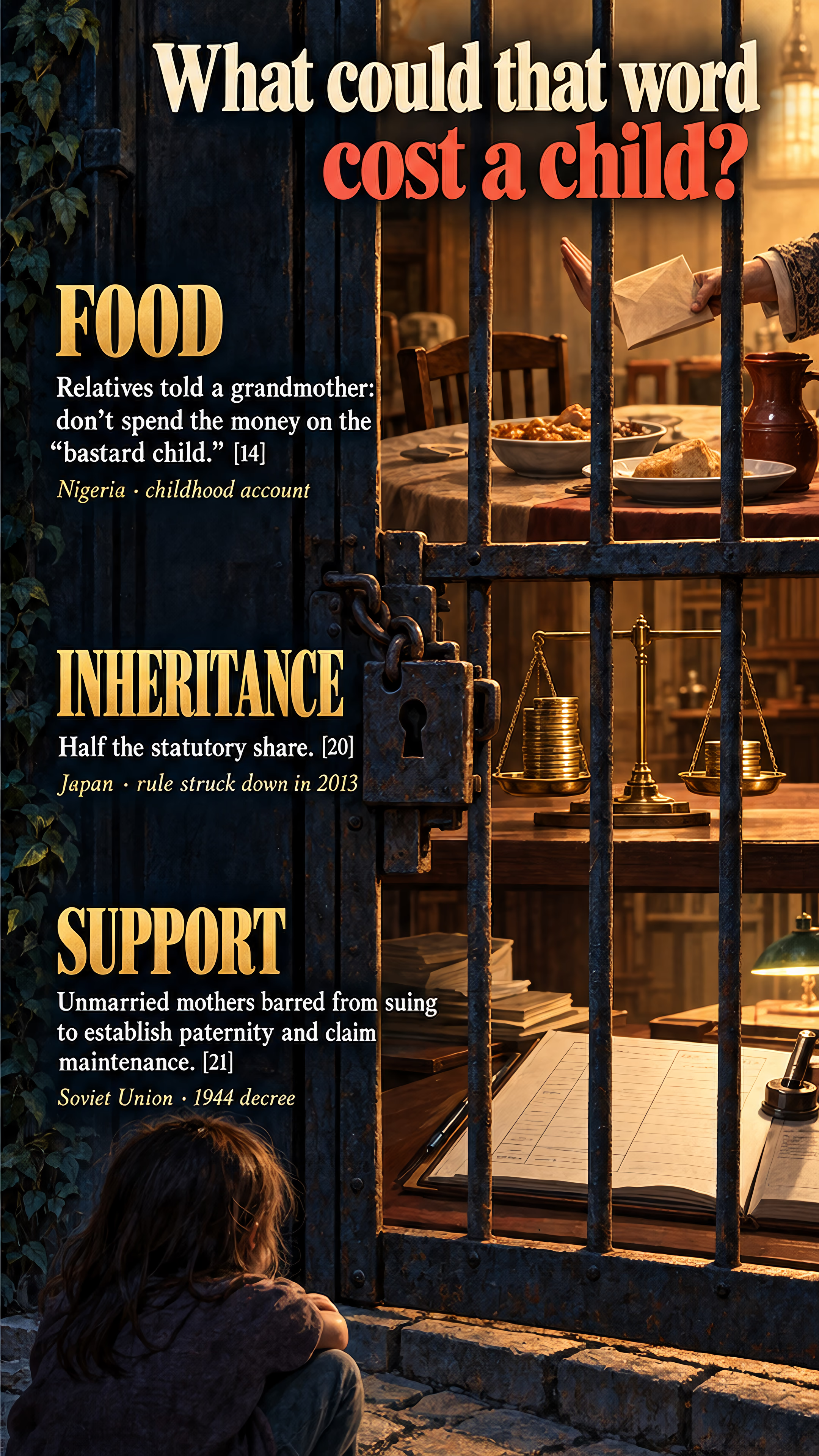
What could that word cost a child?
FOOD Relatives told a grandmother: don’t spend the money on the “bastard child.” [14] Nigeria · childhood account
INHERITANCE Half the statutory share. [20] Japan · rule struck down in 2013
SUPPORT Unmarried mothers barred from suing to establish paternity and claim maintenance. [21] Soviet Union · 1944 decree
Visual Description
On the left, overlapping curves of the Earth form a vertical sweep. Six small gate scenes follow the globe's right edge, each placing a child outside a closed entrance. Country labels and architecture identify the United States, Brazil, France, Nigeria, Japan, and Australia. On the right, a close-up of a chained, padlocked iron gate fills the frame. A child crouches outside at the bottom. Behind the bars are a warmly lit table with food, a hand holding an envelope, balance scales with unequal stacks of coins, and an open ledger beside a pen. Yellow headings distinguish FOOD, INHERITANCE, and SUPPORT. These are selected examples across six continents, rather than a claim that all cultures used identical rules or treated children identically.
Page 6
Transcript
They had other words for her.
BASTARD [1] United States · North America
FILHO ILEGÍTIMO [16] “Illegitimate child” · Brazil · South America
BÂTARD [17] France · Europe
BASTARD [14] Nigeria · Africa
私生児 [18] “Child born outside marriage” · Japan · Asia
ILLEGITIMATE [19] Australia · Oceania
What could that word cost a child?
FOOD Relatives told a grandmother: don’t spend the money on the “bastard child.” [14] Nigeria · childhood account
INHERITANCE Half the statutory share. [20] Japan · rule struck down in 2013
SUPPORT Unmarried mothers barred from suing to establish paternity and claim maintenance. [21] Soviet Union · 1944 decree
Visual Description
On the left, overlapping curves of the Earth form a vertical sweep. Six small gate scenes follow the globe's right edge, each placing a child outside a closed entrance. Country labels and architecture identify the United States, Brazil, France, Nigeria, Japan, and Australia. On the right, a close-up of a chained, padlocked iron gate fills the frame. A child crouches outside at the bottom. Behind the bars are a warmly lit table with food, a hand holding an envelope, balance scales with unequal stacks of coins, and an open ledger beside a pen. Yellow headings distinguish FOOD, INHERITANCE, and SUPPORT. These are selected examples across six continents, rather than a claim that all cultures used identical rules or treated children identically.
Page 7
Transcript
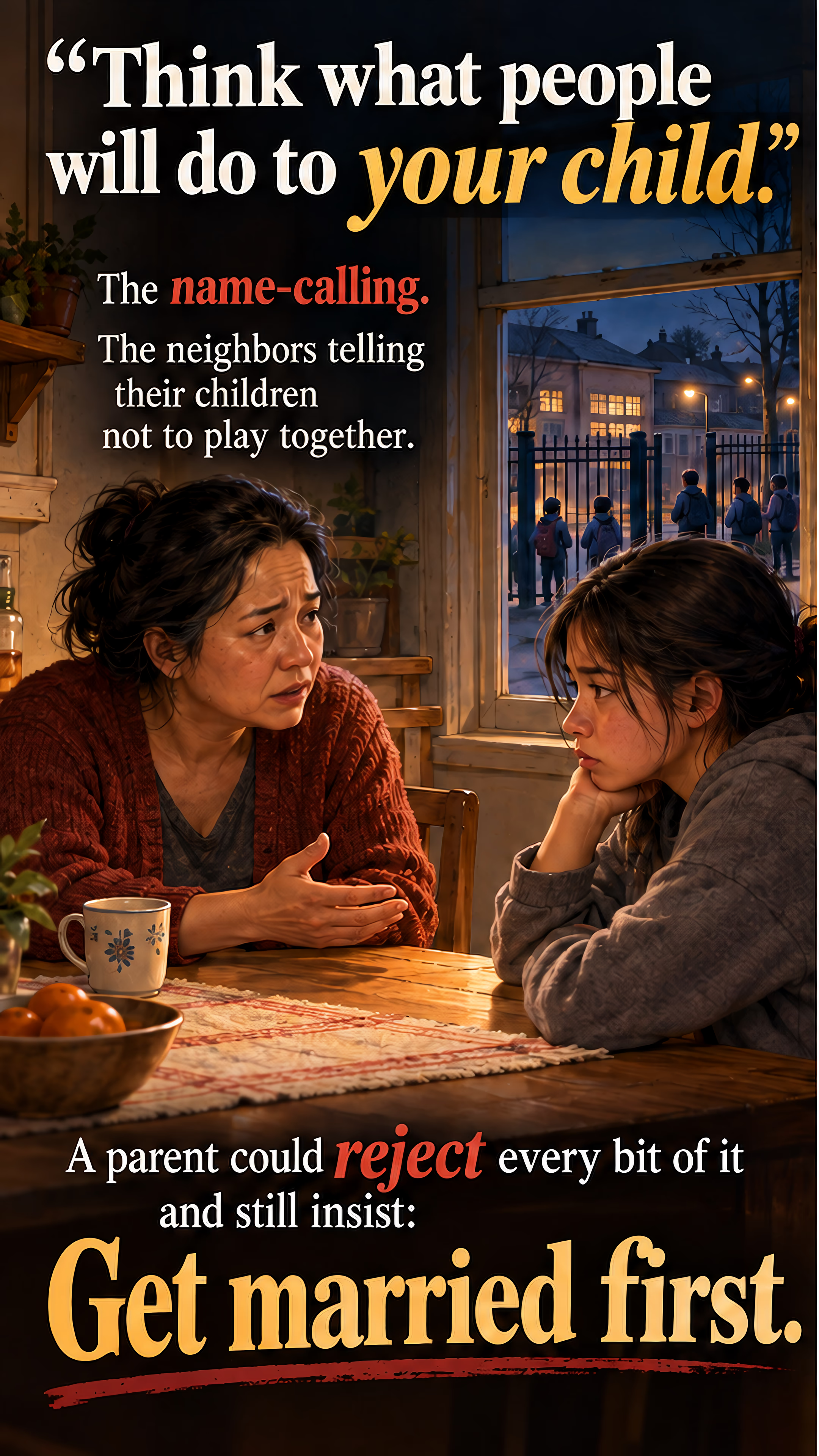
“Think what people will do to your child.”
The name-calling. The neighbors telling their children not to play together.
A parent could reject every bit of it and still insist: Get married first.
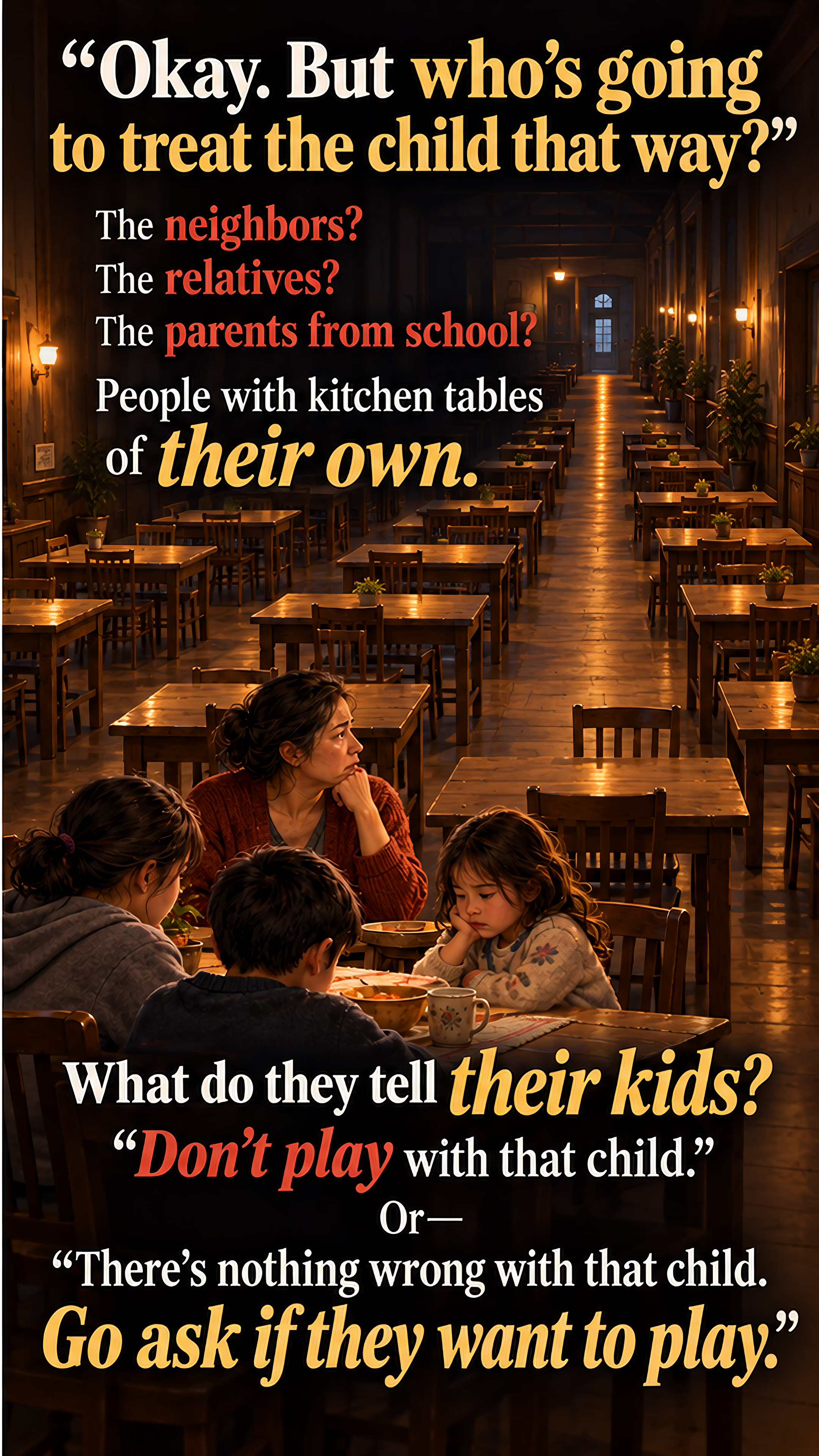
“Okay. But who’s going to treat the child that way?”
The neighbors? The relatives? The parents from school?
People with kitchen tables of their own.
What do they tell their kids? “Don’t play with that child.” Or— “There’s nothing wrong with that child. Go ask if they want to play.”
Visual Description
On the left, a mother gestures across a warmly lit kitchen table toward a daughter resting her head on her hand. A mug and fruit bowl sit between them, and a window looks toward a gate outside. The final instruction, Get married first, appears in large yellow type. On the right, a long hall stretches upward into the distance, lined with many empty wooden kitchen tables. Only the family at the nearest table is present. The composition widens the private conversation into a question about the households that create or refuse social punishment. Red type emphasizes exclusion; yellow type emphasizes the invitation to play.
Page 8
Transcript
“Think what people will do to your child.”
The name-calling. The neighbors telling their children not to play together.
A parent could reject every bit of it and still insist: Get married first.
“Okay. But who’s going to treat the child that way?”
The neighbors? The relatives? The parents from school?
People with kitchen tables of their own.
What do they tell their kids? “Don’t play with that child.” Or— “There’s nothing wrong with that child. Go ask if they want to play.”
Visual Description
On the left, a mother gestures across a warmly lit kitchen table toward a daughter resting her head on her hand. A mug and fruit bowl sit between them, and a window looks toward a gate outside. The final instruction, Get married first, appears in large yellow type. On the right, a long hall stretches upward into the distance, lined with many empty wooden kitchen tables. Only the family at the nearest table is present. The composition widens the private conversation into a question about the households that create or refuse social punishment. Red type emphasizes exclusion; yellow type emphasizes the invitation to play.
Page 9
Transcript
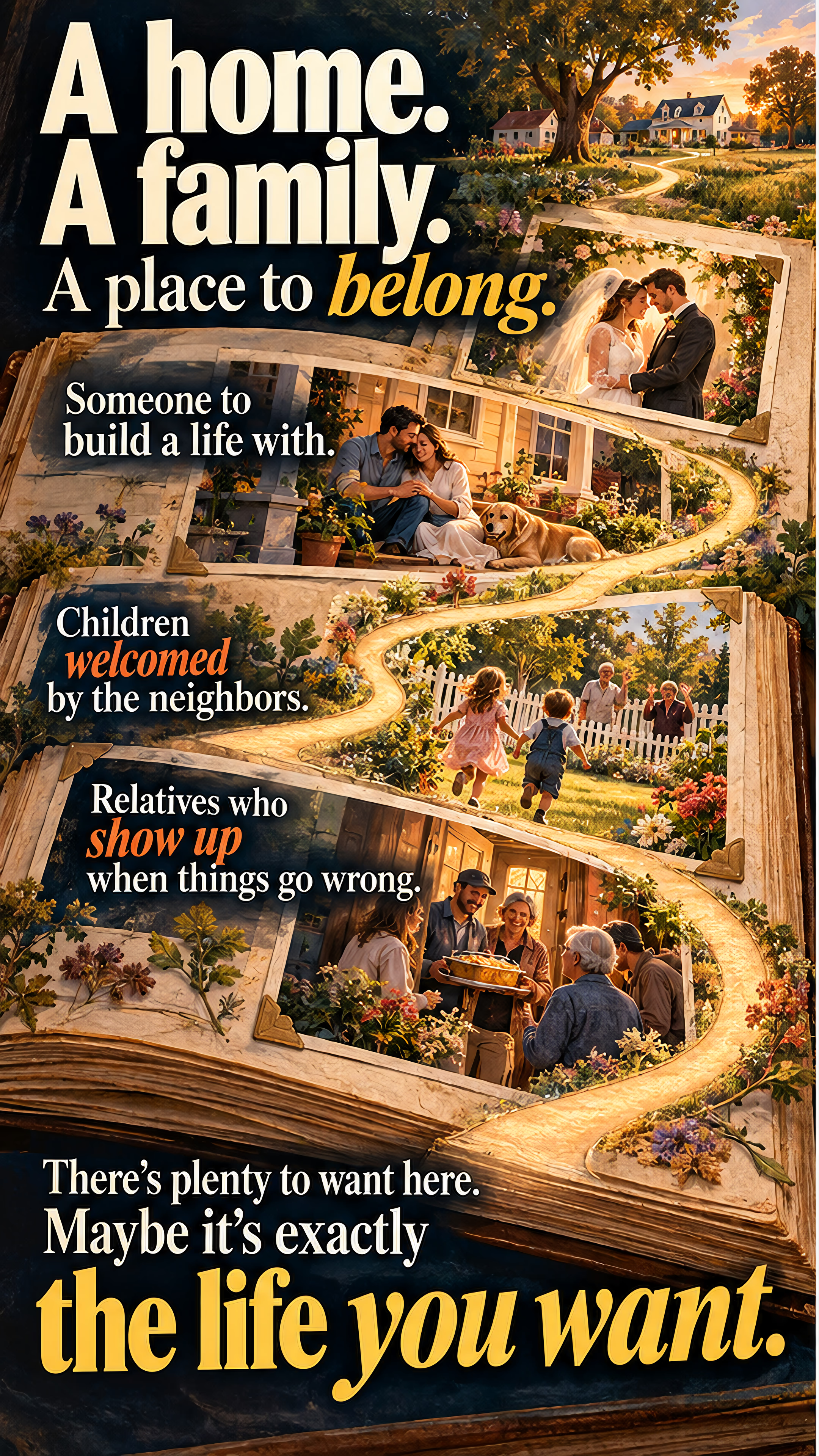
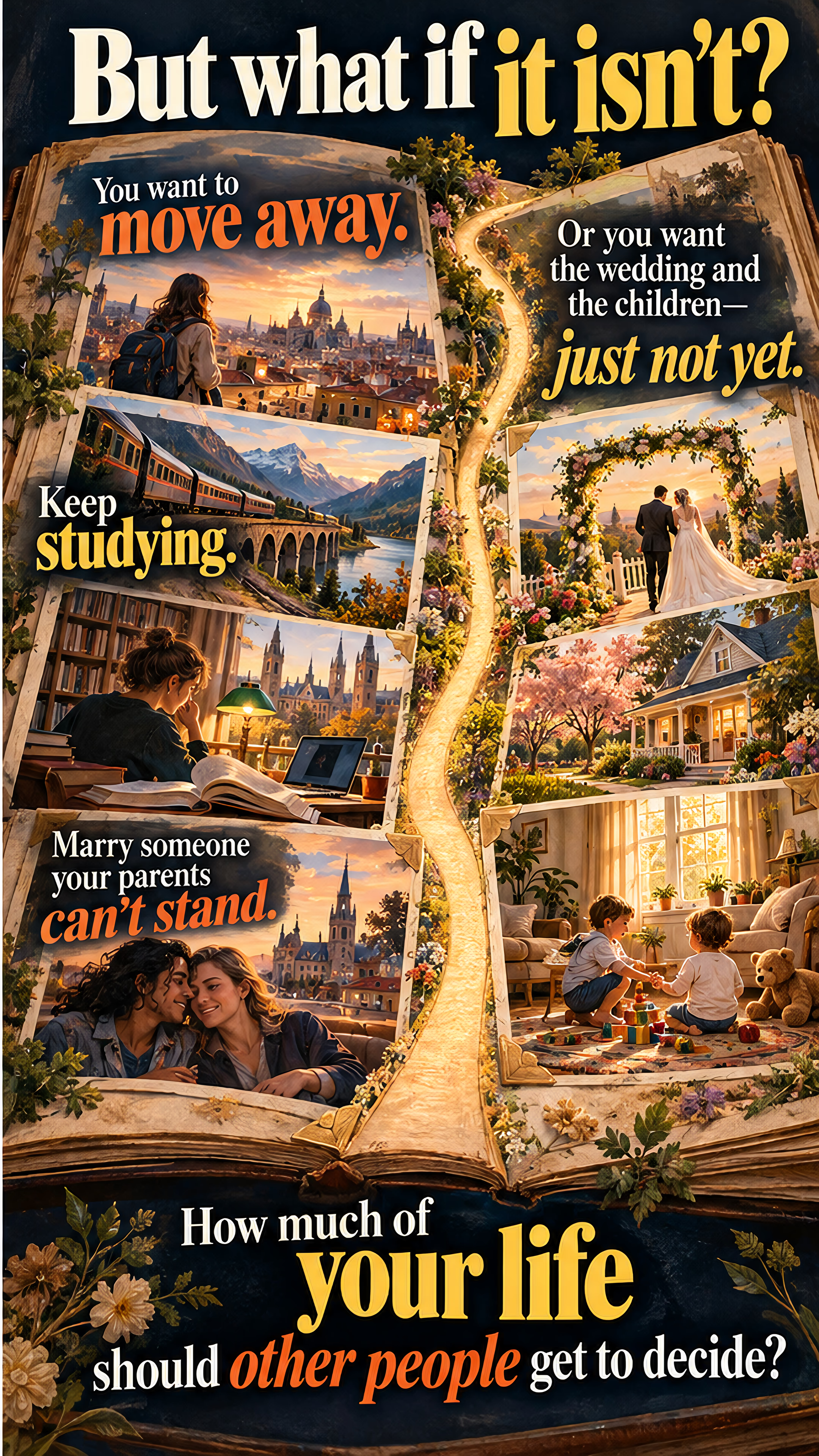
A home. A family. A place to belong.
Someone to build a life with.
Children welcomed by the neighbors.
Relatives who show up when things go wrong.
There’s plenty to want here. Maybe it’s exactly the life you want.
But what if it isn’t?
You want to move away.
Keep studying.
Marry someone your parents can’t stand.
Or you want the wedding and the children— just not yet.
How much of your life should other people get to decide?
Visual Description
An aged photo album lies open across the lower foreground. At left, a luminous golden path winds through photographs of a home, a wedding, a couple, children among neighbors, and relatives gathered around a table. At right, the route branches into two winding paths through different photographs: moving away, studying, choosing a partner, and having a wedding and children on another timetable. People appear within the photographs rather than standing outside the album. Cream, yellow, and orange-red text sits across the images. The album gives an appealing form to belonging while the branching routes introduce choices that may differ from a family's expectations.
Page 10
Transcript
A home. A family. A place to belong.
Someone to build a life with.
Children welcomed by the neighbors.
Relatives who show up when things go wrong.
There’s plenty to want here. Maybe it’s exactly the life you want.
But what if it isn’t?
You want to move away.
Keep studying.
Marry someone your parents can’t stand.
Or you want the wedding and the children— just not yet.
How much of your life should other people get to decide?
Visual Description
An aged photo album lies open across the lower foreground. At left, a luminous golden path winds through photographs of a home, a wedding, a couple, children among neighbors, and relatives gathered around a table. At right, the route branches into two winding paths through different photographs: moving away, studying, choosing a partner, and having a wedding and children on another timetable. People appear within the photographs rather than standing outside the album. Cream, yellow, and orange-red text sits across the images. The album gives an appealing form to belonging while the branching routes introduce choices that may differ from a family's expectations.
Page 11
Transcript
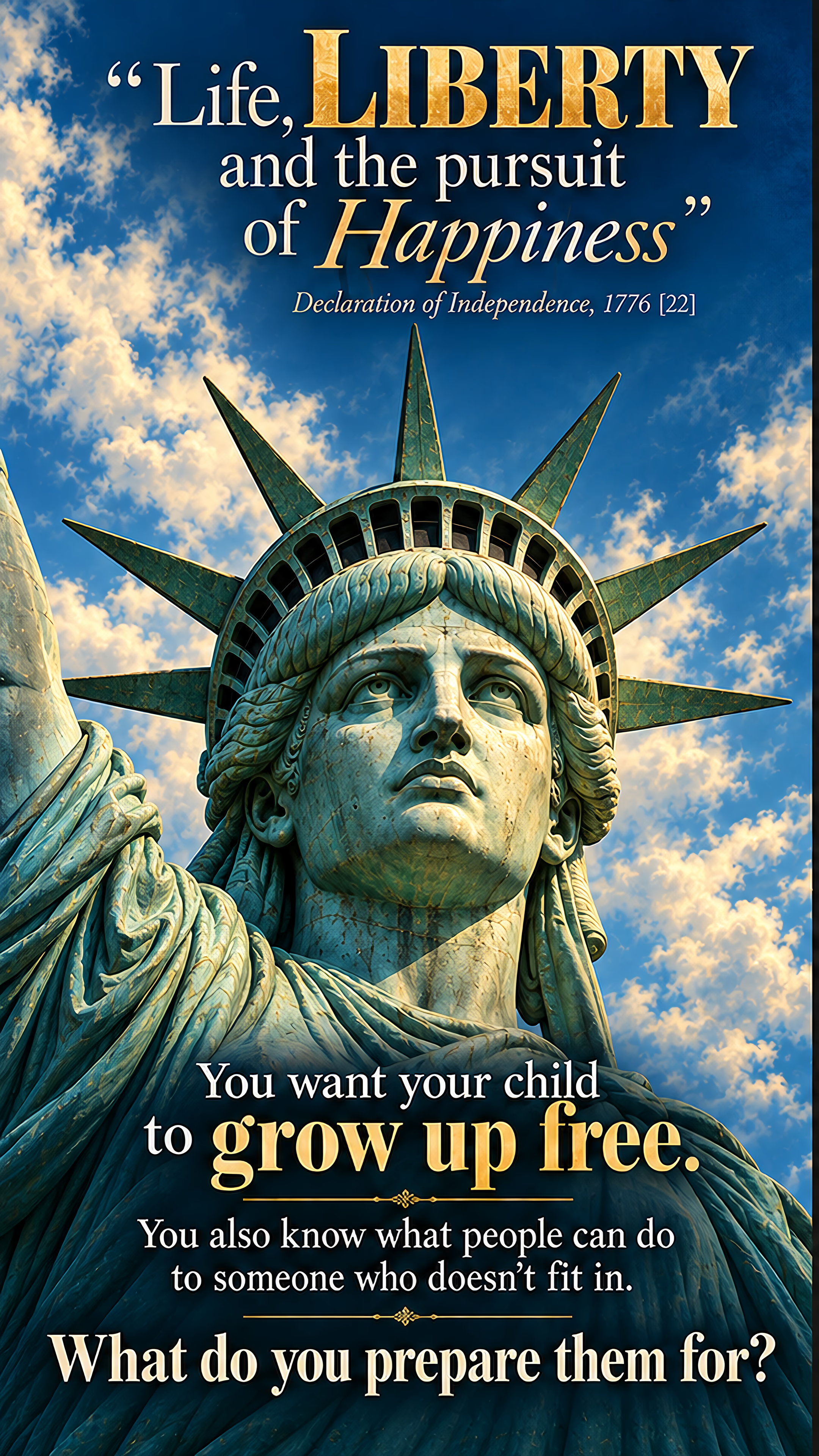
“Life, LIBERTY and the pursuit of Happiness” Declaration of Independence, 1776 [22]
You want your child to grow up free.
You also know what people can do to someone who doesn’t fit in.
What do you prepare them for?
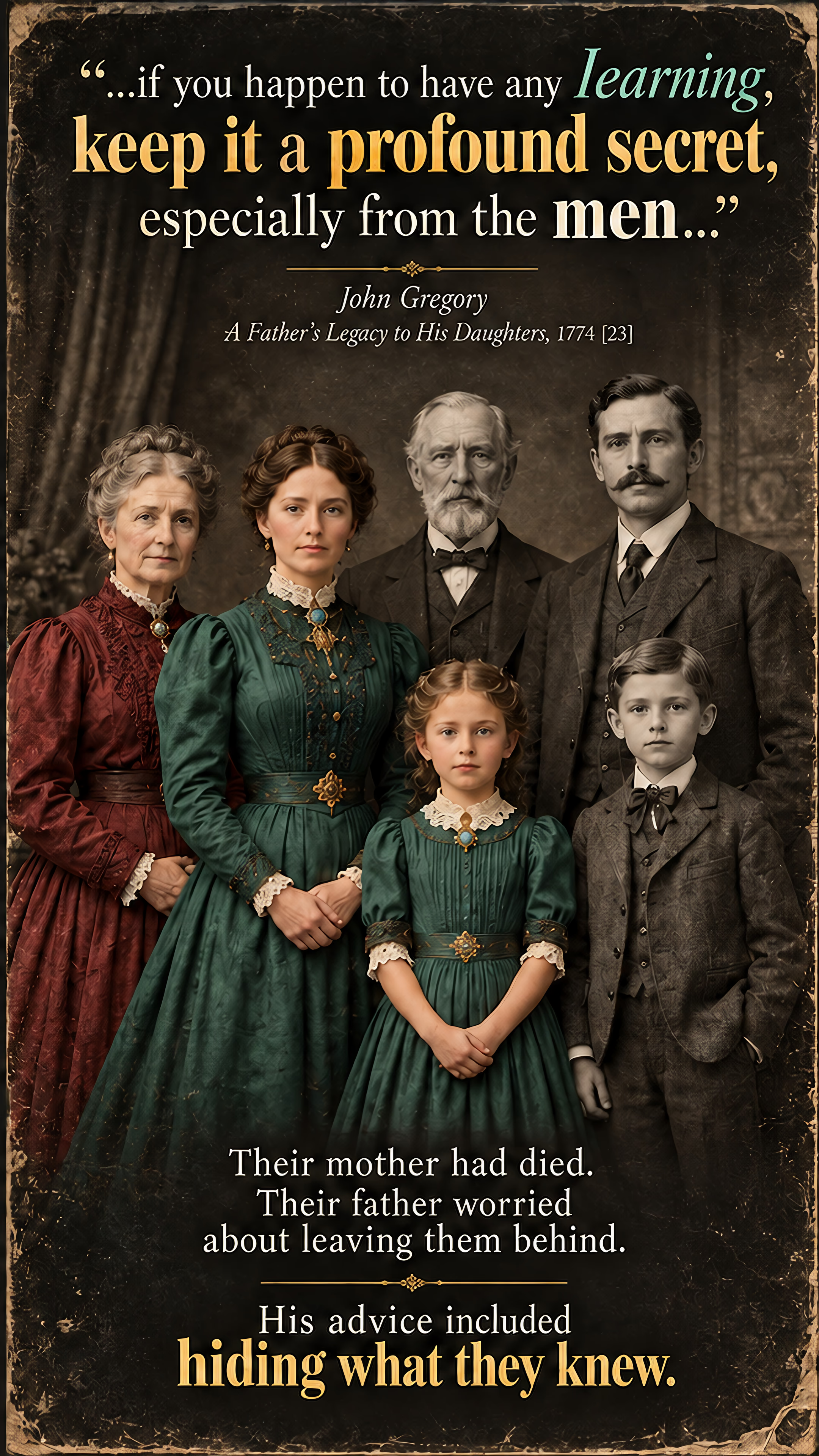
“...if you happen to have any learning, keep it a profound secret, especially from the men...”
John Gregory A Father’s Legacy to His Daughters, 1774 [23]
Their mother had died. Their father worried about leaving them behind.
His advice included hiding what they knew.
Visual Description
The Statue of Liberty fills the left scene in a low-angle close-up, with her entire spiked crown against a bright blue, clouded sky. Gold emphasis picks out LIBERTY and grow up free. On the right, an aged photographic frame holds six formally posed figures in period clothing. The women and girl wear muted red and green; the men and boy appear in grayscale. The portrait is an invented illustration, not a surviving photograph of John Gregory's family. A quotation above it advises concealing learning; text below connects that instruction with a father's fear for his daughters after their mother's death.
Page 12
Transcript
“Life, LIBERTY and the pursuit of Happiness” Declaration of Independence, 1776 [22]
You want your child to grow up free.
You also know what people can do to someone who doesn’t fit in.
What do you prepare them for?
“...if you happen to have any learning, keep it a profound secret, especially from the men...”
John Gregory A Father’s Legacy to His Daughters, 1774 [23]
Their mother had died. Their father worried about leaving them behind.
His advice included hiding what they knew.
Visual Description
The Statue of Liberty fills the left scene in a low-angle close-up, with her entire spiked crown against a bright blue, clouded sky. Gold emphasis picks out LIBERTY and grow up free. On the right, an aged photographic frame holds six formally posed figures in period clothing. The women and girl wear muted red and green; the men and boy appear in grayscale. The portrait is an invented illustration, not a surviving photograph of John Gregory's family. A quotation above it advises concealing learning; text below connects that instruction with a father's fear for his daughters after their mother's death.
Page 13
Transcript
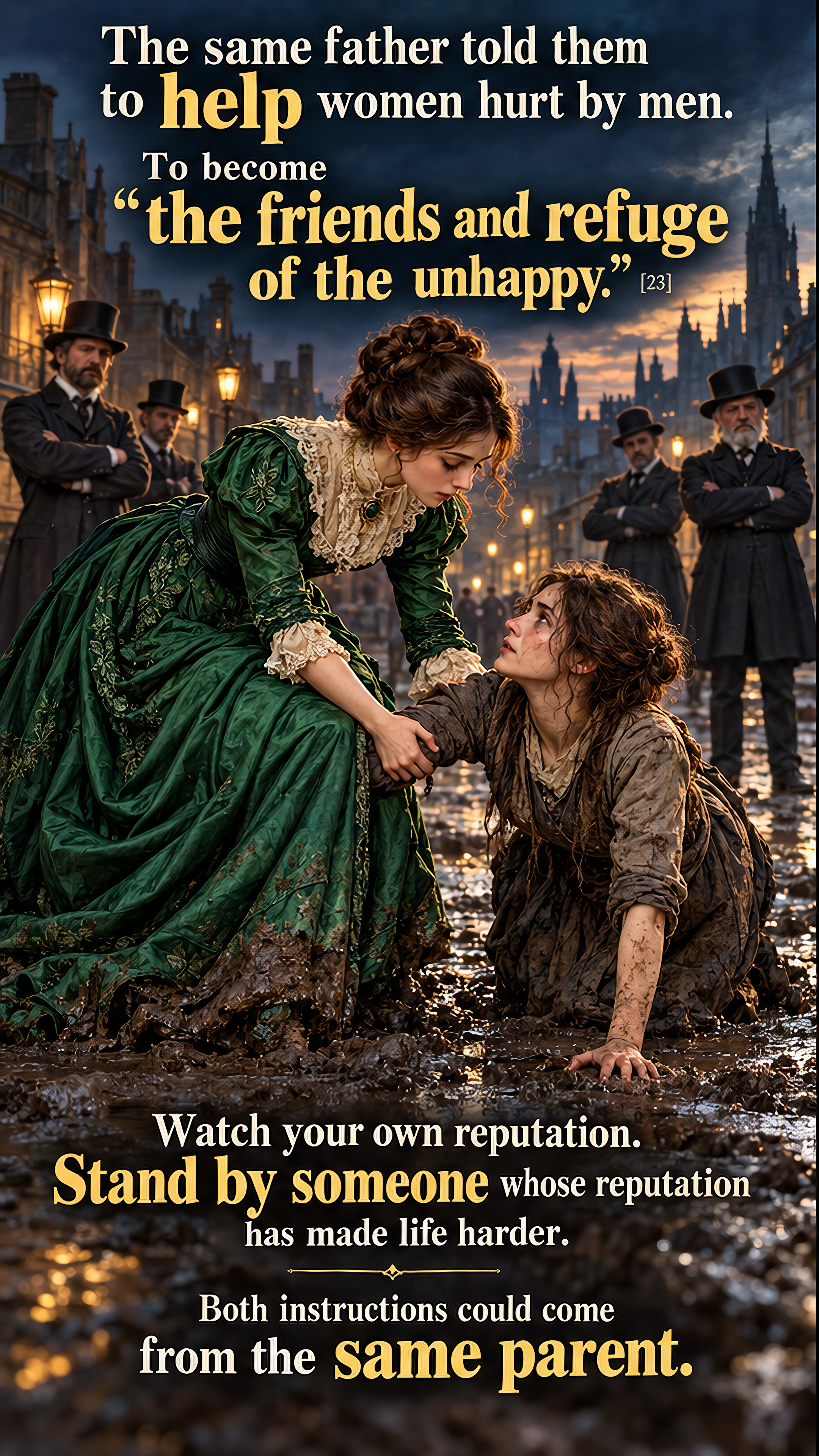
The same father told them to help women hurt by men.
To become “the friends and refuge of the unhappy.” [23]
Watch your own reputation. Stand by someone whose reputation has made life harder.
Both instructions could come from the same parent.
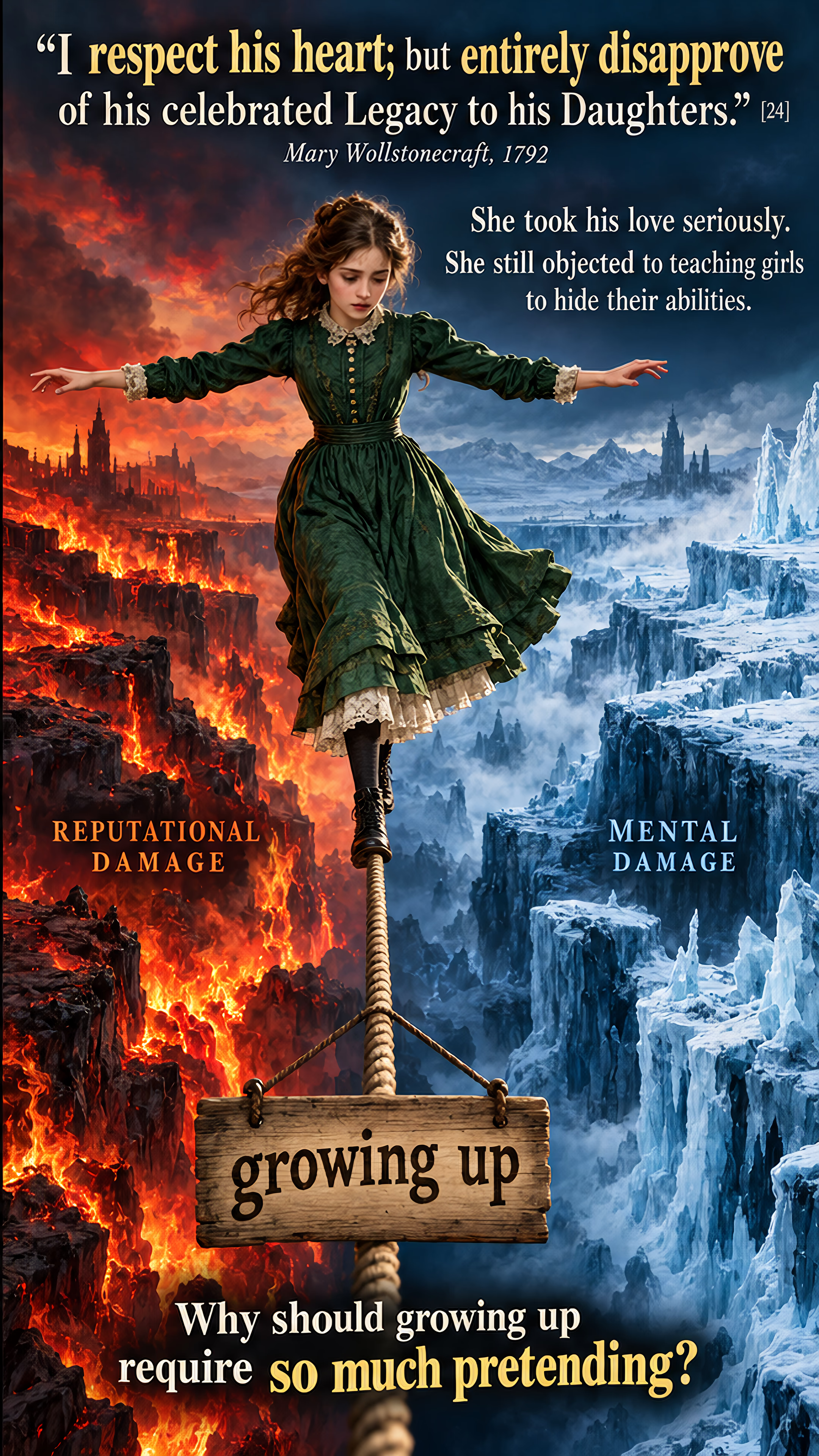
“I respect his heart; but entirely disapprove of his celebrated Legacy to his Daughters.” [24] Mary Wollstonecraft, 1792
She took his love seriously. She still objected to teaching girls to hide their abilities.
REPUTATIONAL DAMAGE MENTAL DAMAGE
growing up
Why should growing up require so much pretending?
Visual Description
On the left, a woman in a rich green Victorian-style dress bends to help a woman on her hands and knees in the mud. Several men stand at a distance with folded arms. A dim street and lamplight surround them. The scene visualizes care for someone facing public condemnation; its Victorian styling is metaphorical rather than a literal depiction of Gregory's eighteenth-century setting. On the right, a girl in a green dress balances on a tightrope with her arms extended. Fire and a burning landscape occupy the left, labeled REPUTATIONAL DAMAGE; blue ice and snowy cliffs occupy the right, labeled MENTAL DAMAGE. A wooden sign reading growing up hangs beneath the rope. Wollstonecraft's objection appears above the crossing.
Page 14
Transcript
The same father told them to help women hurt by men.
To become “the friends and refuge of the unhappy.” [23]
Watch your own reputation. Stand by someone whose reputation has made life harder.
Both instructions could come from the same parent.
“I respect his heart; but entirely disapprove of his celebrated Legacy to his Daughters.” [24] Mary Wollstonecraft, 1792
She took his love seriously. She still objected to teaching girls to hide their abilities.
REPUTATIONAL DAMAGE MENTAL DAMAGE
growing up
Why should growing up require so much pretending?
Visual Description
On the left, a woman in a rich green Victorian-style dress bends to help a woman on her hands and knees in the mud. Several men stand at a distance with folded arms. A dim street and lamplight surround them. The scene visualizes care for someone facing public condemnation; its Victorian styling is metaphorical rather than a literal depiction of Gregory's eighteenth-century setting. On the right, a girl in a green dress balances on a tightrope with her arms extended. Fire and a burning landscape occupy the left, labeled REPUTATIONAL DAMAGE; blue ice and snowy cliffs occupy the right, labeled MENTAL DAMAGE. A wooden sign reading growing up hangs beneath the rope. Wollstonecraft's objection appears above the crossing.
Page 15
Transcript
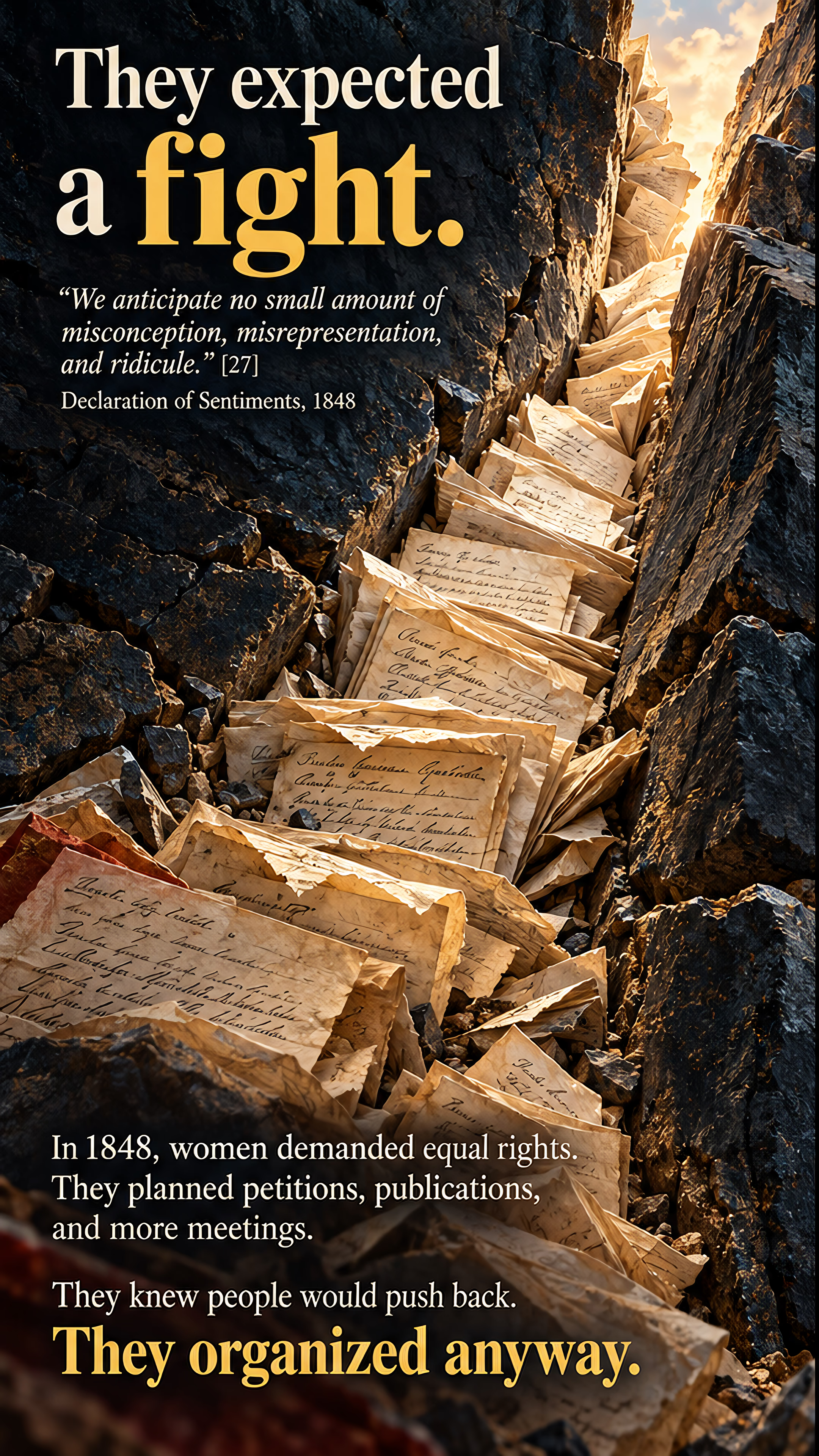
They expected a fight.
“We anticipate no small amount of misconception, misrepresentation, and ridicule.” [27] Declaration of Sentiments, 1848
In 1848, women demanded equal rights. They planned petitions, publications, and more meetings.
They knew people would push back. They organized anyway.
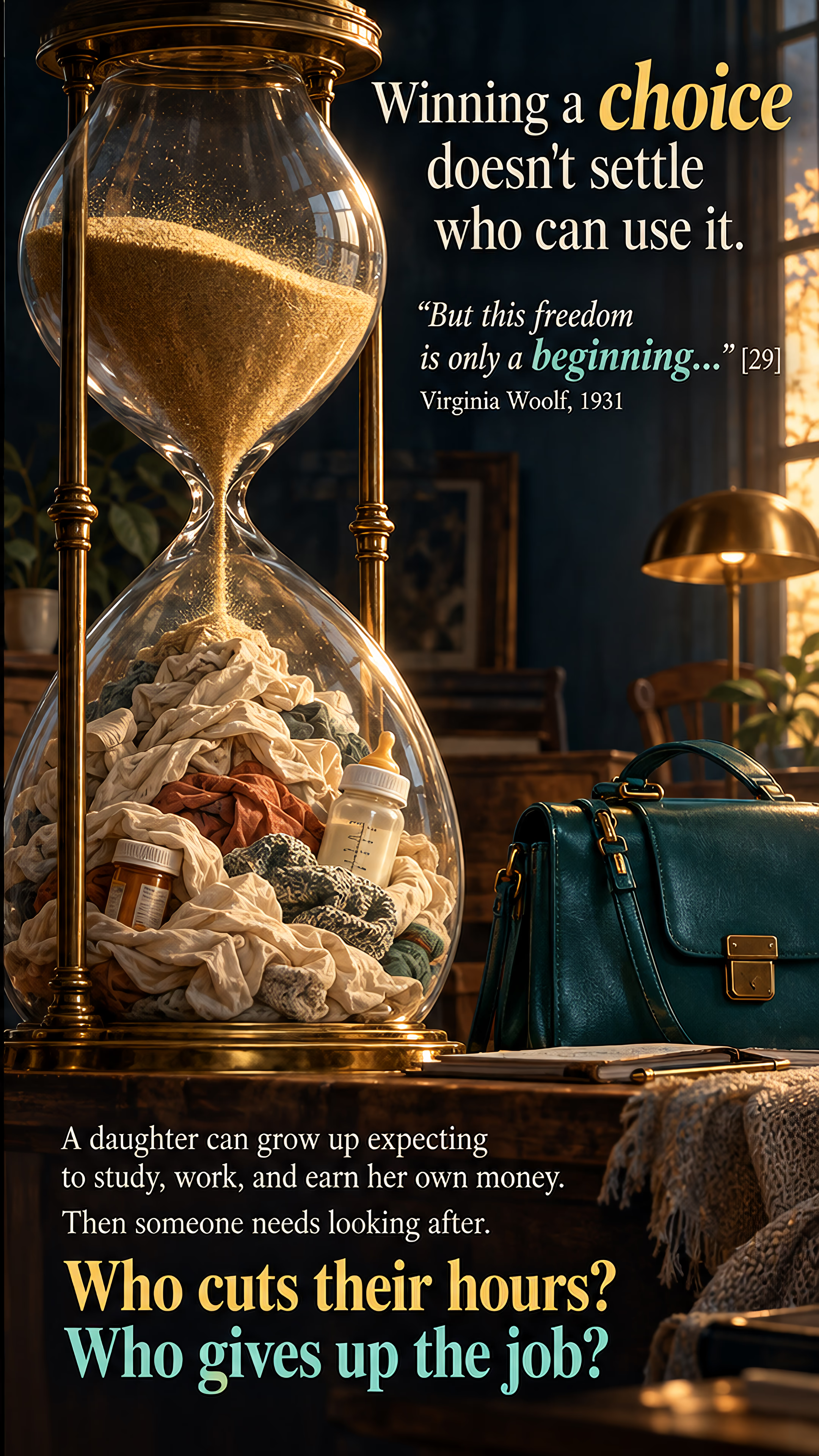
Winning a choice doesn’t settle who can use it.
“But this freedom is only a beginning...” [29] Virginia Woolf, 1931
A daughter can grow up expecting to study, work, and earn her own money.
Then someone needs looking after.
Who cuts their hours? Who gives up the job?
Visual Description
On the left, bundles of aged petitions and written pages form makeshift steps through a narrow, jagged rock passage toward daylight at the top. Large yellow words emphasize a fight and They organized anyway. On the right, a brass-framed hourglass stands on a desk. Sand fills its upper chamber, while crumpled laundry and small household or care-related objects crowd the lower chamber. A teal work bag sits nearby. The pairing moves from the labor of winning formal choices to the time and responsibilities that affect whether someone can exercise them. No people appear.
Page 16
Transcript
They expected a fight.
“We anticipate no small amount of misconception, misrepresentation, and ridicule.” [27] Declaration of Sentiments, 1848
In 1848, women demanded equal rights. They planned petitions, publications, and more meetings.
They knew people would push back. They organized anyway.
Winning a choice doesn’t settle who can use it.
“But this freedom is only a beginning...” [29] Virginia Woolf, 1931
A daughter can grow up expecting to study, work, and earn her own money.
Then someone needs looking after.
Who cuts their hours? Who gives up the job?
Visual Description
On the left, bundles of aged petitions and written pages form makeshift steps through a narrow, jagged rock passage toward daylight at the top. Large yellow words emphasize a fight and They organized anyway. On the right, a brass-framed hourglass stands on a desk. Sand fills its upper chamber, while crumpled laundry and small household or care-related objects crowd the lower chamber. A teal work bag sits nearby. The pairing moves from the labor of winning formal choices to the time and responsibilities that affect whether someone can exercise them. No people appear.
Page 17
Transcript
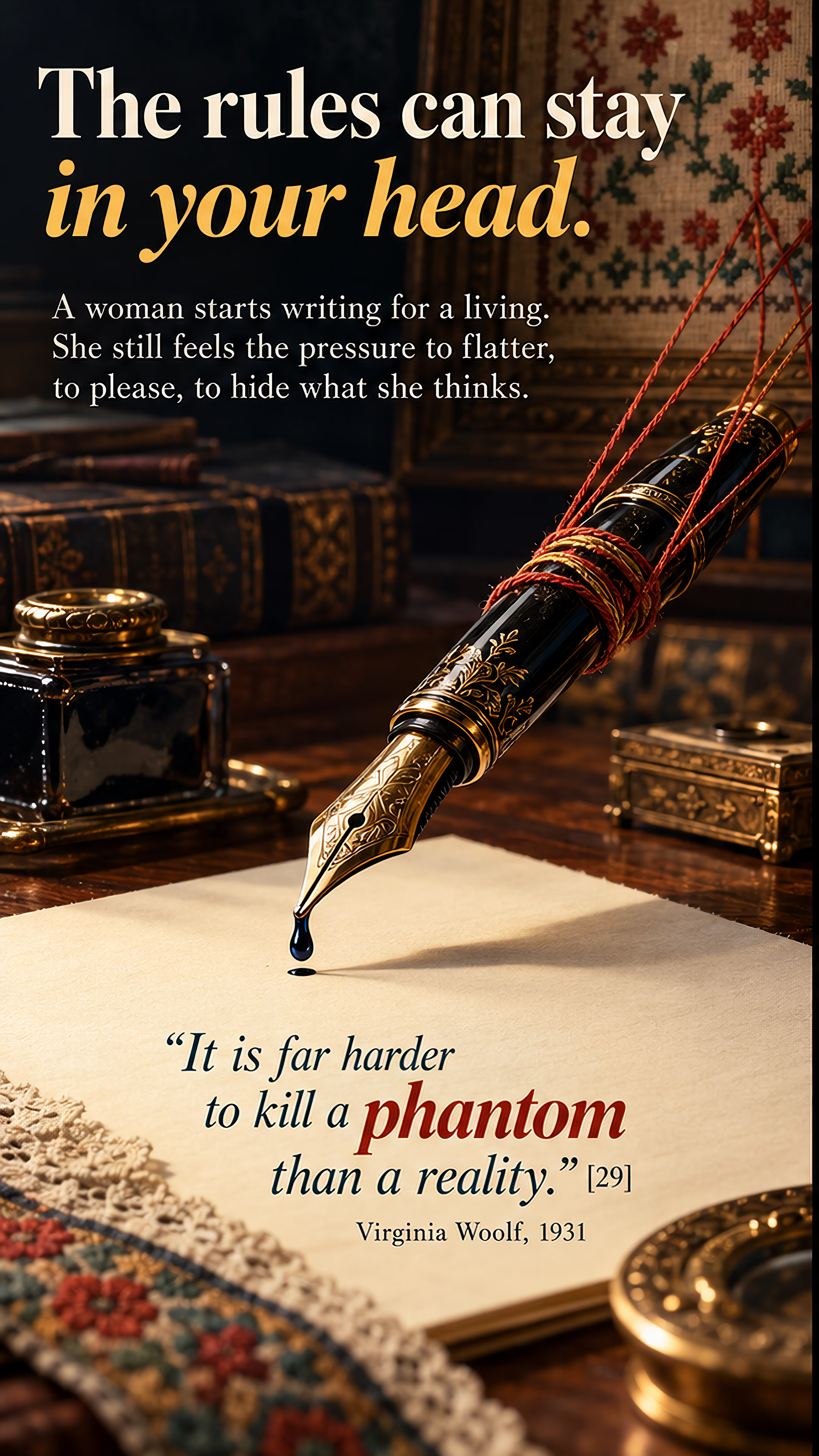
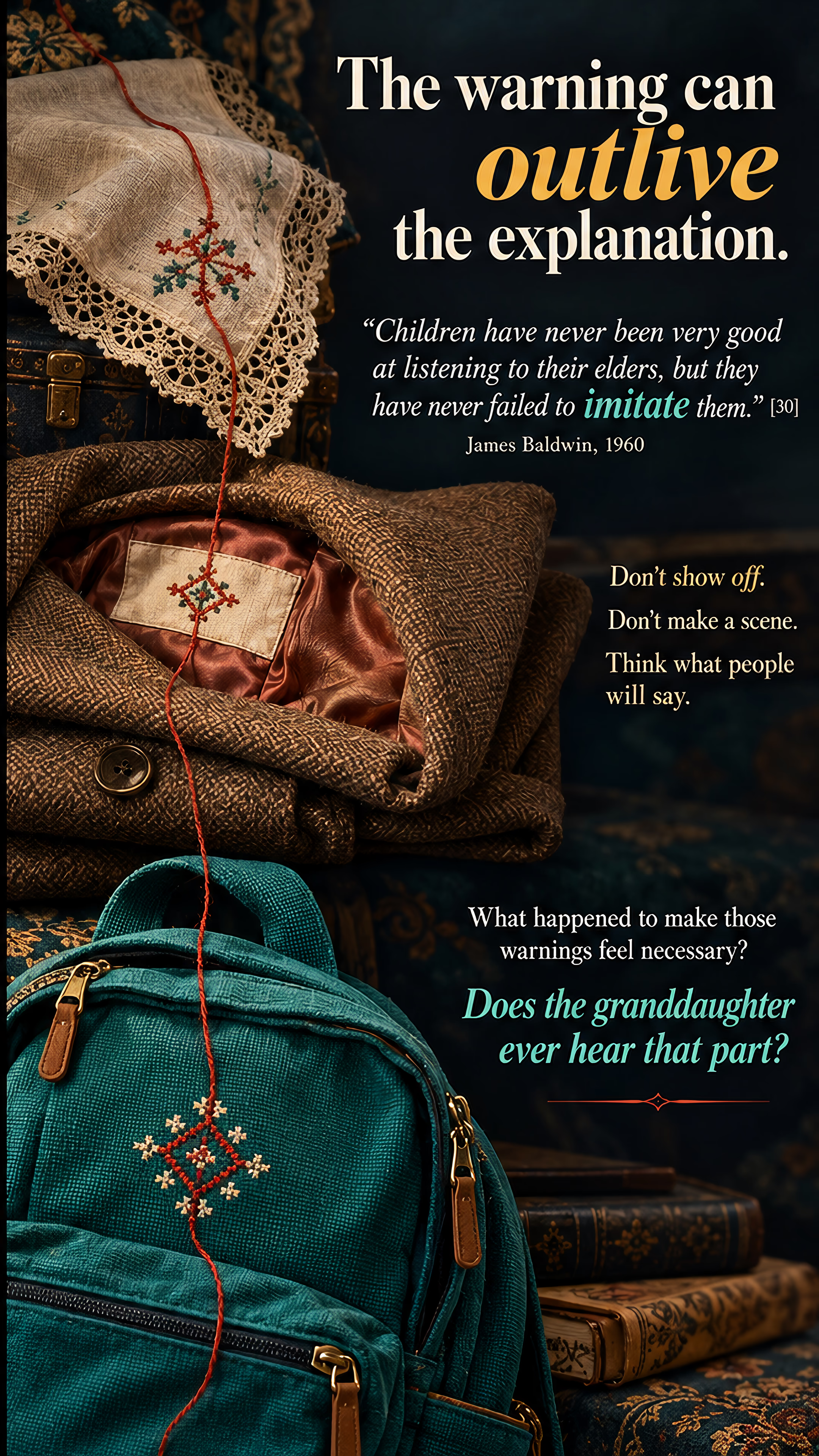
The rules can stay in your head.
A woman starts writing for a living. She still feels the pressure to flatter, to please, to hide what she thinks.
“It is far harder to kill a phantom than a reality.” [29] Virginia Woolf, 1931
The warning can outlive the explanation.
“Children have never been very good at listening to their elders, but they have never failed to imitate them.” [30] James Baldwin, 1960
Don’t show off. Don’t make a scene. Think what people will say.
What happened to make those warnings feel necessary?
Does the granddaughter ever hear that part?
Visual Description
On the left, red threads run from a framed embroidered sampler and bind a large black-and-gold fountain pen. Its nib hangs over a sheet of paper beside an ink bottle and old books. The threads make an internal restraint visible even though the writer has access to the tools of her work. On the right, matching embroidered motifs appear on an old white cloth, inside a brown coat, and on a modern teal backpack. A single red thread links the objects vertically. The recurring stitch suggests learned warnings surviving across generations after the experiences that produced them have faded from family conversation. Cream, gold, and teal type separates the headline, quotation, warnings, and questions.
Page 18
Transcript
The rules can stay in your head.
A woman starts writing for a living. She still feels the pressure to flatter, to please, to hide what she thinks.
“It is far harder to kill a phantom than a reality.” [29] Virginia Woolf, 1931
The warning can outlive the explanation.
“Children have never been very good at listening to their elders, but they have never failed to imitate them.” [30] James Baldwin, 1960
Don’t show off. Don’t make a scene. Think what people will say.
What happened to make those warnings feel necessary?
Does the granddaughter ever hear that part?
Visual Description
On the left, red threads run from a framed embroidered sampler and bind a large black-and-gold fountain pen. Its nib hangs over a sheet of paper beside an ink bottle and old books. The threads make an internal restraint visible even though the writer has access to the tools of her work. On the right, matching embroidered motifs appear on an old white cloth, inside a brown coat, and on a modern teal backpack. A single red thread links the objects vertically. The recurring stitch suggests learned warnings surviving across generations after the experiences that produced them have faded from family conversation. Cream, gold, and teal type separates the headline, quotation, warnings, and questions.
Page 19
Transcript
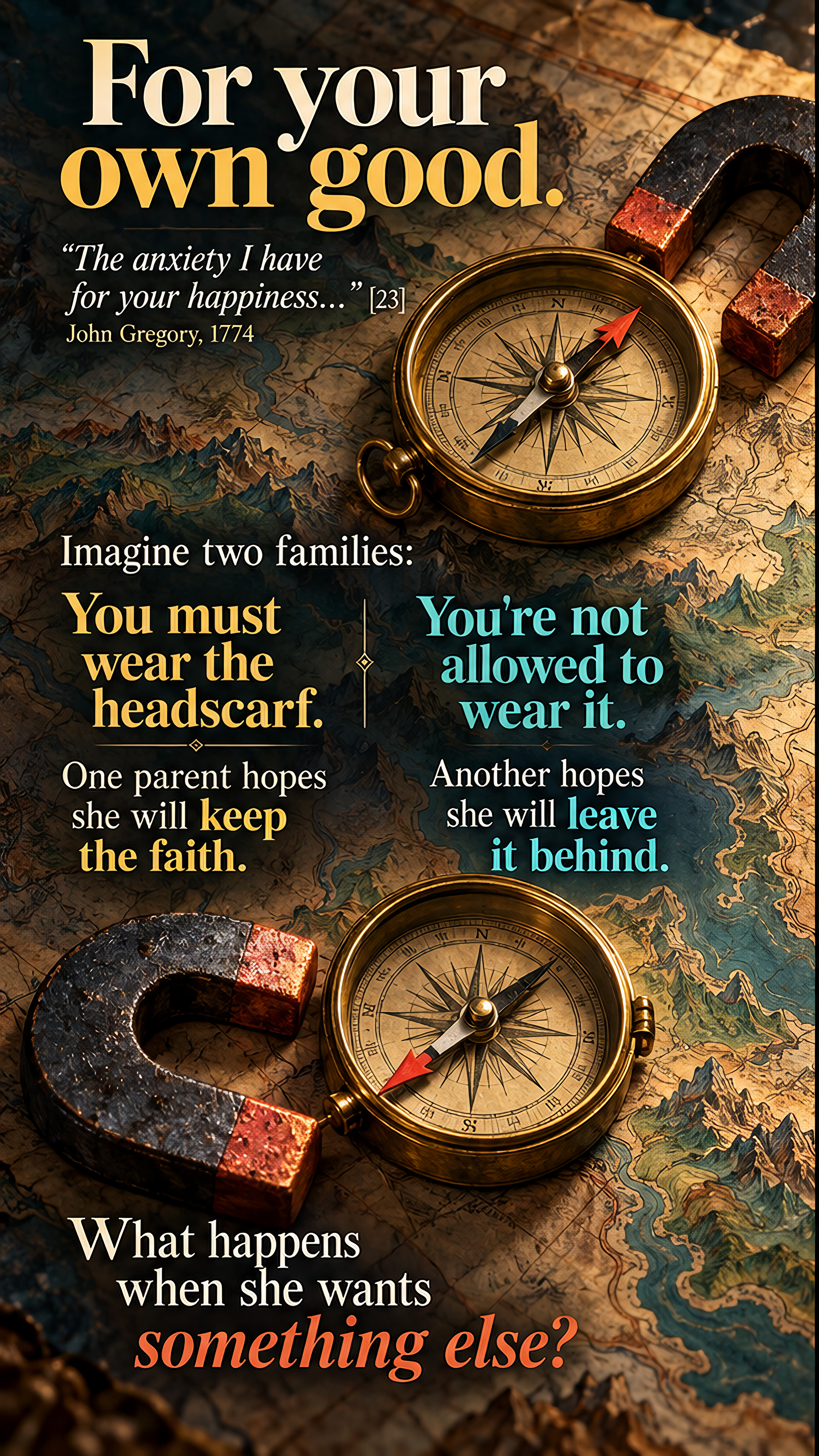
For your own good.
“The anxiety I have for your happiness...” [23] John Gregory, 1774
Imagine two families:
You must wear the headscarf.
One parent hopes she will keep the faith.
You’re not allowed to wear it.
Another hopes she will leave it behind.
What happens when she wants something else?
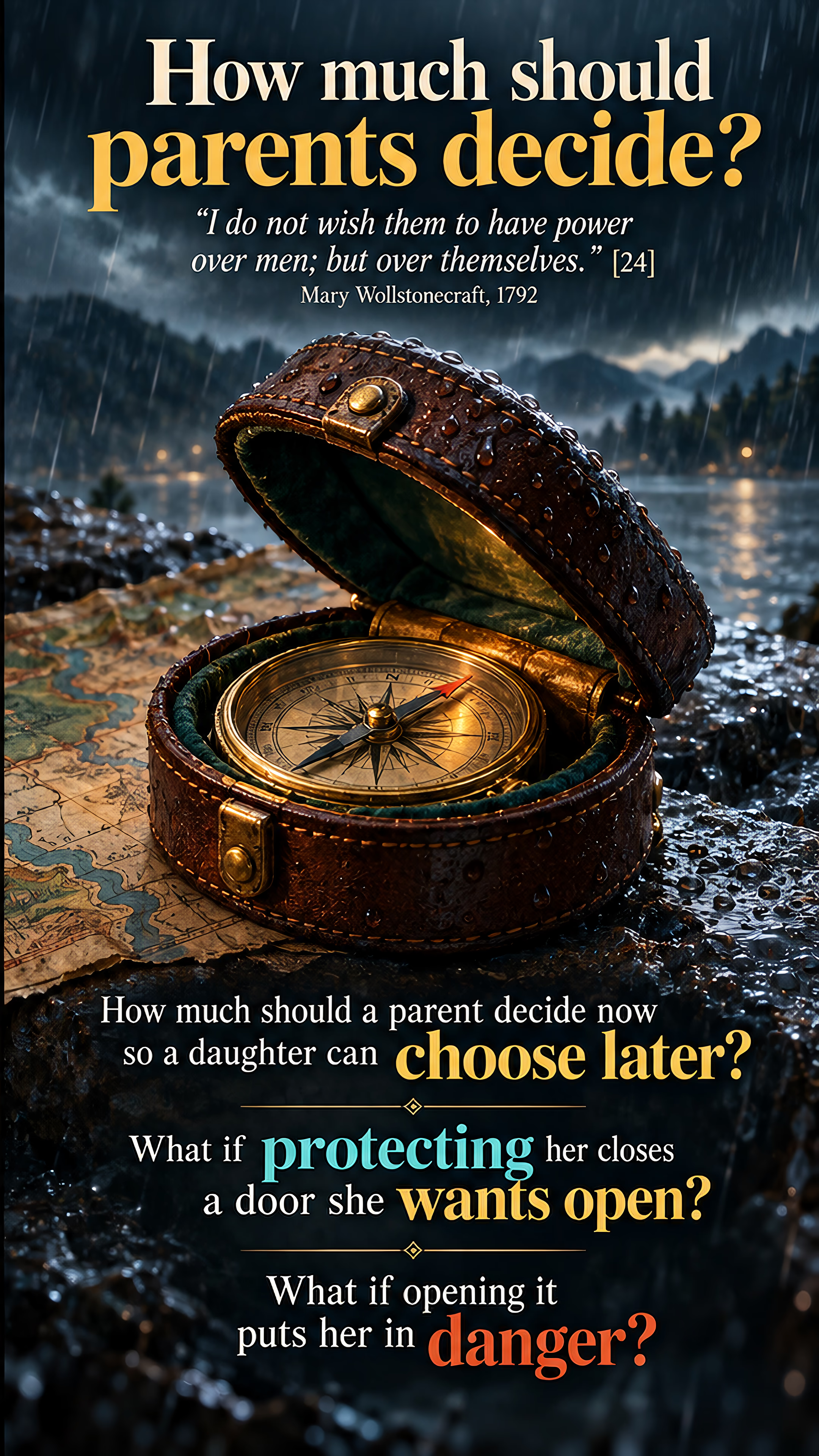
How much should parents decide?
“I do not wish them to have power over men; but over themselves.” [24] Mary Wollstonecraft, 1792
How much should a parent decide now so a daughter can choose later?
What if protecting her closes a door she wants open?
What if opening it puts her in danger?
Visual Description
On the left, two brass compasses rest on an old map. Horseshoe magnets pull their needles in opposing directions. Yellow text describes a parent requiring a headscarf; teal text describes a parent forbidding it. The instructions are explicitly imagined examples, and the magnets represent outside influence on a person's direction. On the right, a brass compass rests inside an open leather case on wet rock beside a map. Rain falls over a dark lake and mountains, and droplets cover the raised lid. The case makes protection tangible while its open position leaves the compass exposed. The final questions remain unresolved; no people appear.
Page 20
Transcript
For your own good.
“The anxiety I have for your happiness...” [23] John Gregory, 1774
Imagine two families:
You must wear the headscarf.
One parent hopes she will keep the faith.
You’re not allowed to wear it.
Another hopes she will leave it behind.
What happens when she wants something else?
How much should parents decide?
“I do not wish them to have power over men; but over themselves.” [24] Mary Wollstonecraft, 1792
How much should a parent decide now so a daughter can choose later?
What if protecting her closes a door she wants open?
What if opening it puts her in danger?
Visual Description
On the left, two brass compasses rest on an old map. Horseshoe magnets pull their needles in opposing directions. Yellow text describes a parent requiring a headscarf; teal text describes a parent forbidding it. The instructions are explicitly imagined examples, and the magnets represent outside influence on a person's direction. On the right, a brass compass rests inside an open leather case on wet rock beside a map. Rain falls over a dark lake and mountains, and droplets cover the raised lid. The case makes protection tangible while its open position leaves the compass exposed. The final questions remain unresolved; no people appear.